"Seven Out of 10 Who Moved Out Bought a Home of Their Own"... Oh Se-hoon Calls Demands for Lease Extensions "Shameless and Unreasonable"
- Input
- 2026-09-08 16:50:35
- Updated
- 2026-09-08 16:50:35
■ Shift reaffirms principle of move-outs after 20 years
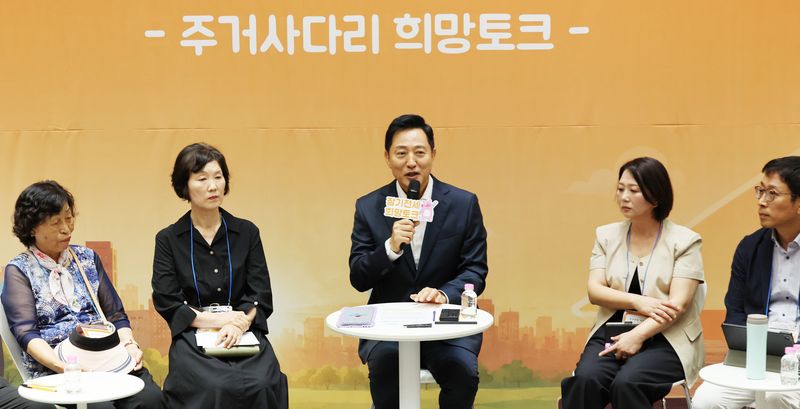
At a meeting titled "From Long-Term Jeonse Housing to Homeownership: Seoul’s Housing Ladder Hope Talk" held in the Seoul Metropolitan Government conference room on the morning of the 8th, Oh said, "Things have become a little heated because some people who have lived there for 20 years say they want to stay longer." He criticized those who claim they did not know the term was 20 years when they moved in, saying, "That is truly a shameless and unreasonable demand."
Known as Shift, the program provides public rental housing for up to 20 years with a deposit below surrounding market rates. The recent controversy erupted after residents of long-term jeonse housing at Gangil River Park and Godeok Rien Park in Gangdong-gu, Seoul, posted appeals seeking extensions of their residency or conversion to ownership. Some residents of other complexes, including Songpa Pinetown in Songpa-gu, also began joint action, but Seoul Metropolitan Government stated that residents must move out once their lease terms expire.
Oh emphasized, "This controversy made me look back," adding, "What is surprising is that far more people voluntarily moved out after successfully buying homes of their own without completing the full 20-year term." According to the city, the 1,708 households that moved out of long-term jeonse housing between 2016 and 2021 had lived there for an average of eight years and four months. A survey found that 72% were living in homes they owned after moving out. This was significantly higher than the 60% owner-occupancy rate among all public rental housing residents who moved out.
Oh reiterated, "I hope those refusing to move out because they are not yet prepared will accurately understand the message," adding, "Seoul Metropolitan Government will not make exceptions. This is because all citizens should have the same opportunities."
■Residency expires for more than 9,300 households by 2031
The number of long-term jeonse housing units reaching the end of their terms will surge from 310 in 2027 to 682 in 2028, 1,747 in 2029, 2,452 in 2030, and 4,170 in 2031. In total, 9,361 households will complete the maximum residency period over the five-year span, allowing new residents to move in. The city plans to reallocate all of these units to other citizens without homes, without converting them to ownership, in line with the circulation principle of public rental housing.
A total of 38,296 long-term jeonse housing units have been supplied to date, and 45,715 households have lived in them cumulatively. The average deposit for current long-term jeonse housing is 293 million won, about 41% of the average jeonse price of 711.78 million won for apartments in Seoul last August, according to KB Real Estate.
Residents were found to have been able to save steadily each month and prepare for housing subscriptions thanks to housing costs below market rates. Some 69.9% of resident households save money, while 83.7% hold housing subscription savings accounts. The meeting also included long-term jeonse residents expressing satisfaction with their homes and sharing stories of successfully buying homes of their own. Resident A said, "The convenient and comfortable home allowed my three children to pursue their dreams, and I was able to buy a home after saving carefully and winning a housing subscription." Resident B expressed gratitude, saying, "Thanks to saving money while living in long-term jeonse housing, I was able to buy the home I had dreamed of 15 years after getting married."
[email protected] Min-kyung Jeon Reporter