'820 Trillion Won Super Budget' Targeted by Jeong Jeom-sig as He Takes Aim at Lee Jae Myung-Style Populism
- Input
- 2026-09-08 15:16:32
- Updated
- 2026-09-08 15:16:32
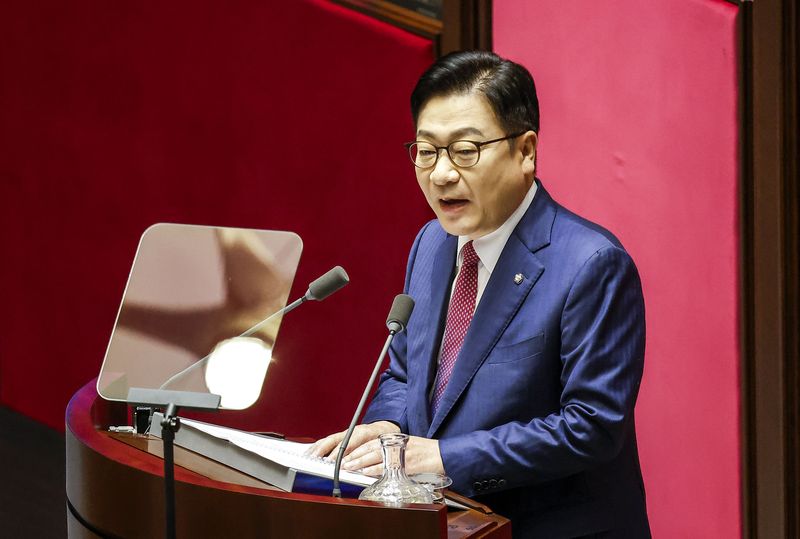
[Financial News] People Power Party floor leader Jeong Jeom-sig criticized the 820 trillion won "super budget" drawn up by the Lee Jae Myung government and the 162 trillion won Future Response Fund as "extreme fiscal expansion." He pointed out that populist fiscal policies cannot contain housing prices and inflation, both of which are on an upward trend. The People Power Party maintains that the government should use state coffers to repay government bonds in accordance with the principles of the National Finance Act.
At a floor leader's address held at the National Assembly on the 8th, Jeong said, "South Korea's national debt has exceeded 1,300 trillion won, yet the government announced an 820 trillion won super budget. Even austerity would not be enough, but it chose extreme fiscal expansion. How does it intend to control inflation and the real estate market while scattering money like this?"
Regarding the Future Response Fund, he said, "It means the government intends to bypass the National Assembly's budgetary oversight and spend money as it pleases." He added, "If finances are managed with an 'live only for today' mindset, the result will be passing debt on to future generations. This is not a response to the future but plunder of the future."
The People Power Party maintains that fiscal policy should move in step with the Bank of Korea (BOK)'s tight monetary policy. The BOK recently implemented two consecutive "baby steps," raising the benchmark interest rate by 0.25 percentage points each time. The party argues that the government's decision to draw up the largest budget in history is therefore "working at cross-purposes." He claimed, "The BOK is raising interest rates to curb inflation, while the government is fueling inflation. It is truly a grotesque theater of the absurd." Regarding the government's plan to issue an additional 106 trillion won in new government bonds, he also asked, "Why issue more debt if you say you have earned money?" and stressed, "When excess tax revenue comes in, the principle is to repay government bonds first."
He also said the issuance of consumption coupons, including livelihood support payments, should be halted. Jeong criticized the policy, saying, "Tens of trillions of won have been handed out whenever the government felt like it, but people's livelihoods have not improved at all. Prices only rise, while ordinary people's wallets grow lighter. In the end, populism is policy pickpocketing aimed at the wallets of ordinary people." He continued, "Small business owners are struggling, yet the government has announced plans to reduce deductions on small business owners' card sales." He added, "It is giving out a small amount of consumption coupons in front while reducing deductions behind the scenes to collect more taxes. The state is using a bait-and-switch deception against the people."
This was a direct counter to Democratic Party of Korea leader Kim Min-seok's floor leader's address on the 7th. Kim explained the government's budget proposal by saying, "It is a simple structure that uses increased national revenue to expand future national revenue, while also reducing unnecessary spending and debt." Regarding the Future Response Fund, he said it "will be used for growth and coexistence," but added, "If it is used like the government's private stash, I will be the first to oppose it."
As policy alternatives for the opposition, Jeong proposed various tax benefits. This appears to have focused on differentiating his position from the government's tax reform plan, which calls for tax increases. The proposals include the complete abolition of inheritance and gift taxes between spouses; the abolition of regulations on private redevelopment and reconstruction; and reductions in acquisition taxes for single-home households and first-time homebuyers. He also said that any excess tax revenue would first be used to repay national debt.
He also launched a fierce attack on the government's industrial policy, calling it "corporate plunder." He denounced the plan to create the Honam Semiconductor Cluster as "chaebol abduction" and called the Yellow Envelope Act, which amends Articles 2 and 3 of the Trade Union Act, "a law that is not even worthy of being called a law." The People Power Party plans to revise the Yellow Envelope Act again to clearly define in law the status of the primary contractor as an employer and the scope of collective bargaining.
He also opposed the constitutional revision proposal jointly raised by President Lee Jae Myung and Kim Min-seok. In an interview with French daily Le Monde on the 6th local time, President Lee said, "Constitutional revision is necessary to strengthen the president's responsibility and distribute authority more appropriately." In line with this, Kim emphasized, "We will pursue a feasible constitutional revision that reflects the changes of the times and the demands of the people while upholding the procedural spirit of the current Constitution and laws."
In response, Jeong declared his opposition to constitutional revision, saying, "There will be no constitutional revision under this government." Constitutional revision is impossible without the People Power Party's support, as approval requires the votes of a majority of all lawmakers, or 200 seats. Jeong said, "I will never discuss constitutional revision with forces that have clearly committed unconstitutional acts and seek private gain through constitutional revision."
[email protected] Lee Hae-ram Reporter