"Supporting South Korea’s Leap as an Indispensable Global AI Power" — Ha Jung-woo, Vice Chair of the National AI Strategy Committee
- Input
- 2026-09-08 15:00:00
- Updated
- 2026-09-08 15:00:00
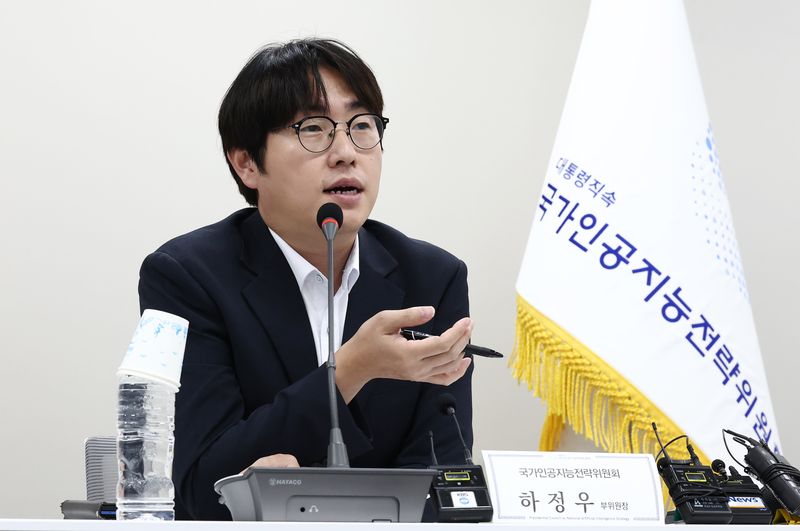
The National AI Strategy Committee held a performance report meeting marking its first anniversary at Seoul Square on the 8th. Under the theme "Policy Recommendations for Becoming One of the World’s Three Leading AI Powers," Vice Chair Ha assessed South Korea’s AI competitiveness amid global competition and presented the future policy direction.
The committee said it had supported the establishment of an efficient system for using national AI computing resources, including graphics processing units (GPUs), in the areas of technological innovation and infrastructure. It also explained that its proposed direction for localizing and integrating AI data center (AIDC) equipment, including domestically produced neural processing units (NPUs), into domestic industry was reflected in the plan to develop AIDCs into a national strategic industry under the three mega-projects.
Going forward, the committee plans to establish an AIDC review and decision-making system and further develop a system for managing the real-time operating status of computing resources such as GPUs.
In science and healthcare, the committee supported the establishment of the "National Strategy for Science and Technology × AI" and the "K-Moonshot Strategy," while also backing the launch of the National AI for Science Research Center (NAIS). It plans to promote specialized AI foundation models for biotechnology, materials, and healthcare, as well as an AI platform for emergency medicine and expanded use of AI in public healthcare.
In industrial AI transformation (AX) and ecosystem development, the committee supported the formulation of strategies to drive AI transformation in key industries, including manufacturing, autonomous driving, and humanoid robots. It established the "Manufacturing AI 2030 Strategy" and the "Plan to Create and Expand the Humanoid Industry Ecosystem." Going forward, the committee will help formulate the "Plan to Foster Global AI Decacorn Companies by 2030" and a plan for the great AI transformation of transportation and logistics.
In public-sector AI transformation (AX) and data, the committee supported the advancement of a government-wide common AI infrastructure and the establishment of an AI-based integrated civil petition platform. It also developed a comprehensive evaluation system for the AI policy achievements of individual ministries. In addition, it promoted AI-friendly management of public data and improved the efficiency of AI recognition of administrative documents. Going forward, it plans to promote the conversion of data into assets through data valuation and links with finance and accounting.
In the social sector, the committee supported the establishment of the "Basic Plan for Employment Stability amid Industrial Transformation" to respond to labor-market changes caused by AI transformation, as well as the expansion of AI-based welfare services. It plans to strengthen an inclusive, people-centered AI foundation by announcing the "AI Welfare and Care Innovation Plan" and the "Comprehensive Plan for Eradicating AI-Enabled Crime."
In defense and security, the committee established a defense data catalog and shared it on a pilot basis with defense-industry and AI companies to expand private-sector participation in defense AI development. It is planning to sequentially open five defense AX hubs to promote data sharing and AX demonstrations.
In global cooperation, the committee launched a government-wide consultative body on global AI governance and began establishing national AI standardization governance. In education and talent development, it strengthened links among AI talent-development programs and supported expanding the number of specialized AI research personnel and introducing the K-STAR visa track.
The committee plans to further develop the operating system for national AI computing resources and monitor the implementation of AI strategies by industry. Vice Chair Ha said, "We will support the realization of ‘AI for everyone,’ so that every South Korean citizen can share in the opportunities and benefits of AI."
[email protected] Yoon Hong-jip Reporter