Could New Treatment Options Open a New Chapter in Hair-Loss Care? The Emergence of Low-Dose Dutasteride and Topical Finasteride [Kim Ji-seok’s Hair-Loss Inside]
- Input
- 2026-09-10 10:04:25
- Updated
- 2026-09-10 10:04:25
[Financial News] Low-dose oral medication and topical treatments have recently emerged as new options for treating male-pattern hair loss. This article examines how they differ from existing hair-loss treatments and how they could be used in the future.
Low-dose dutasteride, which reduces systemic side effects such as sexual dysfunction, now available in South Korea
A low-dose dutasteride treatment that can be used for male-pattern hair loss has recently become available in South Korea. It is 0.2 mg dutasteride. Since 0.5 mg dutasteride is already used to treat hair loss, some may wonder why a lower dose is necessary.
Male-pattern hair loss is generally treated in the following order. Finasteride is prescribed first. Finasteride suppresses dihydrotestosterone (DHT), a hormone involved in hair loss. If finasteride alone does not produce sufficient results, treatment is switched to dutasteride, which has a stronger DHT-suppressing effect.
The concern is that younger patients or those whose hair loss is not severe may find it burdensome to take dutasteride, which acts more strongly on male hormones. This is because the risk of side effects may increase. Doctors may also determine that prescribing it is somewhat excessive for certain patients.
In such cases, 0.2 mg dutasteride can be used as an alternative. It suppresses DHT less effectively than the existing 0.5 mg formulation, but more effectively than Propecia. In other words, its effect falls between the two. Accordingly, it tends to cause fewer side effects. In particular, reproductive-system-related side effects, including sexual dysfunction, occur at roughly half the frequency.
Finjuve, a topical finasteride product that puts “oral medication on the scalp,” may be suitable for treating early hair loss
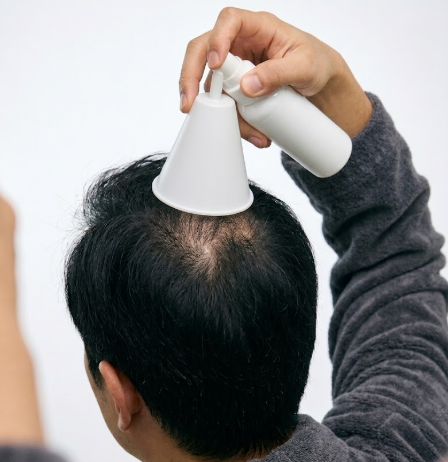
Finjuve is another treatment worth watching. It is a topical formulation developed as a spray that delivers oral finasteride directly to the scalp. It was developed to reduce side effects caused by systemic absorption after the drug is taken orally. Its key feature is that it reduces the burden of systemic side effects associated with oral medication, such as sexual dysfunction, while producing a hair-improvement effect in the treated scalp area similar to that of oral finasteride.
As treatment options for hair loss become more diverse, how should treatment be approached? We have organized treatment methods according to the severity of hair loss and the patient’s age.
For people in their early 20s or those with mild, early-stage hair loss, a topical treatment that applies finasteride directly to the scalp is recommended. This may help protect them from side effects caused by systemic absorption. For people in their late 20s to mid-30s, or those entering the intermediate stage of hair loss, more active treatment is needed. Taking finasteride is advisable, but this approach is recommended only when the hair loss has not reached the crown.
For people in their 30s and 40s, or those with clear intermediate-stage hair loss extending to the crown, treatment can be switched to the recently marketed low-dose dutasteride. As explained above, low-dose dutasteride refers to 0.2 mg dutasteride. For people in their 40s and 50s, or those in the intermediate-to-advanced stage whose hair loss extends to the crown, 0.5 mg dutasteride is prescribed.
Of course, this treatment approach is not an “official formula” for hair-loss treatment. However, I would like to emphasize that the growing range of treatment options makes it possible to tailor treatment more precisely. Any decision should be based on a comprehensive analysis of factors including the severity of hair loss, its recent progression, the patient’s age, and their history of medication use.

/Kim Ji-seok, Director of Mammoth Hairline Clinic in Busan
[email protected] Kim Hyeon-seon Reporter