Why Was the World’s First Dual-Sail LNG Carrier Developed by Japan Built in South Korea?
- Input
- 2026-09-08 13:21:53
- Updated
- 2026-09-08 13:21:53
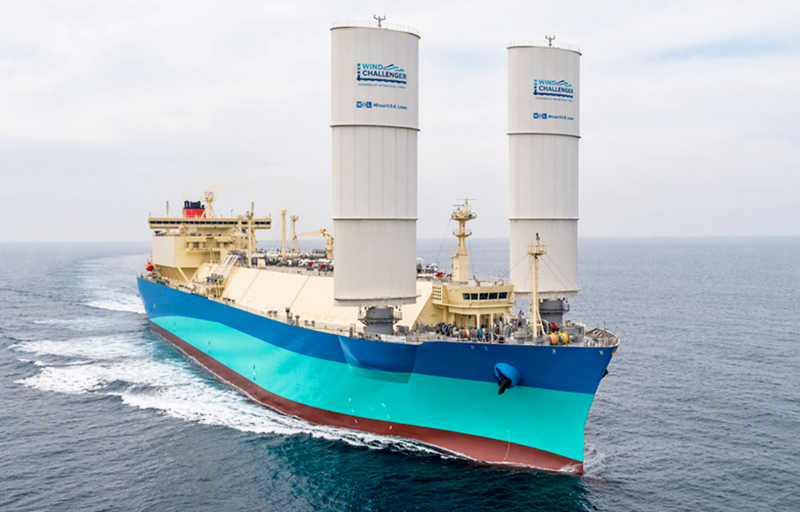
【Financial News, Tokyo—Correspondent Seo Hye-jin】Japan’s largest shipping company, Mitsui O.S.K. Lines, unveiled on the 7th an LNG carrier equipped with two large sails at Hanwha Ocean’s shipyard in Geoje, South Gyeongsang Province. Japan developed the wind-assisted propulsion system, but South Korea built the vessel. Although Japan operates the world’s largest LNG fleet, it has not built a single LNG carrier domestically since 2019.
The Japanese government and shipbuilding industry hope to use the division of labor between Japan and South Korea demonstrated by this vessel as a springboard for resuming domestic LNG-carrier production. Their plan is to revive a production base that has been dormant for seven years by leveraging South Korea’s accumulated expertise in building membrane-type LNG carriers, while countering China’s rapidly growing order volume.
According to the Nihon Keizai Shimbun (Nikkei) on the 8th, the vessel ordered by Mitsui O.S.K. Lines and to be used by Chevron Corporation is equipped with the wind-assisted propulsion system “Wind Challenger.”
Sails approximately 15 meters wide were installed on both sides of the front of the vessel. When fully deployed in three stages, they rise to a maximum height of 49 meters. Sensors detect wind direction and speed and automatically adjust the sails’ height and orientation. The sails are folded during severe weather and when entering or leaving port to ensure visibility and safety.
Mitsui O.S.K. Lines expects the two sails to reduce LNG consumption by up to 12%. Existing coal carriers equipped with one sail have achieved average fuel savings of 5% to 8% per voyage.
The company plans to complete another dual-sail LNG carrier by the end of this year and develop a vessel equipped with four sails in cooperation with a major South Korean shipbuilder. It aims to increase the number of vessels fitted with Wind Challenger from the current three to 25 by 2030 and 80 by 2035.
Kawasaki Kisen Kaisha also plans to introduce a large kite called “Seawing,” measuring approximately 600 square meters, on bulk carriers as early as 2027, reducing fuel consumption by more than 10%. Efforts to use wind as an auxiliary power source are spreading as the industry responds to international carbon-emissions regulations and rising fuel costs. ■Operates the largest LNG fleet but has had ‘zero’ domestic construction for seven years Japan developed next-generation eco-friendly navigation technology but had the vessel built in South Korea because its domestic LNG-carrier production base had effectively collapsed.
Japan was once the world’s leading LNG-carrier builder, but it has not built a single vessel domestically since 2019. Including vessels on order, Mitsui O.S.K. Lines has 129 LNG carriers, Nippon Yusen has 127, and Kawasaki Kisen Kaisha has 68. However, they mainly commission new vessels from shipyards in South Korea and China.
The decisive factor behind Japan’s loss of leadership was a change in LNG storage-tank technology. Until the late 1980s, Japan was strong in Moss-type LNG carriers, which place older-style tanks above the hull. However, membrane-type carriers, which install tanks inside the hull, became the global standard, and Japanese companies lost the market to South Korean shipbuilders with extensive experience in mass production.
Membrane-type tanks are installed to fit the shape of the hull, making more efficient use of space. Even when carrying the same amount of LNG, they can reduce vessel size and operating costs. As Japanese shipping companies also placed orders with South Korean and Chinese shipyards, Japan’s domestic production base—including facilities and skilled workers—also weakened.
The recent blockade of the Strait of Hormuz has heightened Japan’s sense of crisis. Disruptions to LNG shipments from the Middle East and a sharp rise in prices highlighted the vulnerability of Japan’s supply chain, as the country relies on LNG for approximately 30% of its power generation. Calls are growing for Japan to secure not only navigation technologies that reduce fuel consumption but also the domestic production capacity needed to procure LNG carriers in an emergency.■Three Japanese shipbuilders to build jointly and resume production with South Korean technologyThe Sanae Takaichi Cabinet has included shipbuilding among 17 areas in its national growth strategy and plans to invest a combined ¥1 trillion from the public and private sectors by 2035. Its goals are to double Japan’s shipbuilding capacity to 18 million GT annually and produce three to five LNG carriers each year.
To achieve this, Imabari Shipbuilding, Kawasaki Heavy Industries, and Namura Shipbuilding officially announced a joint LNG-carrier construction plan on the 21st of last month. Kawasaki Heavy Industries’ plant in Sakai, Kagawa Prefecture, is considered the leading candidate for the production base. Namura Shipbuilding also plans to build a large dock in Imari Bay, Saga Prefecture, by 2035.
The biggest challenge is the seven-year production gap. Japan’s shipbuilding industry believes it must use South Korea’s accumulated tank-manufacturing and assembly technology, as well as its experience in mass production, to resume building membrane-type LNG carriers, the global standard.
Keitaro Ono, head of the Liberal Democratic Party’s Headquarters for Economic Security, said in a recent interview with Nikkei, “We need to build a cooperative relationship with South Korea, which has a high share of the LNG-carrier market, and construct our own carriers.” This means Japan intends to restore its domestic production base through technological cooperation with South Korea and then reduce its dependence on China’s shipbuilding industry.
High prices are another hurdle. Japanese-built LNG carriers are expected to cost approximately 20% more than those made in South Korea and China. The Japanese government is considering measures to cover the price difference for the first domestically built LNG carrier. It is also reviewing a plan under which the state would own the shipbuilding facilities and entrust their operation to private companies.
China’s pursuit is driving Japan to hasten the resumption of production despite the high costs. In 2022, South Korea received orders for 120 LNG carriers and China for 56. By the end of July this year, the figures had narrowed to 36 and 23, respectively.
The LNG carrier built by Hanwha Ocean and fitted with sails developed by Japan offers a concise snapshot of the current state of the Japanese and South Korean shipbuilding industries. Japanese media noted that Japan is seeking to revive its LNG-carrier production base and respond to China’s expanding market presence by promoting eco-friendly navigation technology while leveraging South Korea’s shipbuilding expertise and experience.
[email protected] Seo Hye-jin Reporter