360 billion won to be invested to train 14,000 talents for regional industries
- Input
- 2026-09-08 12:00:00
- Updated
- 2026-09-08 12:00:00
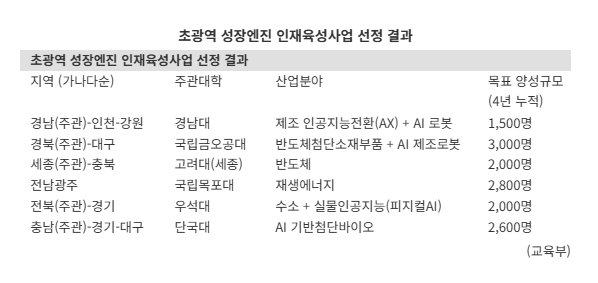
[Financial News] Local governments, universities, and companies will collaborate across administrative boundaries to jointly cultivate talent needed for regional industries, including semiconductors, artificial intelligence (AI), and advanced biotechnology. On the 8th, the Ministry of Education announced the selection of six models for the "Super-Regional Growth Engine Talent Development Project." It stated that it will provide up to 15 billion won annually to each model for approximately four years to foster about 14,000 local talents by 2030. The total state funding allocated to the six models amounts to a maximum of 360 billion won over four years. Each model was jointly planned by local governments, universities, and companies and is designed to meet the workforce demands of regional industries by linking education, research, and support for employment and entrepreneurship. The sectors included are semiconductors, AI, and robotics, as well as renewable energy, hydrogen, and advanced biotechnology.
Collaboration with companies is also being pursued. Megazone is participating in the Gyeongnam, Incheon, and Gangwon models; SK hynix in the Sejong and Chungbuk models; and Yuhan Corporation in the Chungnam, Gyeonggi, and Daegu models. Each model supports education and research linked to corporate workforce needs, as well as field training, projects, employment, startups, and technology commercialization.
The Gyeongbuk-Daegu model, centered on Kumoh National Institute of Technology, will train 3,000 talents in the fields of semiconductor advanced materials and components and AI manufacturing robots. The Jeonnam-Gwangju model, centered on Mokpo National University, will train 2,800 people in the renewable energy sector, while the Chungnam-Gyeonggi-Daegu model, centered on Dankook University, will train 2,600 people in the AI-based advanced bio sector.
The Sejong-Chungbuk model, centered on Korea University Sejong Campus, will train 2,000 talents in the semiconductor field, while the Jeonbuk-Gyeonggi model, centered on Woosuk University, will train 2,000 talents in the fields of hydrogen and physical AI. The Gyeongnam-Incheon-Gangwon model, centered on Kyungnam University, will train 1,500 talents in the fields of manufacturing AI transformation (AX) and AI robotics.
The Ministry of Education plans to finalize the details of financial support for each model in September after an appeals period of about 10 days. Subsequently, the scale of support will be adjusted annually based on an evaluation of performance.
Meanwhile, the Ministry of Education also released the results of the first annual inspection of the 'Regional Growth Talent Development System (Anchor).' As a result of evaluating the implementation process and performance of the 2025 projects by 17 metropolitan and provincial governments, Gwangju, Busan, and Chungnam received an S grade, while Gangwon, Gyeonggi, Gyeongnam, Daejeon, and Ulsan received an A grade. Gyeongbuk, Daegu, Incheon, Jeonnam, and Jeju were evaluated as B grade, and Seoul, Sejong, Jeonbuk, and Chungbuk were evaluated as C grade.
Accordingly, a performance budget of approximately 400 billion won will be allocated differentially based on evaluation grades. Compared to the 2025 baseline, the performance budget and basic allocation amounts are set at a maximum of about 120% for Grade S and a minimum of about 80% for Grade C.
During the annual review, cooperation between local governments and universities, the operation of specialized contract departments, technology commercialization, and the resolution of local issues linked to industrial sites were cited as best practices. Conversely, areas for improvement were identified, such as unclear selection criteria for individual projects, delayed budget execution, and a lack of linkage between unit tasks and university specialization.
Vice Minister of Education Choi Eun-ok stated, "Creating a virtuous cycle ecosystem where local talent learns at regional universities and grows into key personnel for local companies is the core of balanced development," adding, "We will continue to provide support to ensure that regional talent development systems lead to tangible results, such as increased settlement in the regions."
[email protected] Kim Man-gi Reporter