The KOSPI Composite Index Breaks Above 7,100, but Why Is My Stock Falling? Samsung Electronics and SK hynix Lead a ‘Divergent Rally’ [Comprehensive]
- Input
- 2026-09-08 11:29:26
- Updated
- 2026-09-08 11:29:26
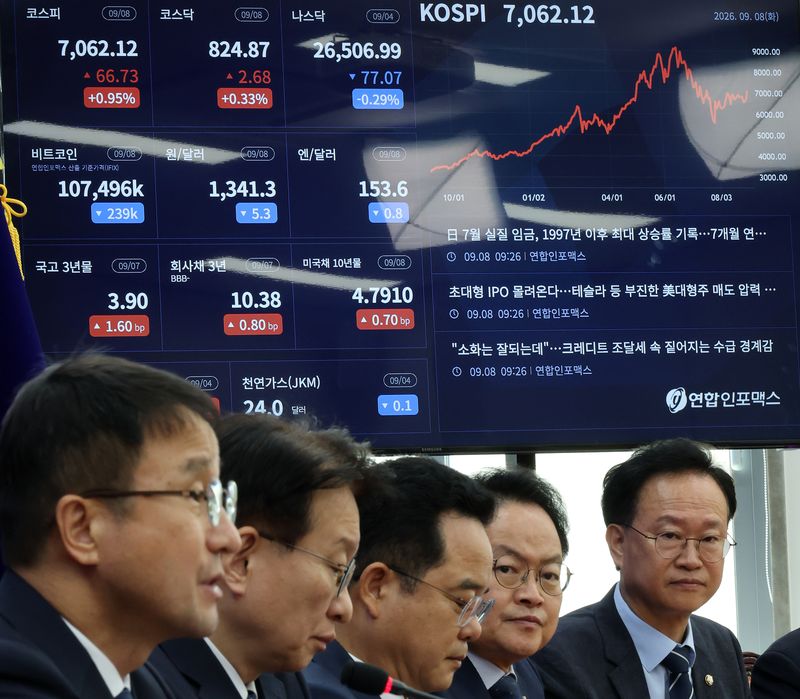
[Financial News] The KOSPI Composite Index broke above 7,100 during the session, following a sharp rise the previous day. Samsung Electronics and SK hynix rose in tandem, lifting the index, while combined net buying by foreign and institutional investors provided additional support. However, declining stocks outnumbered advancing stocks in both markets, highlighting the divergence between the rising indexes and individual stock performance.
As of 11:15 a.m. on the 8th, the KOSPI Composite Index was trading at 7,125.27, up 129.88 points, or 1.86%, from the previous trading day. After surging 4.61% the previous day and coming close to the 7,000 mark, it continued its upward trend. The index opened at 7,045.79, up 0.72% from the previous session. It briefly narrowed its gain to 7,018.53 during the session, but then accelerated to reach 7,134.69.
Large-cap semiconductor stocks led the advance. Samsung Electronics was trading at 277,000 won, up 2.59% from the previous day. It rose as high as 277,500 won during the session. SK hynix gained 3.98% to 1.854 million won, with an intraday high of 1.86 million won.
The concentration of gains in large-cap stocks was also evident in the indexes by market capitalization. The KOSPI large-cap index rose 1.97%, while the gains for mid-cap and small-cap stocks were limited to 0.63% and 0.16%, respectively. As strength in the largest stocks by market capitalization pushed the index higher, the upward momentum of small- and mid-cap stocks remained relatively limited.
In terms of trading flows, institutions and foreign investors were net buyers. At the same time, institutions were net buyers of approximately 479.5 billion won in the KOSPI market, while foreign investors bought approximately 133.8 billion won more than they sold. Other corporations were also buying approximately 623.1 billion won. Individual investors, by contrast, were net sellers of approximately 1.2334 trillion won.
Within the institutional sector, financial investment firms led the buying, posting net purchases of approximately 458 billion won. Investment trusts and private equity funds were also net buyers of approximately 34 billion won and 22.7 billion won, respectively. Pension funds and other entities were net sellers of approximately 44.4 billion won, while insurers sold approximately 10.9 billion won, showing divergent trends among institutional categories.
By sector, construction was strong, rising 4.92%. Machinery and equipment gained 3.67%, electricity and gas 3.66%, electrical and electronics 2.63%, distribution 2.57%, and general services 2.47%. IT services, however, fell 1.65%, while food and beverages and tobacco, paper and wood, and pharmaceuticals declined 0.76%, 0.75%, and 0.62%, respectively.
The index gain did not spread across the market as a whole. In the KOSPI market, 402 stocks advanced, while 453 declined. Fifty-four stocks were unchanged. Even as the KOSPI Composite Index rose nearly 2%, the number of declining stocks exceeded the number of advancing stocks.
Meanwhile, the KOSDAQ (Korea Securities Dealers Automated Quotations) was trading at 828.62, up 6.43 points, or 0.78%, from the previous trading day. After opening at 825.03, it fell as low as 820.58 during the session and briefly turned lower, but later rebounded to reach 830.05.
[email protected] Choi Doo-sun Reporter