Democratic Party Divided Over Strait of Hormuz Deployment... ‘49-43 Split’ 23 Years Ago Too
- Input
- 2026-09-08 11:08:12
- Updated
- 2026-09-08 11:08:12
[Financial News] Conflicting views are emerging within the Democratic Party of Korea over the possibility of deploying troops to the Strait of Hormuz. The party leadership is maintaining a cautious stance, but some lawmakers have publicly expressed opposing positions. If the government actually decides to deploy troops, the ruling party is expected to face internal difficulties, as it did during the Iraq War in 2003.
According to political circles on the 8th, Article 60, Paragraph 2 of the Constitution grants the National Assembly the authority to consent to the dispatch of the armed forces abroad. A troop-deployment consent bill is approved when a majority of all incumbent lawmakers are present and a majority of those present vote in favor.
The Democratic Party of Korea’s leadership says caution is necessary because the government has not yet determined its policy. Kim Won-i, the party’s strategic planning committee chair, reportedly sent a message to a lawmakers’ chat room the previous day asking members to refrain from responding individually on the Strait of Hormuz deployment issue.
Other voices are already emerging within the party. Lee Ki-heon said the previous day, “Directly becoming involved in a war would serve neither the stable supply of energy going forward nor the national interest.” He added, “Many people are extremely concerned and worried about deployment in private conversations.”
By contrast, Park Ji-won said, “Considering the need to protect our vessels in the Strait of Hormuz and our broader relationship with the United States, wouldn’t we have no choice but to deploy troops to some extent if they are noncombat personnel?” He added, “I acknowledge that this is unavoidable.”
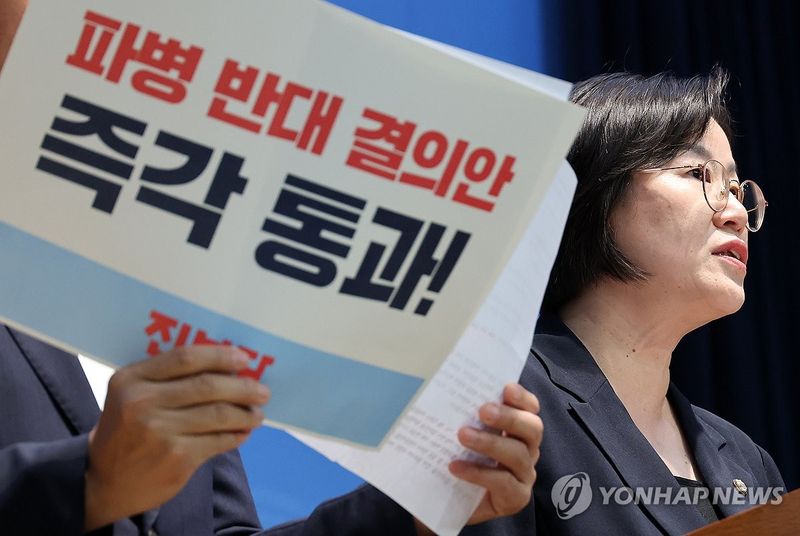
Opposition voices are also continuing to emerge from parties in the broader ruling bloc. Shin Jang-sik, leader of the Rebuilding Korea Party (RKP), demanded that a resolution opposing war and troop deployments, submitted in March by the RKP, Progressive Party, Basic Income Party and Social Democratic Party, be placed on the agenda of a plenary session.
Progressive Party lawmakers also argued, “Deployment would expose our troops, Korean residents, companies and vessels in the Middle East, as well as the territory of the Republic of Korea, to the risk of retaliation and terrorism.”
The governing Democratic Party also split in 2003, when the Roh Moo-hyun administration deployed troops for the Iraq War. After internal divisions over the consent bill led to its consideration being postponed twice, former President Roh Moo-hyun personally visited the National Assembly on April 2 of that year to appeal for approval.
Former President Roh said, “Losing a presidential election would be my personal problem,” but added, “Now that I have become president, the choice I make cannot be a personal choice.” Regarding South Korea-U.S. relations, he explained, “I concluded that helping the United States in difficult times and strengthening South Korea-U.S. relations would be the way to resolve the North Korean nuclear issue peacefully.”
The troop-deployment consent bill ultimately passed with 179 votes in favor, 68 against and nine abstentions among the 256 lawmakers present. Within the Democratic Party, however, the vote was closely divided, with 49 in favor, 43 against and four abstentions. At the time, 118 lawmakers from the Grand National Party, the largest party in the National Assembly, voted in favor.
Unlike at the time, the Democratic Party of Korea currently holds a majority of seats in the National Assembly. However, with differences over deployment already surfacing within the party and opposition voices emerging across the broader ruling bloc, building consensus within the ruling camp is expected to be the first hurdle once substantive discussions on deployment begin.
[email protected] Kim Kyung-min Reporter