"I Can No Longer Keep Up With the Interest"—Mortgage Loan Delinquencies Surge 2.2-Fold in Three and a Half Years, Leaving Highly Leveraged Borrowers in Distress
- Input
- 2026-09-08 11:28:36
- Updated
- 2026-09-08 11:28:36
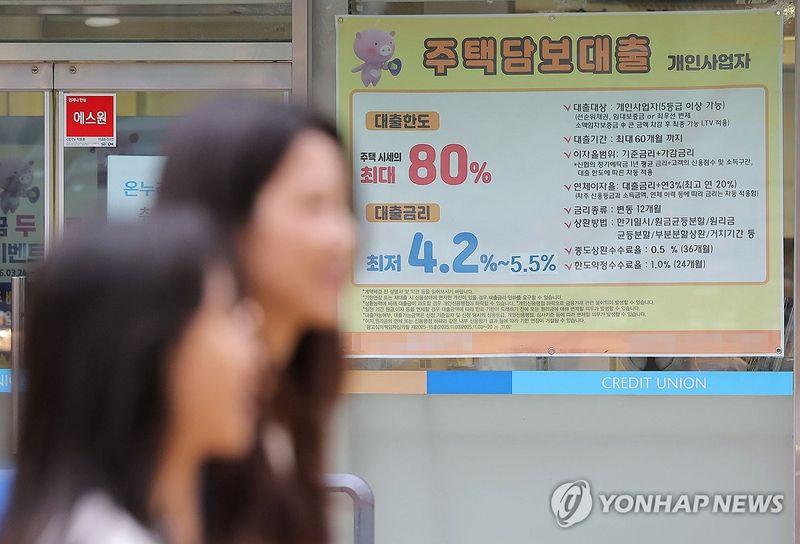
[Financial News] The amount of overdue mortgage loans held by domestic banks has more than doubled in recent years. Delinquencies among highly leveraged borrowers, in particular, appear to be worsening rapidly as lending rates rise.
According to data submitted by the Financial Supervisory Service to Park Sung-hoon of the People Power Party, a member of the National Policy Committee, the outstanding balance of mortgage-loan claims held by domestic banks rose 21%, from KRW 644.3 trillion at the end of 2022 to KRW 779.2 trillion at the end of June this year.
Over the same period, however, overdue claims—those with principal or interest payments at least one month past due—surged 120%, from KRW 1 trillion to KRW 2.2 trillion. In other words, overdue claims grew roughly six times faster than the outstanding loan balance. Overdue mortgage-loan claims have risen sharply each year, reaching KRW 1.6 trillion at the end of 2023, KRW 1.9 trillion at the end of 2024, and KRW 2.1 trillion at the end of last year.
Long-term overdue claims, with payments at least three months past due, also increased from KRW 500 billion at the end of 2022 to KRW 1.4 trillion at the end of June this year. Substandard-and-below loans, or nonperforming loans, more than doubled from KRW 800 billion to KRW 1.7 trillion. As a result, banks increased their loan-loss provisions from KRW 300 billion to KRW 900 billion over the same period, while the loan-loss provision coverage ratio rose from 44.5% to 51.1%.
As of the end of June this year, Nonghyup Bank had the largest overdue balance among individual banks at KRW 511.73 billion. It was followed by KB Kookmin Bank at KRW 368.02 billion, Woori Bank at KRW 341.96 billion, Bank of Hope at KRW 302.66 billion, and Shinhan Bank at KRW 216.88 billion. Nonghyup Bank’s overdue balance rose annually from KRW 134.61 billion at the end of 2022, surpassing KRW 500 billion for the first time this year.
Some regional banks also saw particularly sharp increases in short-term delinquency rates. THE JEONBUK BANK’s mortgage-loan delinquency rate climbed nearly fivefold in just six months, from 0.19% at the end of last year to 0.95% at the end of June this year, the highest level in the banking sector.
The Financial Supervisory Service explained that THE JEONBUK BANK’s increase was caused by large-scale delinquencies on group loans for newly sold housing.
Kyongnam Bank’s delinquency rate rose from 0.14% to 0.41%, while Suhyup Bank’s increased from 0.17% to 0.45%, compared with the end of 2022. Shinhan Bank’s rate rose only slightly to 0.19%, whereas internet-only bank KakaoBank’s rate fell from 0.38% to 0.16%.
Park Sung-hoon said, "Households’ ability to repay their debts is failing to keep pace with the growth in lending. Financial authorities must proactively assess the risks of vulnerable borrowers and group-loan defaults."
[email protected] Ahn Ga-eul Reporter