The Question Posed by ‘The Odyssey’s’ 10 Million Viewers: Must Premium Screens Also Meet the 73-Day Requirement?
- Input
- 2026-09-08 11:19:44
- Updated
- 2026-09-08 11:19:44

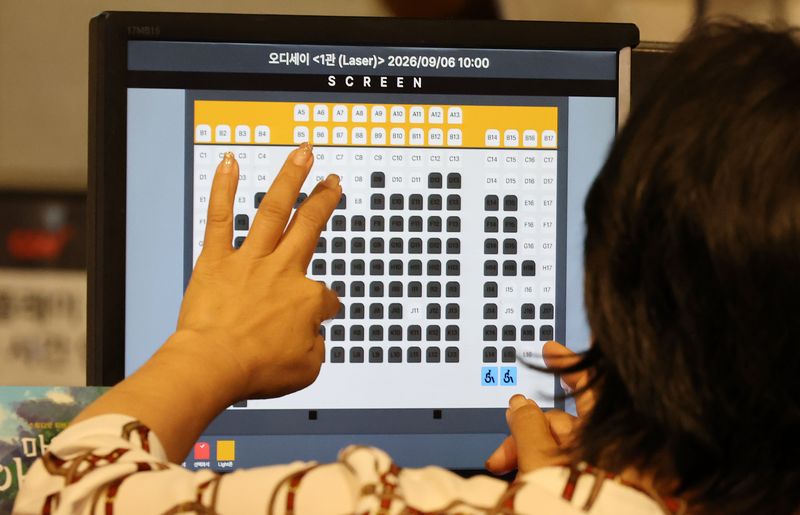
[Financial News] The IMAX theater at Yongsan I’Park Mall is considered the place in Korea where audiences can experience ‘The Odyssey’—which was filmed entirely with IMAX film cameras—in the most complete form. As a result, whenever a major film such as a Hollywood blockbuster is released, people say that getting tickets for the so-called ‘Yongsan IMAX’ is as difficult as booking tickets for a concert by a popular singer.
‘The Odyssey’ Virtually Sold Out at Yongsan IMAX Through the 15th
Although ‘The Odyssey’ surpassed 10 million viewers 33 days after its release, it remains difficult to see the film at Yongsan IMAX. As of the 8th, bookings had opened through the 15th, but the main time slots were virtually sold out. Only a few seats remained for the late-night screening beginning at 12:30 a.m. the following day.
It remains unclear how long this popularity will continue to translate into screenings. The screen quota applied to each individual screen remains a variable in future programming.
The success of ‘The Odyssey’ in premium theaters has prompted calls to reconsider how the screen quota is applied so that it reflects changing moviegoing habits. The goal of guaranteeing Korean films opportunities to be screened would be maintained, while the mandatory screening days assigned to individual screens would be combined across an entire theater and operated more flexibly.
The screen quota is a system requiring theaters to show Korean films for a certain number of days. Article 19 of the current Enforcement Decree of the Promotion of the Motion Pictures and Video Products Act requires Korean films to account for at least one-fifth of a theater’s annual screening days. For a screen operating 365 days a year, this means at least 73 mandatory screening days. This standard applies not only to regular auditoriums but also to premium theaters such as IMAX, 4DX, and Dolby Cinema.
Should the Screen Quota Be Abolished for Premium Theaters Only?
The issue is that the characteristics of premium theaters conflict with obligations imposed on each individual screen.
Audiences expect premium theaters to offer experiences available only in those venues, including large screens, specialized sound systems, and moving seats. However, when there are not enough Korean films supplied in formats suited to premium theaters, venues may have to schedule Korean films in standard formats on premium screens to meet the mandatory number of days.
In August, an internet user posted an article titled, “I Wish the Screen Quota Would Be Abolished for Premium Theaters Only,” pointing out the rigidity of the current system.
The user agreed with the goal of protecting Korean films but argued that applying the same standards to premium and regular theaters could limit viewers’ choices. The user also noted that it is necessary to examine whether the screen quota actually expands the diversity of Korean films. If mandatory screening days are used mainly to schedule commercial films from major production and distribution companies rather than independent, art-house, or small- and medium-scale productions, the system’s protective effect could be limited. The user suggested that, if abolishing the system entirely is difficult, it should be operated flexibly to reflect the formats of premium theaters and actual audience demand.
What About Operating the Screen Quota at the Theater Level?
One alternative under discussion is to change the unit used to calculate the screen quota from individual screens to the theater as a whole. The total number of mandatory screening days for Korean films within a theater would remain unchanged, while programming could be adjusted more flexibly across its auditoriums.
For example, a theater operating 10 screens 365 days a year has a total of 3,650 screening days. Under the current system, each of the 10 screens must meet 73 days of Korean-film screenings. If the total were calculated at the theater level, the theater would need to secure at least 730 combined days on which Korean films are shown across all screens. If one screen showed Korean films for 50 days, another could make up the shortfall by showing them for 96 days.
Of course, an identical total number of screening days does not necessarily produce the same protective effect for Korean films. Therefore, any revision would require careful consideration not only of the calculation unit but also of seating capacity, the number of screenings, time slots, and access to premium theaters.
Flexibility is the key. The system needs to move away from uniform regulation and operate more flexibly, reflecting rapidly changing content industries and viewing environments while preserving its original purpose.
[email protected] Shin Jin-a Reporter