Number of International Students Exceeds 300,000... Cultivating 'Talent' Instead of 'Numbers'
- Input
- 2026-09-08 12:00:00
- Updated
- 2026-09-08 12:00:00
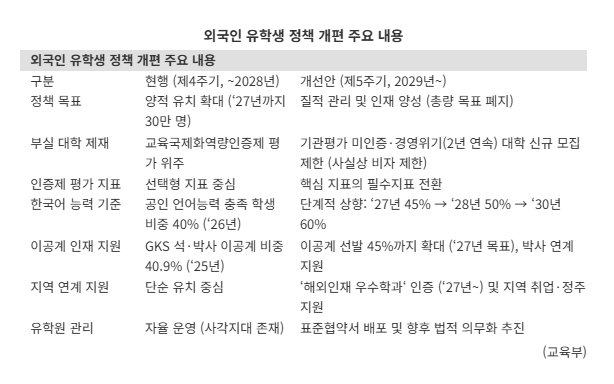
[Financial News] The government is shifting its policy on international students from "how many are attracted" to "how they are educated and nurtured into outstanding talent." While achieving the goal of attracting 300,000 international students one year ahead of schedule, the total target for the number of students itself will be abolished. Instead of restricting the recruitment of international students by underperforming universities, support for outstanding talent in science and engineering and regional fields will be expanded.
On the 8th, the Ministry of Education announced the 'Innovation Strategy for Fostering Talents for International Students,' which includes these details. The number of international students this year was tallied at 307,464, achieving the original goal of attracting 300,000 students by 2027 through the 'Study Korea 300K Project' one year ahead of schedule. The number of international students increased from 182,000 in 2023 to 209,000 in 2024 and 253,000 in 2025, before surpassing 300,000 this year.
■ Expulsion of substandard universities and reform of the certification system
Sanctions against universities that have been poorly managed in a desperate attempt to meet international student recruitment quotas will become significantly heavier. Under the 5th Cycle of the International Education Quality Assurance System (IEQAS), which begins in 2029, the Ministry of Education plans to immediately classify universities that fail to receive institutional accreditation, or private universities diagnosed as "universities in management crisis" for two consecutive years in the financial assessment of private universities, in the lowest tier of the system and restrict their recruitment of new international students. The Ministry of Education explained that this measure, coordinated with the Ministry of Justice, effectively means the "suspension or restriction of new visa issuance," the most devastating measure for universities.
Lee Nan-young, Director General of International Education Planning at the Ministry of Education, stated, "The focus on quantitative expansion has led to cases of poorly managed universities, so this measure aims to improve them, not to regulate universities that are performing well." She added, "We will strictly crack down on poor recruitment through visa issuance restrictions, the most powerful sanction under the accreditation system, while strengthening linked support for universities that effectively select and nurture international students through initiatives such as the RISE project."
Education and management standards for general universities will also be significantly strengthened. Core indicators of the accreditation system will be converted into mandatory indicators, and the proportion of students meeting official language proficiency standards will be gradually increased from 40% this year to 45% in 2027, 50% in 2028, and 60% in 2030. This approach does not raise the proficiency level standards themselves—such as Test of Proficiency in Korean (TOPIK) Level 3 or higher for freshmen and Level 4 or higher for current students—but rather increases the percentage of students who meet those standards.
■ Support for Outstanding Talent and Local Settlement
On the other hand, exceptional benefits are provided to outstanding talent needed for high-tech industries and regions. The proportion of science and engineering students selected for the Global Korea Scholarship (GKS) is being increased from 40.9% last year to 43% this year and 45% by 2027, and support is being provided to master's students who have produced outstanding research results to continue their studies to doctoral programs, while preferential visa treatment is also being considered.
Support for employment and settlement aligned with local industries will also be fully launched. Starting in 2027, a new 'Certification System for Excellent Overseas Talent Departments' will be established to link financial support and scholarship allocation to departments with high regional employment outcomes. In fact, the proportion of international students outside the capital area has risen by 1.6 percentage points, from 45.8% last year to 47.4% this year.
In addition, the Korea Study Abroad Comprehensive System provides 24-hour native-language AI counseling and customized job posting services to help students settle in Korea after graduation. As of 2024, the employment rate for international students was recorded at 33.4% out of 14,966 eligible candidates, but the Ministry of Education did not present a separate employment rate target, taking into account individual circumstances.
The management of study abroad agencies, which has been a blind spot in the admissions process, will also be made more transparent. To prevent false and exaggerated advertising, a standard agreement between universities and agencies will be distributed in the second half of this year, and measures to protect international students, such as tuition refunds, will be made mandatory through amendments to relevant laws.
The Ministry of Education plans to announce the basic plan for the 5th Accreditation Cycle, which will be implemented starting in 2029, in the second half of this year, and will sequentially proceed with follow-up procedures, including the amendment of the Higher Education Act.
[email protected] Kim Man-gi Reporter