South Korean Students Falling Behind in Reading and Mathematics
- Input
- 2026-09-08 16:30:00
- Updated
- 2026-09-08 16:30:00
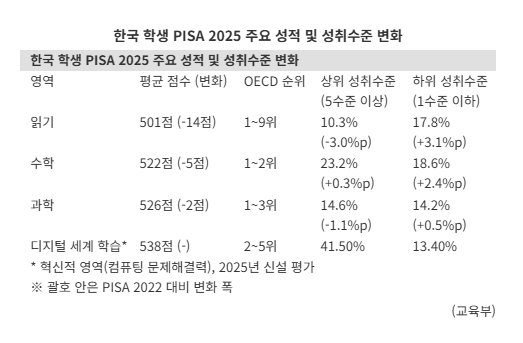
[Financial News] South Korea’s 15-year-old students remained among the top performers across Organisation for Economic Co-operation and Development (OECD) member countries, but the proportion of students at low achievement levels in reading and mathematics increased from three years earlier. In particular, the decline in reading scores was observed not only in South Korea but worldwide. It was analyzed as being influenced by digital media environments, as well as students’ motivation and attitudes toward reading.
According to the Ministry of Education and the Korea Institute for Curriculum and Evaluation (KICE), the OECD officially released the results of the Programme for International Student Assessment (PISA) 2025 on the 8th. About 760,000 students from 91 countries and economies worldwide participated in PISA 2025, including 6,859 students from 196 schools in South Korea. Among the 38 OECD member countries, South Korea ranked first or second in mathematics, first through third in science, and first through ninth in reading, remaining among the top performers in all areas. Among all 91 participating countries and economies, it ranked fifth through seventh in mathematics, fifth through seventh in science, and third through 13th in reading.
Reading showed the largest change in detailed achievement levels. South Korea’s average reading score was 501, down 14 points from 515 in PISA 2022. The proportion of students at the highest achievement levels—Level 5 or above—fell by 3.0 percentage points, from 13.3% to 10.3%. By contrast, the proportion at the lowest achievement levels—Level 1 or below—increased by 3.1 percentage points, from 14.7% to 17.8%.
The proportion of students at low achievement levels also increased in mathematics. The average score fell by five points, from 527 to 522, while the share of students at Level 1 or below rose by 2.4 percentage points, from 16.2% to 18.6%. The proportion at Level 5 or above increased by 0.3 percentage points, from 22.9% to 23.2%.
Science, the main assessment area this year, scored 526 points, down two points from 528 in 2022. However, Park Hyun-jung, director of the Ministry of Education’s Public Education Promotion Division, explained, "This decline is not statistically significant." The proportion of students at Level 1 or below in science rose by 0.5 percentage points, from 13.7% to 14.2%, while the proportion at Level 5 or above fell by 1.1 percentage points, from 15.7% to 14.6%.
The decline in reading achievement was not limited to South Korea. Park said, "Reading has declined not only in our country but worldwide," adding, "It is difficult to attribute the cause to a single factor, but the digital media environment, short-form content and social media, and students’ motivation and attitudes toward reading are presumed to have worked together in complex ways." She continued, "KICE plans to conduct a more comprehensive analysis by reconnecting the detailed framework of the reading assessment measured by PISA with educational-context variables and survey data."
In the “computational problem-solving” assessment under “Learning in a Digital World (LDW),” which was designated as an innovative domain for the first time in PISA 2025, South Korean students recorded an average score of 538. This was above the OECD average of 500, ranking second through fifth among the 38 OECD member countries and sixth through 10th among all 85 participating countries and economies.
The Ministry of Education said it plans to promote reading education linked to subject classes and expand a classroom culture centered on questions and discussion based on the results.
[email protected] Man-ki Kim Reporter