Ko Eui-sook to Face First Education-Administration Questions on the 8th: Student Obesity Rate at 34.9%, Deepfakes and Sharp Fund Decline
- Input
- 2026-09-08 09:56:52
- Updated
- 2026-09-08 09:56:52
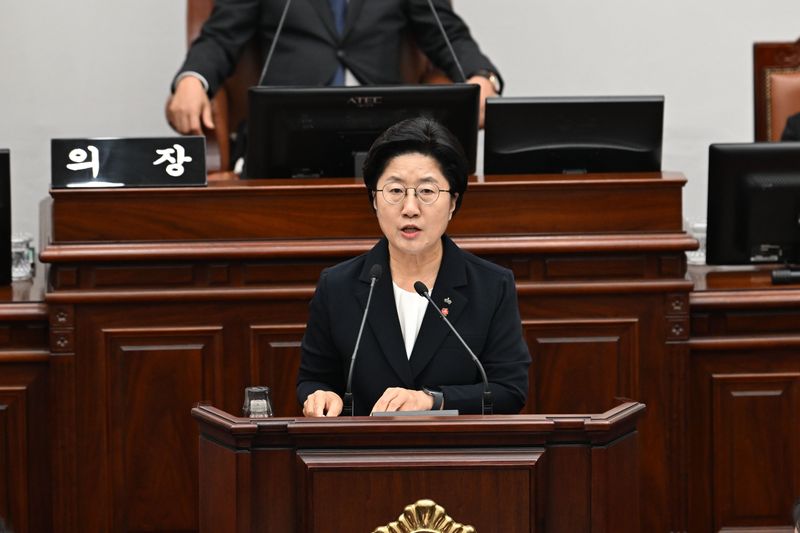
【Financial News Jeju = Reporter Yong-bok Jeong】 Ko Eui-sook, superintendent of the Jeju Special Self-Governing Provincial Office of Education, will take the answerer's seat at 10 a.m. on the 8th for her first education-administration questions before the Jeju Special Self-Governing Provincial Council since taking office.
According to the Jeju Special Self-Governing Provincial Council on the 8th, five council members—Jang Hee-soon, Park Ho-hyung, Park Ji-eun, Kang Jeong-beom and Lee Kyung-cheol—will question Superintendent Ko Eui-sook at the fifth plenary session of the first regular meeting of the council’s 454th session.
Council members Park Ho-hyung, Park Ji-eun and Kang Jeong-beom will use a question-and-answer format, while Jang Hee-soon and Lee Kyung-cheol will submit grouped questions followed by grouped answers. After 30 questions on the first day, the education-administration questioning will continue for two days through the 9th.
The most direct indicator raised on the first day concerns student health. In the Ministry of Education’s 2025 sample statistics on student health examinations, the proportion of students classified as overweight or obese in Jeju was 34.9%, the highest among the nation’s 17 metropolitan cities and provinces. That was 5.2 percentage points above the national average of 29.7%, exceeding the figures for South Jeolla Province at 34.7% and Gangwon Province at 34.5%.
The overweight-or-obese category does not refer only to obese students. It is the combined proportion of students classified as overweight or obese based on body mass index by sex and age. In Jeju, more than one in three sampled students fell into this category.
Council member Park Ho-hyung will ask about the current obesity situation and the results of existing obesity-reduction programs, while examining whether the policy direction needs to change.
Student mental health is another major issue. According to figures compiled by the Jeju Special Self-Governing Provincial Office of Education, suicide and self-harm attempts reported as school safety accidents rose from 25 cases in 2023 to 30 in 2024 and 71 last year. Over the same period, the number of people receiving support from the emergency response team of mental-health professionals increased from 152 to 195 and then to 217.
Park will ask about the management of students facing emotional crises, support for students who attempt suicide or self-harm, and improvements to prevention policies. He will also question responses to safety accidents involving students and school staff, as well as those occurring in cafeterias and school facilities.
Digital risks will be addressed in depth in questions from Jang Hee-soon and Kang Jeong-beom. Jang will ask about how school deepfake cases are handled, the limitations of prevention activities, support for affected students and measures to prevent recurrence. She will also ask whether school-violence cases are being handled within the official management system and whether the current response manual needs to be supplemented.
Kang will examine the situation involving illegal gambling among students and the prevention and treatment system. Regarding AI education, he will call for ethics education and a guidance system to prevent misuse and abuse that may occur as students use generative AI and other technologies.
The protection of teachers’ educational activities is also subject to questioning. Kang will ask about the current status of violations of teachers’ authority, prevention and response systems, and the effectiveness of guidance measures for individual cases.
Council member Park Ji-eun will raise the largest number of issues, asking about 12 matters. She will broadly examine key policies of the new superintendent, from school safety police, safe taxis, staff safety and serious accidents at schools to Jeju-style autonomous schools, the establishment of a sports high school and highly individualized, customized education.
How much of the previous superintendent’s policies should be maintained is also at issue. A representative program is the Dream Notebook initiative for new middle-school students. During the election and preparations for taking office, Superintendent Ko’s side proposed abolishing the Dream Notebook program and replacing it with school-entry preparation grants for elementary, middle and high school students.
Park Ji-eun and Lee Kyung-cheol will separately ask about the Dream Notebook’s educational effects, its management status and its future distribution. If the existing program is eliminated and replaced with a new support program, the required funding and method of support must also be explained.
The issue of the deputy superintendent of education for political affairs will also return to the plenary chamber. On August 27, Superintendent Ko said she would not appoint a deputy superintendent for political affairs during her term. She explained that the decision was based on a comprehensive consideration of the appointment process, public consensus and the financial burden.
However, she maintains that the position itself, which was already established by ordinance, will not be abolished and will remain in place. Park Ho-hyung will ask why the appointment was abandoned, why the position is being retained and what direction future organizational reforms will take.
Education finance is another question that cannot be avoided. The second supplementary budget submitted by the provincial education office to the provincial council in July totaled 1.6925 trillion won. Of the 38.3 billion won in additional funding, 25.7 billion won consisted of earmarked money, including special grants and establishment funds. After excluding 7.6 billion won for facilities at new schools and 1.7 billion won in matching investments, the office said only about 3.3 billion won remained available for discretionary use.
The funds are also declining rapidly. Based on the fund-management plan reviewed during deliberations on the 2026 main budget, education-office funds were projected to fall from 353.572 billion won in 2025 to 206.001 billion won at the end of this year—a decrease of 147.410 billion won, or 41.7%. That is why Kang Jeong-beom placed “measures to address the depletion of the provincial education office’s funds” on the agenda as a separate issue.
International Baccalaureate (IB) education and disparities between regions will also be discussed. Jang Hee-soon will ask about links between IB education at the elementary, middle and high school levels, equal access to education and plans to expand the Diploma Programme. Lee Kyung-cheol will call for measures to address the education gap between eup·myeon areas and urban neighborhoods, designate a new IBDP school in western Jeju and develop an education-innovation hub using an autonomous public high school.
Until just a few months ago, Superintendent Ko questioned the education office’s policies and budget as a council member. This time, she will stand in the plenary chamber as the respondent. The key question is how specifically she can present what should be changed first and when it will be implemented amid concerns over student safety and fiscal pressure.
[email protected] Yong-bok Jeong Reporter