"Delivery Robots Will Roam Apartment Complexes"... Hyundai Engineering and Construction Establishes Safety Standards
- Input
- 2026-09-08 09:35:08
- Updated
- 2026-09-08 09:35:08
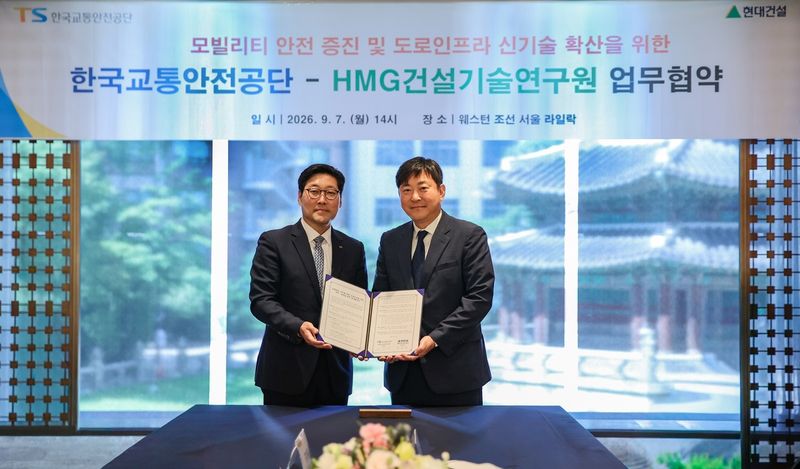
[Financial News] Hyundai Engineering and Construction is developing safety technologies for future mobility to be introduced in apartment complexes and other multi-unit housing developments.
According to industry sources on the 8th, Hyundai Engineering and Construction signed an MOU with the Korea Transportation Safety Authority the previous day to cooperate on demonstrations of safety technologies for future mobility in multi-unit housing. The signing ceremony was attended by key officials, including Kim Jae-young, head of the HMG Construction Technology Research Institute, the integrated R&D organization of Hyundai Engineering and Hyundai Engineering and Construction, and Min Seung-gi, head of the Mobility Division at the Korea Transportation Safety Authority.
The agreement was reached as the introduction of various modes of transportation and services—including demand-responsive transport (DRT), delivery and service robots, and personal mobility devices—is accelerating in multi-unit housing. The initiative aims to develop complex design and operational technologies that can ensure residents’ pedestrian safety while responding to changing transportation conditions.
Under the agreement, the parties plan to pursue joint research on ways to enhance the safety of future mobility in multi-unit housing, identify transportation safety improvements resulting from the introduction of future mobility, and review ways to improve road environments through SDR technology.
The parties will also validate research aimed at creating a safe mobility environment. Rather than limiting the study to specific modes of transportation, they will use DRT as a framework to examine mobility options that could be used in future residential complexes, including delivery and service robots and personal mobility devices. They will also conduct a comprehensive analysis of elements that make up actual residential environments, such as roads within complexes, pedestrian routes, pickup and drop-off areas, waiting spaces, and operating systems for each mode of transportation. Through on-site demonstrations, they will assess the feasibility of applying these measures from multiple perspectives.
Hyundai Engineering and Construction plans to develop designs that can be applied to actual residential environments based on the research findings. It will upgrade transportation systems within complexes with residents’ pedestrian movement as the priority, while optimizing road and route designs using data on mobility operations and space utilization. Based on this approach, the company aims to create an environment that can flexibly accommodate various mobility services, including by developing mobility infrastructure models connecting residential complexes with smart cities.
A Hyundai Engineering and Construction official emphasized, "As various mobility services enter residential complexes, the importance of spatial planning and operating systems that allow pedestrians and vehicles to coexist harmoniously is growing. Through joint research and demonstrations with the Korea Transportation Safety Authority, we will establish a safe and efficient mobility environment and systematically develop design and operating standards for multi-unit housing that take future mobility into account."
[email protected] Jung Kyung-soo Reporter