ETRI-Korea Military Academy to Develop AI-Based Future Defense Technologies
- Input
- 2026-09-08 09:39:56
- Updated
- 2026-09-08 09:39:56
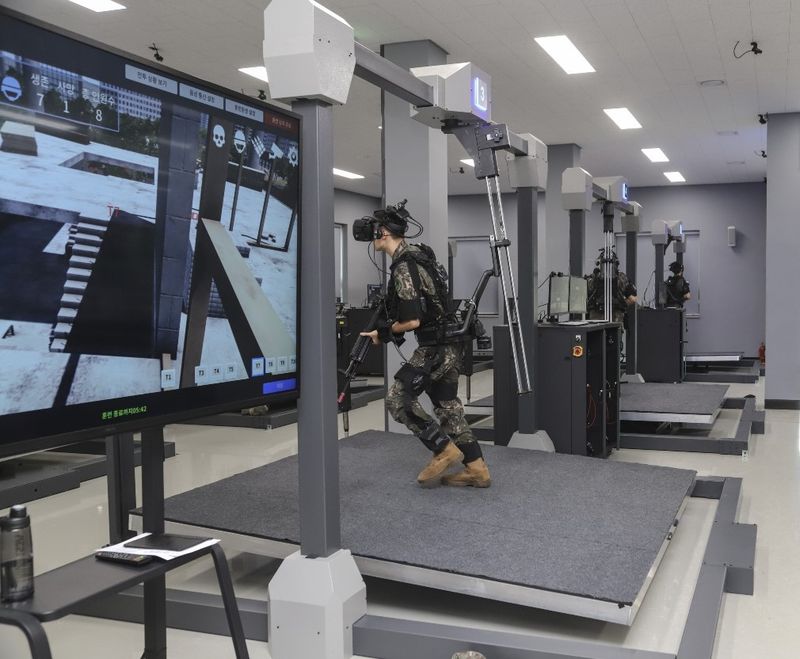
The Electronics and Telecommunications Research Institute (ETRI) announced on the 8th that it had signed a memorandum of understanding (MOU) with the Korea Military Academy at ETRI headquarters for joint research on AI-based future defense technologies, as well as the establishment of military operational concepts and field demonstrations. This is the first time the two institutions have signed an MOU at the leadership level.
The agreement was established to combine ETRI’s AI and information and communications technology (ICT) capabilities with the Korea Military Academy’s expertise in military and tactical fields, advancing cutting-edge AI technologies developed in laboratories into technologies that can be used in actual military missions. The two institutions have previously collaborated by jointly carrying out national research and development projects in AI and defense.
Under the agreement, cooperation will expand from individual research projects into a continuous institution-level research partnership. The two sides also plan to broaden their collaboration across future defense AI technologies, ranging from individual soldiers and small-unit command and control to defense networks and manned-unmanned teaming systems.
The centerpiece of the practical cooperation is ETRI’s strategic research project launched this year, “Development of AI-In-Glass Technology for Personal AI Agents.” AI-In-Glass combines AI with eyewear-shaped wearable devices, enabling AI to understand in real time the surroundings that users see and hear and provide necessary information directly in their field of vision to support situational awareness and decision-making. Applied to defense, the technology would allow soldiers to quickly identify their surroundings, potential hazards and operational information while carrying out missions, while receiving necessary information in real time. For commanders, it would compile field information gathered by multiple soldiers, helping them understand situations more quickly and make command decisions.
The research is particularly significant because it aims to extend defense command-and-control technologies, which have so far primarily focused on higher echelons at the battalion level and above, to small units at the company level and below as well as individual soldiers. Through the strategic research project, ETRI will integrate and develop four core technologies: spatial intelligence for precisely recognizing surrounding spaces and objects; personal AI agents that provide information tailored to the user’s situation; low-power, high-resolution displays that clearly present information within the user’s field of vision; and AR devices and portable AI computing devices for implementation in the form of actual glasses. Through this effort, ETRI plans to secure core source technologies for AI-In-Glass by combining AI software with displays and devices.
The goal is to develop field-oriented AI technologies that enable soldiers on the front lines to identify necessary information more quickly and help small-unit commanders make more effective decisions despite limited time and information.
[email protected] Yeon Ji-an Reporter