"A unified high-speed rail network... expanded transportation options for the public"
- Input
- 2026-09-09 08:00:00
- Updated
- 2026-09-09 08:00:00
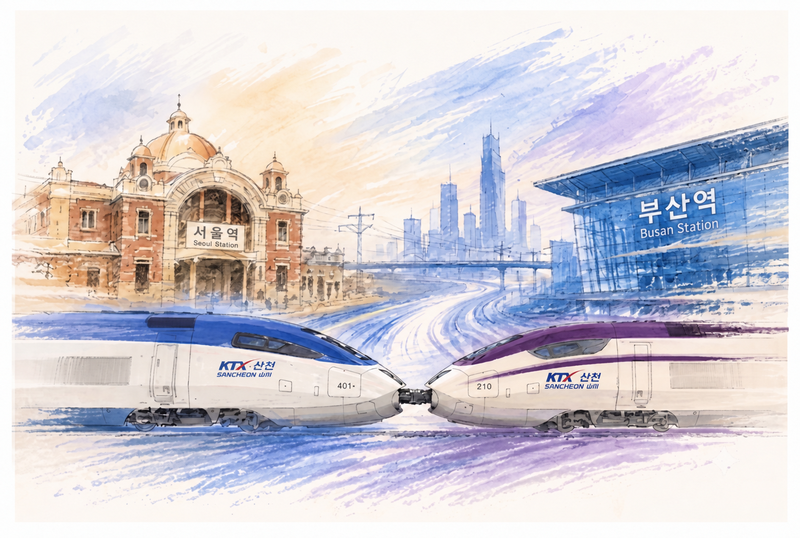
The changes were confirmed by the figures from the very first day of integration. On September 1, the number of high-speed rail passengers reached 213,000, a 7.9% increase compared with the same day last year. The number of available seats increased by 6.3% to 253,000. In particular, the number of available seats on the Suseo axis increased by 30.5% to 65,000, and the number of passengers rose by 11.3% to 64,000.
More services on the lines... 116,000 additional seats per week
The biggest change the public can feel is the expansion of seating capacity. According to Korea Railroad Corporation (KORAIL) on the 9th, the number of train services increased by 23 per day on weekdays and 26 per day on weekends. The number of available seats increased by 15,679 per day on weekdays and 17,655 per day on weekends. On a weekly basis, this amounts to approximately 116,000 additional seats. Services were increased on the Gyeongbu, Gyeongjeon, Donghae, Honam, and Jeolla lines. At Seoul Station, two additional KTX-Eum services operate daily on the Jungang Line, and a new route has been established for trains departing from Suseo Station that stop at Seodaejeon Station and Gupo Station.
According to Korea Railroad Corporation (KORAIL), deploying KTX-1 cars with greater seating capacity on the Suseo axis and expanding coupled train operations have made it possible to transport more passengers in a single trip. For passengers, this has increased the possibility of choosing their preferred time and route. The expansion of seating capacity is not merely limited to increasing the number of seats; it is leading to greater freedom of choice in travel.
Based on Korea Railroad Corporation (KORAIL) standards, rail travel benefits have been expanded in ways that are more favorable to the public. Mileage equivalent to 5% of the ticket price is accumulated for high-speed trains departing from Suseo Station, and a 'transfer discount' has been added, offering a 30% discount on the regular train fare when a high-speed train is combined with a regular train. Various discount products are also available, including benefits for pregnant women, teenagers, and young adults, as well as online special discounts and the KTX N Card.
Along with this integration, Korea Railroad Corporation (KORAIL) has refined its compensation standards for train delays. If a train is delayed by 90 minutes or more, 75% of the fare will be reimbursed, and if it is delayed by 120 minutes or more, the full fare will be reimbursed. This is another improvement addressing the various inconveniences passengers may experience while using the railway.
Simplified booking... 'Korail+' extends to accommodation and car rentals
Digital services have also changed. With the integrated app 'Korail+', users can view trains nationwide and reserve tickets in one place. The reservation process has been reduced from seven steps to four. Users can compare travel time, the number of stops, and fares on a single screen, and can change the date and time directly from the search screen.
Users can log in with a PIN, fingerprint, or facial recognition. Large-font mode, dark mode, and widget features are also provided. A new digital ticket service linked with Samsung Wallet has also been launched.
The role of 'Korail+' extends beyond ticket reservations. Based on the departure and arrival stations on a ticket, users can view parking, rental cars, car sharing, sightseeing taxis, accommodation, and leisure services all in one place. The travel preparation process, which previously required users to find lodging and local transportation separately after booking a train ticket, is now connected in a single flow. Railway apps are expanding beyond simple ticket-booking tools to become comprehensive platforms for travel planning.
Expanding emergency-response infrastructure... all-out effort for safety and service
Above all, Korea Railroad Corporation (KORAIL) is devoting every effort to strengthening railway vehicle safety and services. In preparation for the expansion of coupled train operations, it has provided maintenance personnel with training in coupling and emergency procedures and distributed 494 types of vehicle maintenance parts among major hubs so that it can respond quickly to unusual situations. A separate response system has been established and is being operated for passenger-cabin cleanliness management. Additional personnel are deployed depending on the extent of train delays, and replacement vehicles are used when necessary.
The significance of high-speed rail integration lies not merely in consolidating operating systems into one. It lies in expanding travel choices through more seats and diverse routes and reducing inconvenience throughout the entire process, from booking to transfers. Ultimately, the success of the integration depends on how much convenience the public experiences in daily life. It means being able to choose trains more easily, use tickets more conveniently, and continue traveling naturally after arriving at the destination. This is the change being created by high-speed rail integration. Attention is focused on how expanded choices and improved services will transform people's daily lives and travel experiences.
[email protected] Kim Won-jun Reporter