Submission of IAEA CSA Intent Letter Marks 'First Step' Toward International Approval of South Korean Nuclear-Powered Submarine; Grossi Makes It Public
- Input
- 2026-09-08 08:35:18
- Updated
- 2026-09-08 08:35:18
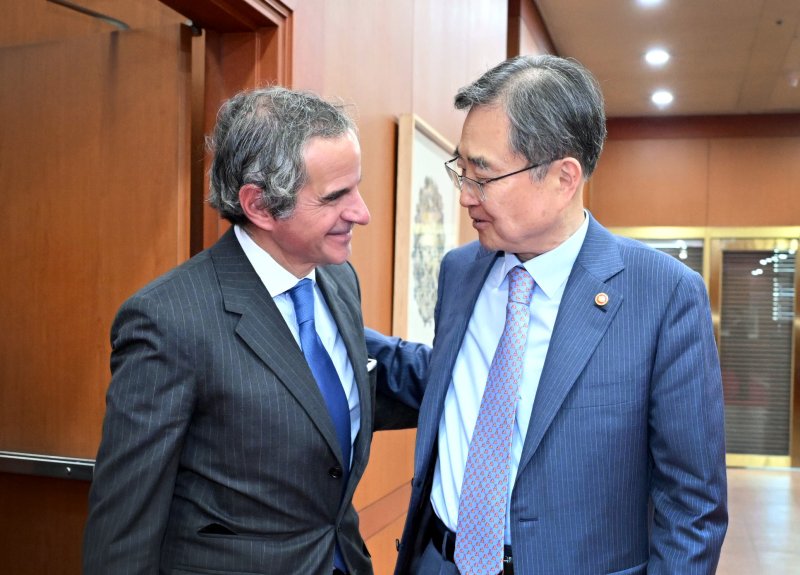
Rafael Mariano Grossi, director general of the IAEA, said at a press conference held at the IAEA headquarters in Vienna, Austria, on the 7th local time, "South Korea has officially notified the Secretariat of its intention to begin consultations with the IAEA on a separate arrangement under Article 14 of the Comprehensive Safeguards Agreement."
He added, "South Korea has already submitted the relevant declarations to the IAEA and reaffirmed its commitment to fulfilling its obligations under the Treaty on the Non-Proliferation of Nuclear Weapons (NPT), the Comprehensive Safeguards Agreement, and the Additional Protocol." He continued, "We look forward to the consultations continuing in a spirit of transparency."
However, at a press conference during his visit to South Korea in April, Grossi said, "There are still a considerable number of issues that remain questions in South Korea's case." He assessed, "Although the South Korean government has made clear its intention to pursue a nuclear-powered submarine through cooperation with the United States, there are still aspects that need to be clarified regarding actual construction and the supply of nuclear fuel."
The South Korean government is expected to pursue the conclusion of a CSA with the IAEA while also finalizing a nuclear agreement with the United States. South Korea and the United States signed a joint fact sheet on cooperation in building a South Korean nuclear-powered submarine and procuring its fuel at a summit in October last year, but the nuclear agreement has yet to be concluded and remains delayed.
To implement the agreement between the two leaders, South Korea and the United States launched an interagency working group involving their foreign affairs, defense, and energy ministries and have continued working-level consultations. MOFA has established and is operating a Nuclear-Powered Submarine Negotiation Team, an autonomous body responsible for diplomatic affairs with the United States and international organizations, including the IAEA, as well as negotiations on related agreements concerning the construction and operation of nuclear-powered submarines.
The two countries are also expected to resolve soon their differences over where the South Korean nuclear-powered submarine will be built. U.S. President Donald Trump wanted the submarine to be constructed in the United States, while the South Korean government is pursuing domestic construction.
The NPT, to which South Korea is a party, prohibits a state not possessing nuclear weapons from diverting nuclear material such as uranium to develop nuclear weapons. However, Article 14 of the CSA allows a non-nuclear-weapon state, through a separate agreement with the IAEA, to use nuclear material for nonprohibited military purposes, such as a nuclear-powered submarine.
[email protected] Kim Kyung-soo Reporter