President Lee: "Korea-France Launch 'Lumière Partnership'; May It Become a Light for the Film Industry Amid Crisis"
- Input
- 2026-09-07 18:29:07
- Updated
- 2026-09-07 18:29:07
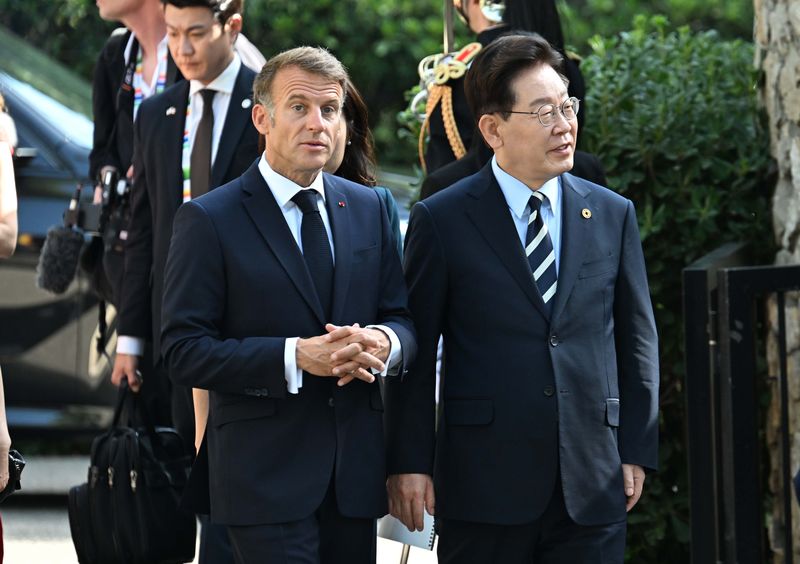
In his opening speech at the Lumière Summit held in Saint-Paul-de-Vence in southern France that day, President Lee said, "Today, I would like to announce the launch of a global investment and cooperation initiative for the film and audiovisual industry aimed at promoting prosperity and mutual growth in the sector."
He added, "This cooperation, to be named the Lumière Partnership, includes a commitment by South Korea and France to invest 500 million euros each, or approximately 800 billion won, in the film and audiovisual industry over the next five years."
President Lee said, "Proposed by South Korea and welcomed by France, this partnership will involve investment to revitalize each country's film and audiovisual industry, as well as joint investment and co-production by the two countries. It will serve as a strong stepping stone for local content to enter the global stage." He emphasized, "I hope this partnership will go beyond bilateral relations and expand to the world, becoming a light that illuminates a new future for the film and audiovisual industry worldwide."
Regarding changes in the environment surrounding the film and audiovisual industry, he said, "If we fail to properly respond to the changes of the times, it is clearly a crisis. But if we respond proactively, it is clearly an opportunity." He added, "It is time for the leaders of the film and audiovisual industry, who have driven innovation in the cultural sector, to pool their wisdom and turn these changes into an opportunity rather than a crisis."
President Lee presented four challenges that day: the crisis facing theaters; the threats and opportunities brought by artificial intelligence (AI); independent films and diversity; and mutual growth and cooperation between the local and global sectors.
Regarding generative AI in particular, he noted, "We have entered an era in which one or two creators can produce audiovisual works of various scales at low cost, without investing vast amounts of manpower, money, and time." At the same time, he pointed out, "A mountain of challenges must be addressed for AI to play a positive role, including job losses in the industry, the replication of actors' likenesses and voices, and issues involving copyright and training data."
He continued, "We must build an era in which artificial intelligence develops more responsibly and in a human-centered manner, with its benefits creating opportunities fairly for everyone." He asked, "I hope all of you in the film and audiovisual industry will join forces so that AI technology can be used in the creative process to support human development on the foundation of human-centered values."
On the relationship between global over-the-top media services (OTT) and local content, he said, "The emergence and spread of global OTT platforms have opened a new era in which local content can go global." However, he added, "The declining influence of local broadcasters and the conflicts surrounding mutually beneficial growth between local content producers and global OTT platforms are important challenges that we must consider and resolve together."
He went on to state, "South Korea will lead the production of local content that people around the world can relate to beyond borders and language barriers. At the same time, we will fulfill our responsibility to ensure that mutual growth and coexistence between the local and global sectors become the foremost principle of the film and audiovisual industry worldwide."
President Macron also said, "France and South Korea hope this summit will become a milestone in a new form of cooperation—a 'multilateralism of projects and action'—bringing together countries, creators, producers, broadcasters, platforms, cinemas, video game and technology companies, and international organizations." He added, "We will protect the world's audiovisual heritage wherever it is most at risk," and said, "We will make education about images a universal goal so that every child learns not only how to view images, but also how to understand and create them."
He continued, "Because access to works depends on places where they can be screened and shared, we will support independent cinemas in the most vulnerable regions." He also said, "We will provide video games, one of the major forms of creativity of our time, with a new international forum commensurate with their cultural and economic importance."
Meanwhile, the participants, including the leaders of the two countries, adopted the 'Lumière Declaration on the Future of Film and Audiovisual Works,' which contains 15 principles for addressing changes in the film and audiovisual industry.
In a joint declaration, the two countries stated, "As artificial intelligence transforms the conditions of creation, audiences discover new ways to enjoy stories, and audiovisual experiences become an increasingly important part of our lives, the choices we make today will help ensure that the value of audiovisual works continues to grow not only economically but also culturally."
[email protected] Seong Seok-woo Reporter