Kang Hoon-sik on sanitation worker’s death: “A workplace must not become a scene of death”
- Input
- 2026-09-07 17:02:35
- Updated
- 2026-09-07 17:02:35
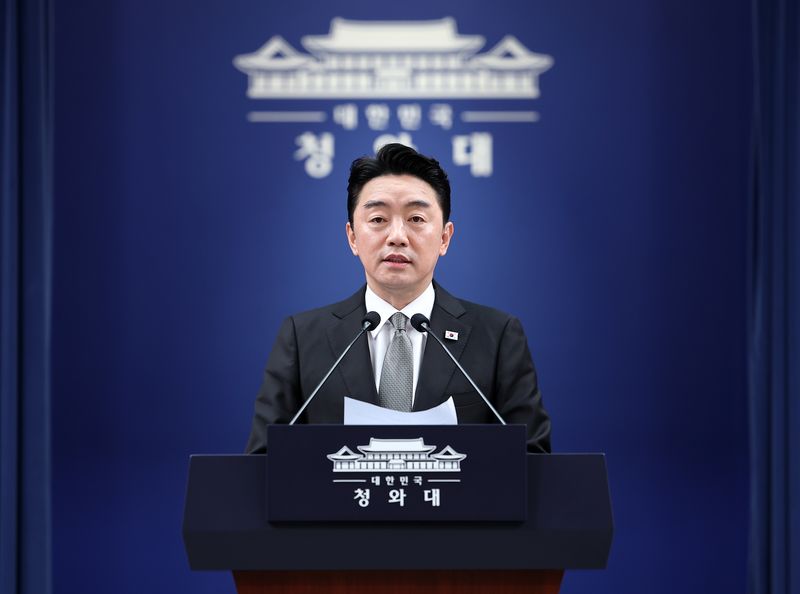
[Financial News] Kang Hoon-sik, chief of staff at the Office of the President of the Republic of Korea, instructed relevant ministries on the 7th to devise effective measures in response to a series of industrial accidents involving sanitation workers during early-morning hours. He also called for a comprehensive plan, including changes in use, to address high vacancy rates and poor management at knowledge industry centers.
As President Lee Jae Myung was carrying out a state visit to France, Kang chaired a senior aides’ meeting at Cheong Wa Dae that day. He noted that industrial accidents involving sanitation workers averaged 836 cases annually from 2023 through last year, and referred to recent fatal accidents in Yeongcheon, North Gyeongsang Province, and Seoul. He stressed, “A workplace people go to in order to make a living must not become a scene of death.”
The government made work in groups of three and daytime work mandatory in December 2019 to protect sanitation workers, but Kang also pointed out that exceptions are being widely granted in the field. He instructed the Ministry of Climate, Energy and Environment, the Ministry of Employment and Labor, and the Ministry of the Interior and Safety, among other relevant ministries, to identify why the work principles are not functioning in practice. He ordered them to review the extent of excessive exceptions and promptly prepare effective measures.
Kang also said fundamental institutional improvements were needed to address the sharp rise in vacancies and poor management at knowledge industry centers. He pointed out that supply expanded significantly around 2020 as low interest rates and the real estate boom coincided with excessive profit-seeking by builders and developers, as well as indiscriminate approvals by some local governments.
The average unsold rate for knowledge industry centers completed over the past three years was 27%, while the vacancy rate reached 44%. In some areas with poor locations, vacancy rates have exceeded 70%, with some centers effectively being left as “ghost buildings.”
Kang particularly stressed that “people are being deceived by false and exaggerated advertisements and are suffering losses from sales fraud and split resale schemes,” adding that a fundamental overhaul, rather than a temporary fix, was needed. He also instructed relevant ministries, including the Ministry of Trade and Industry and the Ministry of SMEs and Startups, to promptly prepare a “Comprehensive Plan to Resolve Vacancies at Knowledge Industry Centers and Improve the System.”
[email protected] Choi Jong-geun Reporter