Diabetes support, previously limited to Type 1, will now include Type 2... Health insurance changes starting in December
- Input
- 2026-09-08 13:40:00
- Updated
- 2026-09-08 13:40:00
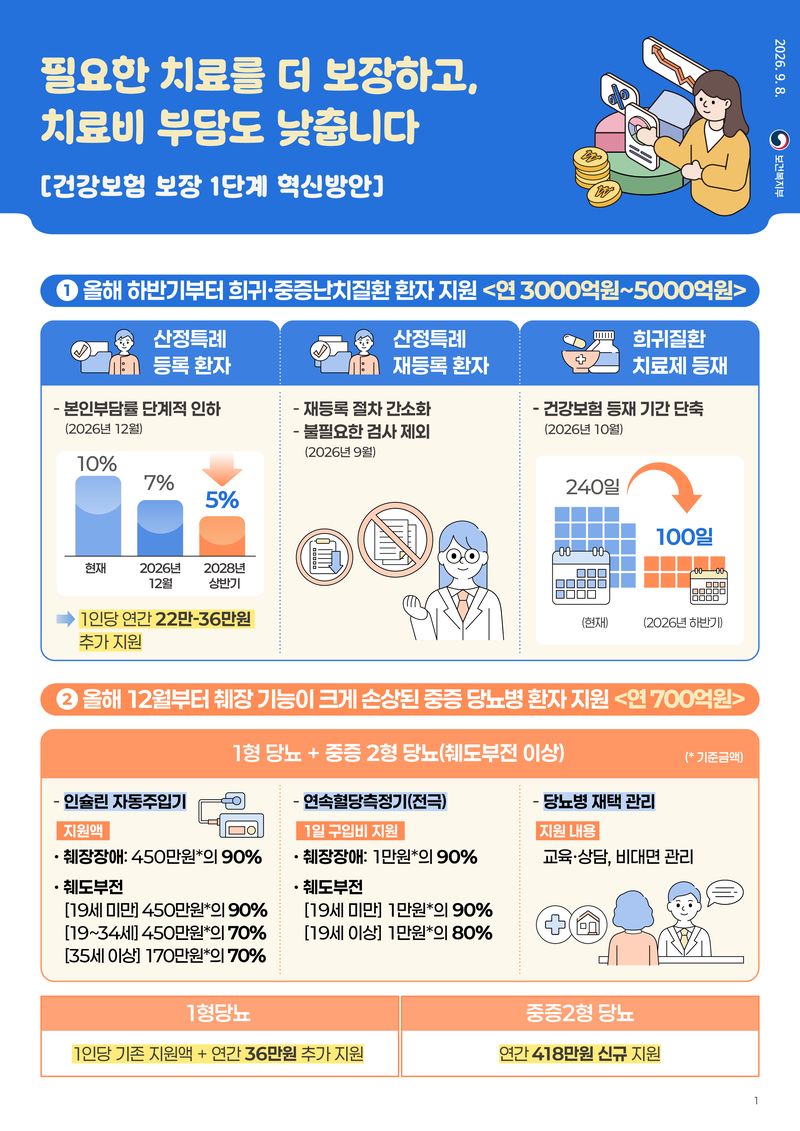
[Financial News] Starting this December, support for automatic insulin injectors and continuous glucose monitors, previously applicable only to Type 1 diabetes patients, will be extended to Type 2 diabetes patients with the same severity. In addition, the health insurance co-payment for 1.36 million patients suffering from rare diseases such as hemophilia and severe intractable diseases will be reduced by up to approximately 360,000 won.
On the 8th, the Ministry of Health and Welfare (MOHW) approved the 'Decision on Health Insurance Premium Rates for 2027,' which is the first phase of innovation plans for health insurance coverage, at the 15th National Health Insurance Policy Deliberation Committee.
Gradual reduction of out-of-pocket expenses for 1.36 million patients with rare and severe intractable diseases
The health insurance co-payment rate for 1.36 million patients suffering from rare diseases (1,389) and severe intractable diseases (234) that are difficult to cure and require continuous treatment will be gradually lowered from the current 10% to 7% in December and to 5% in the first half of 2028. Accordingly, the average annual co-payment per patient is expected to decrease from 750,000 won to 530,000 won in 2027 and 390,000 won in 2028. The reduction is expected to be greater for diseases with high co-payments, such as hemophilia and Paroxysmal Nocturnal Hemoglobinuria (PNH).
The re-registration process for special medical benefit exceptions will also be simplified. For 312 diseases (approximately 340,000 patients) that previously required the submission of separate test results along with a clinical diagnosis every five years, re-registration will now be possible based solely on clinical diagnosis and treatment history, without the need for test results. This will be applied first to 95 diseases, including Guillain-Barre syndrome, starting in September, and will be expanded to 146 diseases by next year.
In addition, we plan to implement a pilot project to simplify the health insurance listing procedure for treatments for rare diseases, thereby shortening the listing period from the current 240 days to within 100 days.
Support for severe diabetes expanded to include Type 2 as well as Type 1
Support for insulin pumps and continuous glucose monitors, which was previously only available to patients with Type 1 diabetes, will be extended to patients with Type 2 diabetes of the same severity. As a result, approximately 11,000 patients with Type 2 diabetes who have a severity level comparable to Type 1 diabetes will newly receive benefits.
Patients with pancreatic disorders will receive support covering 90% of the device purchase cost regardless of age, and their co-payment rates will be reduced from 30% to 10% for Type 1 and from full burden to 10% for Type 2. Young adults aged 19 to 34 will receive the same standard amount (4.5 million won) as children, further reducing their financial burden. In addition to device support, the home care program will be expanded from Type 1 diabetes to include severe Type 2 diabetes to ensure appropriate treatment and management at home.
With the expansion of support for nursing care expenses and home care services for diabetes patients, it is expected that the burden will be alleviated by 360,000 won per year for Type 1 diabetes patients and 4.18 million won per year for severe Type 2 diabetes patients.
Support for patients with glycogen storage disease and neurogenic bladder is also newly established and expanded
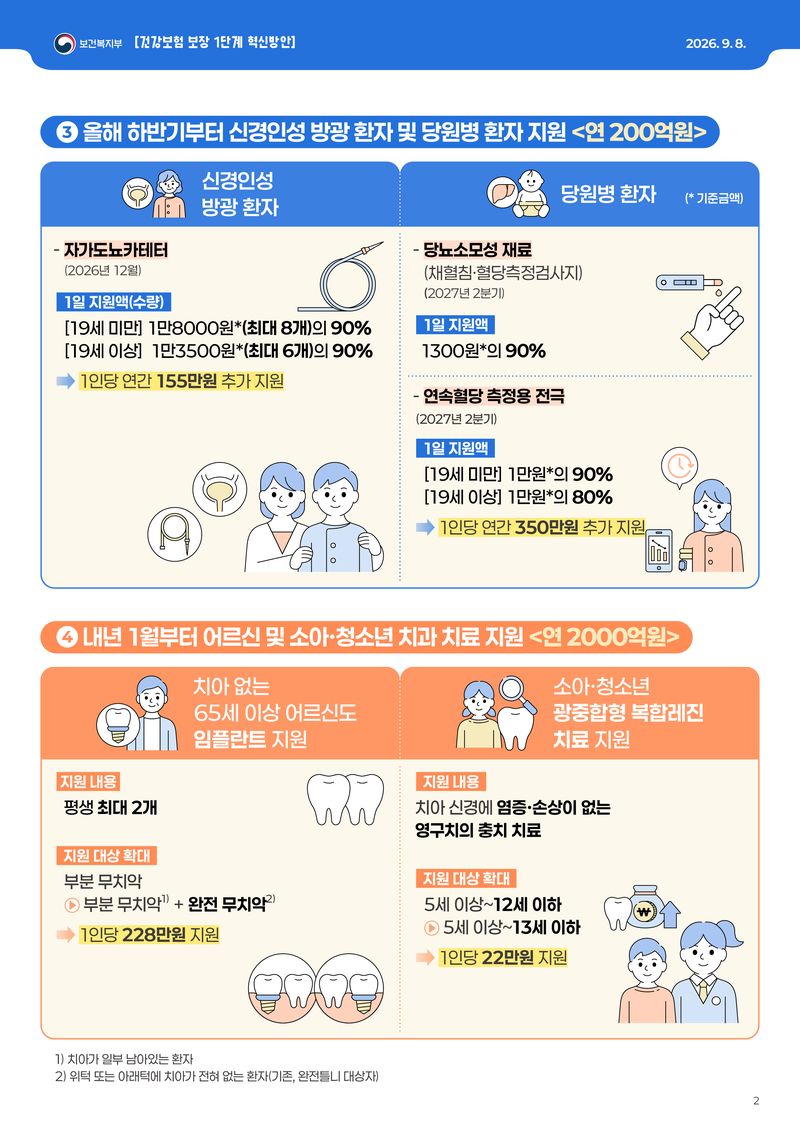
For the first time, medical expense support for blood glucose test strips and other items has been introduced for patients with glycogen storage disease (about 344 people) who require blood glucose management, and the burden per patient is expected to decrease by about 3.5 million won per year.
Support for self-catheterization catheters for patients with neurogenic bladder who are unable to urinate on their own (approximately 10,978 people) will also be expanded. For those under 19, the number of covered items per day will increase from 6 to 8, and the standard amount will be raised from 9,000 won to 18,000 won for those under 19 and 13,500 won for those 19 and older, which is expected to alleviate the burden by 1.55 million won per patient annually.
Expansion of support for senior implants and pediatric dental care starting next January
Starting in 2027, seniors aged 65 or older who have no teeth will be able to receive support for two dental implants. Previously, support was only available to those who still had teeth, but with the inclusion of completely edentulous patients, it is estimated that approximately 70,000 people will receive benefits of about 2.28 million won per person.
The eligible age for light-cured composite resin used to treat cavities in children and adolescents has also been expanded from the existing 5–12 years to 5–13 years, allowing approximately 140,000 people to receive 220,000 won in medical expense support annually.
Lee Hyung-hoon, the Second Vice Minister of Health and Welfare, stated, "The expansion of insurance benefits for patients with severe and rare diseases, the elderly, and children and adolescents has eased the burden of medical expenses, enabling more proactive treatment and management," adding, "We will continue to pursue the expansion of benefits under the broad roadmap for strengthening health insurance coverage."
Meanwhile, the Ministry of Health and Welfare (MOHW) decided to freeze the health insurance premium rate for 2027 at 7.19%, the same as this year. It also decided that the amount per property premium assessment point for regional subscribers would remain at 211.5 won, the same as this year. This decision was made after comprehensively considering factors such as the stable operation of the current health insurance finances, including a surplus in the current account balance over the past five years and the holding of reserves equivalent to 3.5 months (30.2 trillion won as of 2025); an increase of approximately 1.1 trillion won in government support for next year; and the expectation of increased premium revenue due to the recent boom in the semiconductor industry.
[email protected] Jeong Myeong-jin, Medical Specialist Reporter