Ruling Party Proposes Korea Power Corporation Act... Aligns with Government's Public Institution Reform
- Input
- 2026-09-07 16:40:19
- Updated
- 2026-09-07 16:40:19
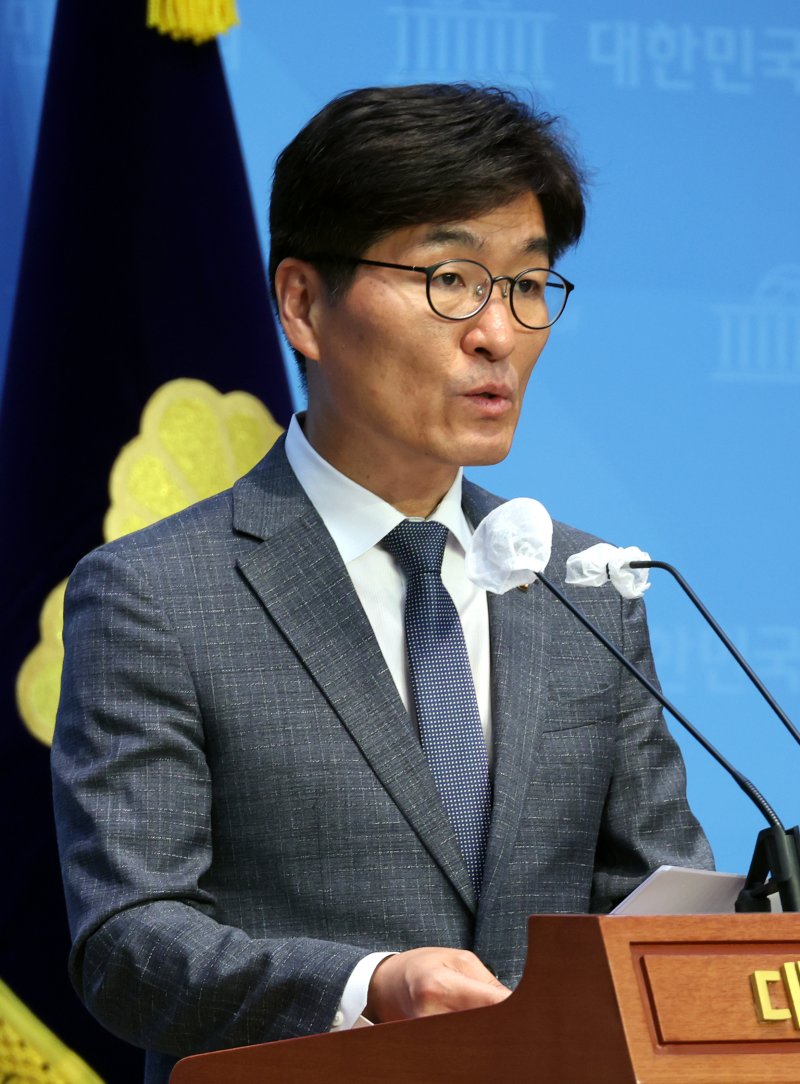
On the 7th, Democratic Party of Korea lawmaker Park Hae-cheol held a press conference at the National Assembly of the Republic of Korea Communication Center to announce the representative proposal for the Korea Power Corporation Act. Given that this came immediately after the government announced plans to merge the five power generation companies, it is interpreted as follow-up legislation.
Rep. Park pointed out, "In 2001, the power generation division of Korea Electric Power Corporation (KEPCO) was split into five companies through the restructuring of the power industry," adding, "Twenty-five years have passed since we blocked the groundwork for privatization, which was intended to strengthen competitiveness, and maintained the separated companies. During this time, the effects of forced competition among power generation companies have been minimal, while duplicate investments and management costs have accumulated."
He said, "The integration of power generation companies is a matter of national competitiveness," adding, "Consolidating the capabilities of the five dispersed state-owned power companies into one to coordinate overlapping functions and secure economies of scale is not a choice, but a necessity."
He explained the rationale behind the bill, stating, "In particular, the three major mega-projects promoted by the Lee Jae Myung administration are projects on which the nation's future depends, with over 1,500 trillion won to be invested over the next 10 years." He added, "To determine the success or failure of these massive projects and to keep the heart of future industries beating, we must supply electricity stably, while realizing carbon neutrality. This is a role that only an integrated public power generation enterprise can properly fulfill."
The core of Rep. Park's proposal is to consolidate the five power generation companies into a single entity, just as announced by the government. Prior to the government's official announcement, bills with the same name had been introduced three times in the National Assembly of the Republic of Korea. Ultimately, the core of all these bills is the consolidation of the five power generation companies.
Above all, Rep. Park's proposal is noteworthy in that the labor union directly participated in its drafting. Typically, the consolidation of public institutions exacerbates job insecurity among workers. Taking this into account, the bill incorporates various safeguards by listening to the union's opinions. Attention is now focused on whether this will serve as a mechanism to preemptively prevent potential conflicts with the labor union during the government-led consolidation process and the legislative review process in the future.
It has been confirmed that there is a consensus between the ruling and opposition parties regarding the consolidation of the five power generation companies. This is because, excluding the previously mentioned Rep. Park's proposal, one of the three other bills was introduced by the People Power Party. Rep. Kang Min-kook of the People Power Party introduced the Korea Power Corporation Act on the 27th of last month. Rep. Kang's constituency is Jinju, South Gyeongsang Province, where Korea South-East Power Co., Ltd. is located. Ultimately, considering these factors, there is ample room to view the possibility of future negotiations between the ruling and opposition parties as open.
The key issue is the location of the integrated headquarters. Rep. Kang has stipulated in the law a provision designating Jinju, South Gyeongsang Province—his constituency—as the location of the integrated headquarters. On the other hand, Rep. Park maintains that "it is desirable for the location to be determined through sufficient deliberation among workers, management, and the government." The prospects for negotiations between the ruling and opposition parties are expected to differ significantly depending on where the headquarters location is ultimately decided.
[email protected] Kim Hyung-gu Reporter