"Caution Needed in Introducing a Sugar Surcharge"... Tax Experts Emphasize Education and Promotion Instead of Price Regulation
- Input
- 2026-09-07 16:55:44
- Updated
- 2026-09-07 16:55:44
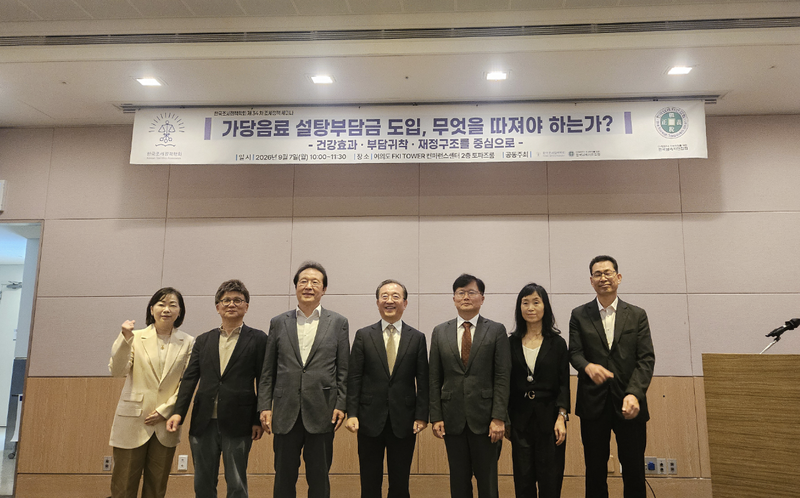
[Financial News] Tax experts have effectively expressed opposition regarding discussions on introducing a sugar levy on sweetened beverages. They argue that education and public awareness campaigns regarding the harmful effects of consuming sweetened drinks should take precedence over the establishment of a new levy that controls prices or corporate profits. According to industry sources on the 7th, the Korean Association of Tax Policy and the Korea Taxpayers Association jointly held the 34th Tax Policy Seminar in Yeouido, Seoul, under the theme "Introduction of a Sugar Levy on Sweetened Beverages: What Needs to Be Considered?"
Kim Gap-sun, President of the Korean Association of Tax Policy, emphasized, "Uniform price regulations such as the sugar levy harbor structural limitations behind their outward good intentions, including tax regressivity that increases the consumption burden on low-income groups and young people, and undermining fiscal transparency by circumventing budget controls." He added, "As autonomous efforts to reduce sugar consumption are already operating in the market, non-price and market-friendly approaches should be prioritized over price controls."
Choi Won-seok, President of the Korea Taxpayers Association, said, "It is very timely that a venue has been set up to discuss from various angles whether the introduction of a sugar surcharge on sugary drinks is truly desirable," adding, "I hope that today's seminar will serve as an important starting point for rational and systematic policy discussions."
Professor No Jeong-ran of Myongji University, who gave the keynote presentation on this day, presented the results of an empirical analysis of raw data from the Korea National Health and Nutrition Examination Survey (KNHANES, 2016–2024) and a burden incidence simulation under the theme of "Effectiveness and Policy Limitations of the Sugar Surcharge on Sugared Beverages."
According to Professor Noh's analysis, the average daily per capita consumption of sugary drinks decreased by 25.6% from 116.9g in 2016 to 87.0g in 2024, and the proportion of total sugar intake also steadily decreased. This suggests that consumers have voluntarily reduced their consumption of sugary drinks without the imposition of artificial surcharges.
It was also pointed out that the sugar levy increases spending by children and adolescents, who are the main consumers, and consequently concentrates the burden on low-income young adults and adolescents, exhibiting a regressive nature to the tax burden.
In particular, it was warned that if the sugar levy results in a quasi-tax in the form of the National Health Promotion Fund rather than a tax, it could lead to a "fiscal illusion" that bypasses strict parliamentary budget controls and avoids tax resistance. The explanation is that a structural contradiction arises where achieving health promotion goals through reduced consumption leads to decreased fund revenue, while conversely, maintaining fund revenue prevents the achievement of health improvement objectives.
In the ensuing discussion, Professor Ha Sang-do of Chung-Ang University stated, "The obesity rate among Korean adults is 5.1%, the lowest in the world, and while the national sugar intake is decreasing, the causes of obesity are complex, including a lack of physical activity (less than 61% of Korean adults)." He added, "We must be cautious about introducing easy regulations such as taxes or levies without empirical evidence of total calorie reduction and verification of side effects, and policies that support the market's autonomous change to reduce sugar intake should be prioritized."
The Korean Association of Tax Policy stated, "Since the sugar levy is an issue where health policy and tax policy intersect, it is necessary to objectively verify its effects and the substance of the burden before discussing whether to introduce it," adding, "We hope this seminar will serve as a starting point for discussions on designing a rational system."
[email protected] Park Kyung-ho Reporter