Governor Wi Seong-gon officially apologizes for "Jeju-Qingdao policy failure"... This year's loss compensation budget is 6.457 billion won
- Input
- 2026-09-07 16:06:18
- Updated
- 2026-09-07 16:06:18
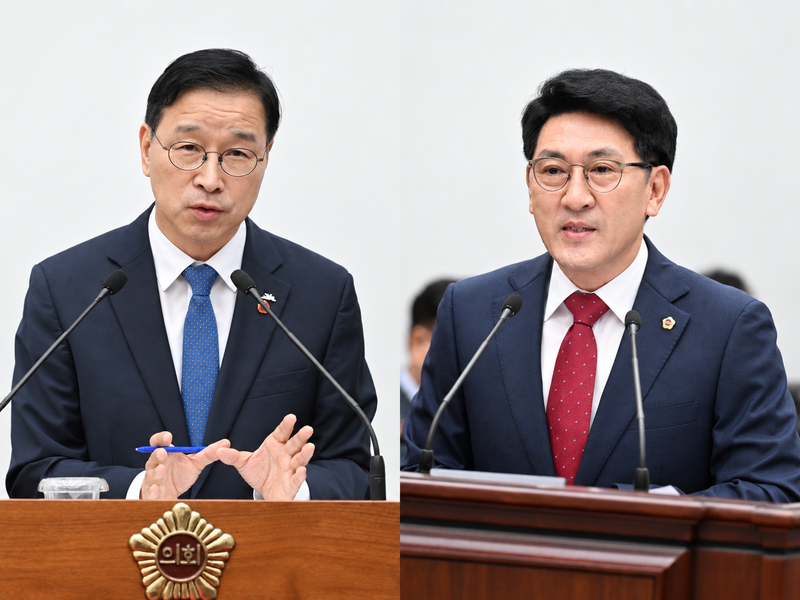
[Financial News Jeju = Reporter Jeong Yong-bok] Jeju Governor Wi Seong-gon officially apologized to the residents on the 7th, characterizing the Jeju-Qingdao international cargo ship route as a "policy failure." As it was confirmed that the route had not even undergone a central investment review, with cargo volume remaining at only 10% of the break-even point and a budget of 6.457 billion won allocated for loss compensation this year alone, Jeju Special Self-Governing Province revised the three-year agreement with the Chinese shipping company and entered into renegotiations to increase cargo volume.
According to the Jeju Special Self-Governing Provincial Council on the 7th, Governor Wi Seong-gon stated during the provincial administration questioning at the 4th plenary session of the 454th 1st regular session that day, "I officially apologize to the residents of Jeju for the waste of taxpayer money regarding the Qingdao international shipping route."
When Jeju Special Self-Governing Provincial Council member Kim Hwang-kok pressed on the project's feasibility and financial losses, Governor Wi replied, "The forecast regarding cargo volume was a massive failure," adding, "I am sorry that compensation for losses will be paid out due to policy failure."
They also acknowledged that the failure to undergo a central investment review was an "administrative error in judgment."
The Jeju-Qingdao regular cargo ship launched on October 16 of last year as a regular international container route connecting the Port of Jeju and Qingdao Port in China. The purpose was to increase exports of Jeju agricultural and marine products to China and to reduce logistics costs and transit times associated with passing through the mainland.
Jeju Special Self-Governing Province has signed an agreement with Shandong Ocean Shipping Group to cover losses incurred during the operation of the shipping route for three years.
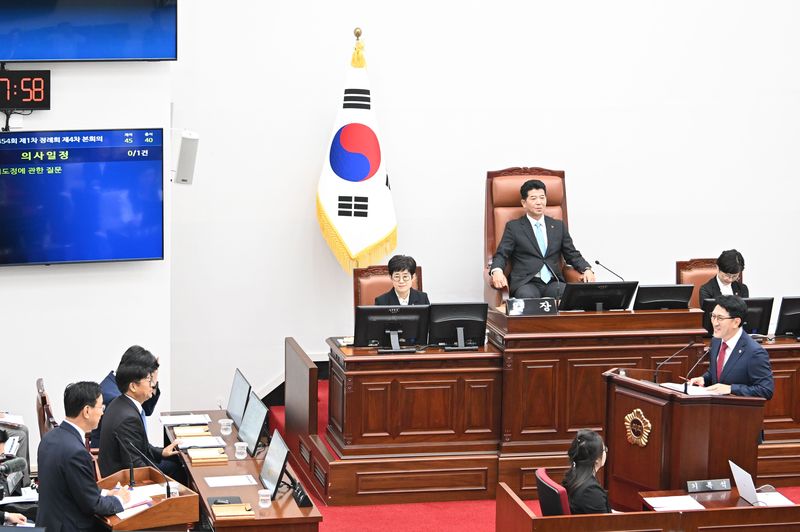
Securing cargo volume, which was a prerequisite for the project, deviated significantly from the plan. During a provincial government questioning session on this day, Council member Kim pointed out that the actual average cargo volume remains at only 10% of the break-even point. As sufficient cargo necessary for ship operations is not secured, a structure has become entrenched where the shortfall is covered by Jeju Special Self-Governing Province's finances.
3.8 billion won in loss compensation was reflected in this year's main budget. Jeju Special Self-Governing Province had planned to increase the total to 7.157 billion won by requesting an additional 3.357 billion won in the second supplementary budget. However, during the supplementary budget review last July, the Provincial Council cut 700 million won from this amount. The final secured budget for loss compensation this year is 6.457 billion won.
The operation of container handling equipment also incurs a separate financial burden. During the Provincial Council's review last July, a budget of approximately 1.6 billion won was proposed to cover operating losses related to the equipment. The structure is such that when cargo volume is low, not only do shipping companies suffer operational losses, but the burden of fixed costs for the Port of Jeju's cargo handling facilities also increases.
Procedural issues also increased the burden on the project. Jeju Special Self-Governing Province did not undergo a central investment review while signing an agreement to financially compensate for the shipping company's operating losses over a long period. A central investment review is a procedure in which a local government verifies the necessity, feasibility, and financial soundness of a large-scale investment project that bears a long-term financial burden before proceeding with the project.
Governor Wi acknowledged on this day that the omission of the central investment review was an "administrative error in judgment," officially stating that there were problems not only with the project's feasibility but also with the preliminary verification procedures.
The problem lies in the fact that it is difficult to immediately suspend the shipping route simply because the deficit is large. At the Provincial Council last July, the Jeju Provincial Bureau of Marine Affairs and Fisheries explained the results of a legal review stating that the agreement signed with the Chinese shipping company is valid for three years and that it is difficult for Jeju Special Self-Governing Province to unilaterally terminate the contract without the Chinese side's consent. Suspending the route could lead to contractual and diplomatic issues with the Chinese side, while maintaining it would result in continued increases in compensation for losses.

The Wi Seong-gon administration has decided to revise the agreement itself. Governor Wi stated, "We are faithfully proceeding with negotiations within a scope that does not damage diplomatic relations between the two countries from the perspective of the interests of the provincial residents."
Jeju Special Self-Governing Province is discussing revisions to the agreement with the Chinese shipping company, including a loss compensation structure. At the same time, it is operating a working group to identify local Chinese buyers and importers and is pursuing measures to increase import and export cargo volumes through incentives for using the Qingdao route. The assessment is that to revitalize the route, it is necessary to fill the ships with actual cargo in addition to changing the loss compensation structure.
The opening of the shipping route was initially anticipated as a project that would alleviate the structural limitations of Jeju's import and export logistics. The logic was that by sending Jeju-produced agricultural and marine products directly to China and bringing in Chinese raw materials and goods directly through the Port of Jeju, the costs and time associated with passing through mainland ports such as Busan and Pyeongtaek could be reduced.
However, the economic viability of a shipping route depends more on whether a stable volume of imports and exports can be secured every week than on the opening of a direct route itself. If it remains at the current level of 10% of the break-even point, the financial burden accumulates the longer the route is maintained.
With Governor Wi's official apology, the provincial administration's judgment on the policy failure has become clear. The remaining issue is damage control rather than the apology. The key factors are how far the agreement with the Chinese shipping company can be changed, securing cargo volume that falls far short of the break-even point, and when to reduce the loss compensation structure that costs billions of won annually.
[email protected] Jeong Yong-bok Reporter