Won–Dollar Exchange Rate in the 1,330-Won Range, Lowest in 1 Year and 11 Months... "Won Strength Continues"
- Input
- 2026-09-07 15:52:11
- Updated
- 2026-09-07 15:52:11
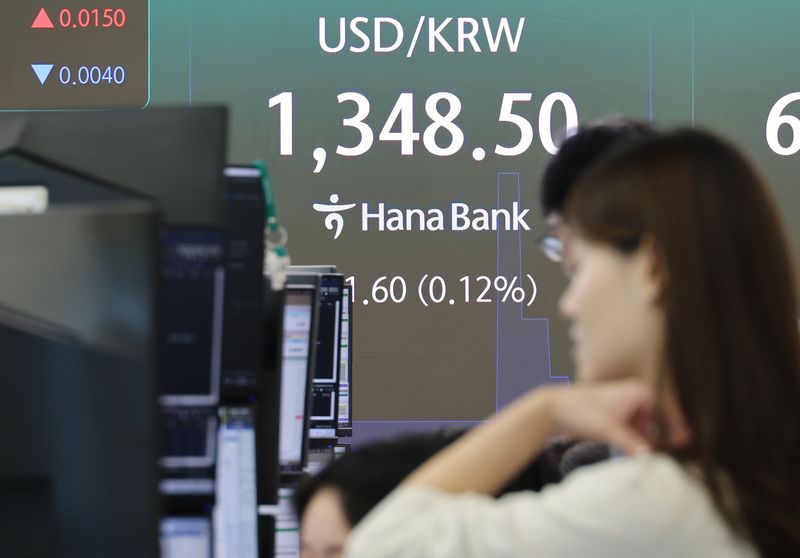
[Financial News] The won–dollar exchange rate fell to the 1,330-won range during trading for the first time in 1 year and 11 months. It has fallen by more than 200 won in two months from the high of around 1,550 won last July, marking the fastest decline since the global financial crisis. The prevailing view is that the won's strengthening trend will continue for the time being, driven by factors including the narrowing interest rate differential between Korea and the United States, a record current account surplus, and bargain-buying demand.
On the 7th, the won–dollar exchange rate in the Seoul foreign exchange market (as of 3:30 p.m.) stood at 1,340.5 won, down 9.9 won from the previous trading day's reference rate of 1,350.4 won.
The exchange rate briefly fell to 1,330 won during trading that day, its lowest level in 1 year and 11 months since October 4, 2024, when it stood at 1,331.3 won. After rising to the 1,500-won range on May 19, the exchange rate peaked at 1,559.2 won on July 1. It remained in the 1,500-won range for about two months before falling to the 1,400-won range on July 15 and the 1,300-won range on August 21. Compared with the peak, it had fallen by nearly 220 won in just two months.
The exchange rate opened at 1,347.8 won and extended its decline into the 1,330-won range after 9 a.m. It fluctuated thereafter before falling below the previous trading day's low of 1,345.0 won.
Although U.S. employment data released on the 4th (local time), which was expected to have a short-term impact on exchange rates, exceeded market forecasts, it failed to halt the won's strength. U.S. nonfarm payroll employment rose by 162,000 in August from the previous month, significantly exceeding market expectations. Although the dollar strengthened as a U.S. interest-rate hike became likely this month, the won–dollar exchange rate continued to decline.
Dollar supply and demand conditions are favorable for the won. Dollar-selling orders are flooding the market as semiconductor companies benefiting from a sustained export boom continue converting the dollars they have earned. According to the Bank of Korea (BOK), South Korea's current account surplus exceeded the record level of $40 billion for two consecutive months in June and July. Expectations of additional dollar supply following large-scale shareholder returns by Samsung Electronics Co., Ltd. and SK hynix, the continued conversion of SK hynix ADRs, and bargain-buying demand are also supporting the won's strength. The narrowing interest rate differential between Korea and the United States following two consecutive benchmark interest-rate hikes by the Bank of Korea (BOK) is another factor driving up the won.
If this trend continues, the won–dollar exchange rate has considerable room to fall further. Hyun Song Shin, governor of the Bank of Korea (BOK), said at a meeting of the Monetary Policy Board, which decided to raise the benchmark interest rate on the 27th of last month, "Although the exchange rate has fallen considerably, it is still high by historical standards," adding that "there is room for the won to strengthen further through a preemptive monetary policy response."
A decline in the won–dollar exchange rate, together with an increase in the current account surplus, benefits the government's efforts to stabilize prices and support domestic economic recovery by lowering import prices for crude oil and raw materials.
However, the rapid decline in the exchange rate is problematic. According to the Bank of Korea (BOK), the exchange-rate decline in July was 8.09%, the steepest pace in more than 17 years since March 2009, when it fell 9.81% following the global financial crisis.
A sharp decline in the exchange rate is unwelcome for exporters. Directly affected by falling export prices, they must revise earnings forecasts that had already been prepared on the assumption of a high exchange rate. If the profits of major semiconductor and automobile exporters decline because of the strong won, tax revenues, including corporate taxes, will also fall. This could negatively affect the government's largest-ever medium-term expansionary fiscal policy.
[email protected] Normal bacteria Reporter