Daegu Metropolitan City Accelerates Efforts to Build Youth Startup Ecosystem
- Input
- 2026-09-07 15:23:38
- Updated
- 2026-09-07 15:23:38
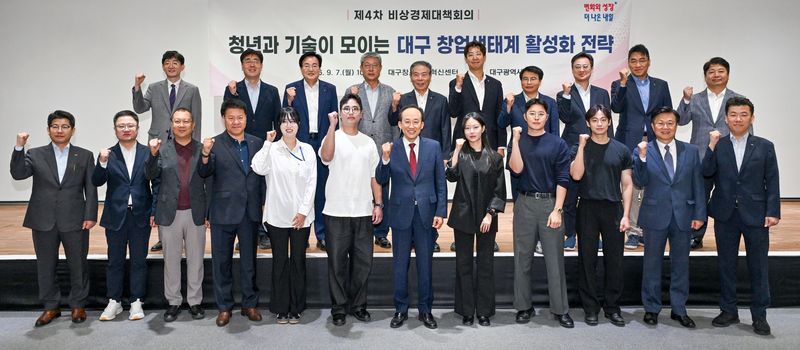
Daegu Metropolitan City is stepping up efforts to build a youth startup ecosystem in the region.
On the 7th, Daegu Mayor Choo Kyung-ho chaired the fourth Emergency Economic Measures Meeting at the Daegu Center for Creative Economy and Innovation under the theme “Strategies to Revitalize Daegu’s Startup Ecosystem, Where Youth and Technology Converge.”
The meeting addressed three agenda items: pursuing the National Flagship Startup City Project, expanding the supply of venture capital according to companies’ growth stages, and implementing support programs for youth technology startups.
Mayor Choo emphasized, “I hope the announced support measures will encourage local startups to take on creative challenges and serve as an opportunity to drive Daegu’s new growth.” He added, “Based on the opinions discussed, we will consider practical support measures needed in the field and establish Daegu’s own special and differentiated policies to build Daegu into a startup innovation city where youth and technology grow together.”
According to Daegu Metropolitan City, it was selected in May for the National Flagship Startup City Project, which the Ministry of SMEs and Startups is pursuing for the first time this year to build startup ecosystems outside the Seoul metropolitan area. More than KRW 80 billion in national funding is expected to be invested over five years through 2030.
More than 20 universities and research institutes, including the Daegu Center for Creative Economy and Innovation, Daegu Gyeongbuk Institute of Science and Technology (DGIST), and Korea Institute for Robot Industry Advancement (KIRIA), will participate in the project task force. The plan provides a package of support, including commercialization funding, customized growth programs, and expanded startup space linked to the startup city project.
Of the 74 companies, 25 from outside the region have pledged to relocate to Daegu. For some relocating companies, the city will provide additional support from its budget equivalent to 10% of their self-funded share—30% of the total project cost—up to KRW 17 million. It will also provide rent support of KRW 2.4 million for up to six months, or KRW 400,000 per month. The city is also considering additional support, such as linking companies with employment subsidies when they newly hire local talent as regular employees.
In addition, as a follow-up measure to the first Emergency Economic Measures Meeting held in July, the city plans to establish the Small and Medium-sized Enterprise Investment Fund by January 2027. With a goal of raising KRW 1 trillion by 2030, it will create four funds worth a combined KRW 157 billion this year—the Early-Stage Startup Fund, Early-Stage Deep-Tech Fund, Youth Startup Fund, and Advanced Strategic Industries Fund—and begin investing in October.
To expand local companies’ opportunities to attract investment, the city will review each fund’s investment performance in local companies every quarter and closely manage promising companies with high growth potential. It also plans to hold investment briefings regularly at least once a month.
Daegu Metropolitan City will also establish a technology startup support program exclusively for young people through a supplementary budget. The program will provide youth entrepreneurs with package support, including turning ideas into business models and helping them settle in the region.
To build networks among young entrepreneurs, the city will organize team-building programs matching young founders in fields such as planning, development, and marketing, involving 80 participants, as well as mentoring for 120 promising entrepreneurs. It will also operate practical training programs ranging from basic startup education to using artificial intelligence (AI) to develop and demonstrate initial prototypes, aimed at strengthening participants’ capabilities.
Kim Su-min, CEO of muaheng, and Lee Hee-jun, CEO of Big Wave AI, said, “It is truly surprising that the city is thinking beyond simple support about how youth and technology can grow together.” They added, “We hope the announced support measures will be felt meaningfully in the field.”
[email protected] Kim Jang-wook Reporter