Jeonnam-Gwangju and Ulsan, Korea’s Leading Automobile Cities, Pursue an AI Transformation of Manufacturing Processes
- Input
- 2026-09-07 15:12:27
- Updated
- 2026-09-07 15:12:27
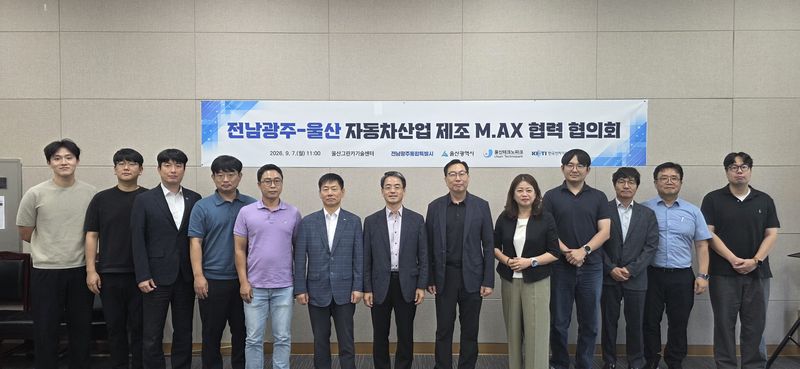
【Financial News Jeonnam-Gwangju = Hwang Tae-jong】 Jeonnam-Gwangju Integrated Special City (Gwangju Metropolitan City) and Ulsan Metropolitan City, two of Korea’s leading automobile-producing cities, are pursuing an artificial intelligence (AI) transformation of automobile manufacturing processes.
The initiative aims to address labor shortages at production sites caused by a declining working-age population and workers’ reluctance to take on high-risk, high-difficulty processes. It also seeks to create an environment where humanoid robots and workers can work together.
According to Gwangju Metropolitan City on July 7, the city held a cooperation council that day in Ulsan Metropolitan City to discuss an artificial intelligence transformation (M.AX) plan for the manufacturing sector in the automobile industry. Eighteen people attended, including Lee Dong-hyun, head of the Future Automobile Industry Division at Gwangju Metropolitan City; Song Gyu-wan, head of the Industrial Transformation Division at Ulsan Metropolitan City; and officials from KETI’s Gwangju regional headquarters and Ulsan Technopark.
The Automobile Manufacturing Artificial Intelligence Transformation (M.AX) Cooperation Project will be carried out over five years from 2027 to 2031, with Gwangju Metropolitan City and Ulsan Metropolitan City each investing 29 billion won—15 billion won in central government funding and 14 billion won in local government funding. The government’s budget proposal for next year includes 4.5 billion won for each city, or 9 billion won in total.
The two cities plan to proceed in stages with the following initiatives: establishing a demonstration center for humanoid robots in automobile assembly processes; building and demonstrating a platform for training manufacturing humanoids to perform at a human level; developing facilities and infrastructure to demonstrate the durability and reliability of humanoids in manufacturing environments; and supporting manufacturers’ AI transformation.
Lee Seung-joo, head of KETI’s Gwangju regional headquarters, said at the meeting, "Through this cooperation project, Jeonnam-Gwangju will be able to improve both the productivity and safety of work in the region’s automobile industry." He added, "The data and verification standards accumulated through this project will later be extended to local parts manufacturers more broadly, helping to build an industrial ecosystem for the transition to future automobiles."
Moon Jin-soo, a center director at Ulsan Technopark, stated, "Ulsan plans to deploy humanoid robots first in high-weight, high-risk processes, such as vehicle bodies and large modules, and proceed to on-site implementation after preliminary verification and demonstration."
Lee Dong-hyun, head of the Future Automobile Industry Division at Gwangju Metropolitan City, said, "We need to respond proactively to the trend of expanding the use of humanoid robots in automobile manufacturing processes." He added, "We will work actively with Ulsan Metropolitan City and the National Assembly to build broader support and ensure that the relevant funding reflected in the government’s budget proposal is finalized."
Meanwhile, the attendees shared updates on automakers’ efforts to introduce humanoid robots, including Atlas and Optimus, by Hyundai Motor Company and Tesla. They also visited Hyundai Motor’s Ulsan EV plant to tour a future electric-vehicle production site.
[email protected] Hwang Tae-jong Reporter