Jeju Province, Jeju Technopark Drive AI Transformation at 31 Biotech Firms; Demonstrate 100% Detection of Defective Citrus Materials
- Input
- 2026-09-07 14:51:08
- Updated
- 2026-09-07 14:51:08
【Financial News Jeju = Reporter Yongbok Jeong】 As Jeju pursues AI transformation (AX) at 31 biotech companies, a demonstration at a food manufacturing site has achieved a 100% detection rate for defective citrus materials and raised normal-material classification accuracy from 70% to 85%. The initiative is moving beyond applying AI to research and administration toward improving quality control and productivity in manufacturing processes.
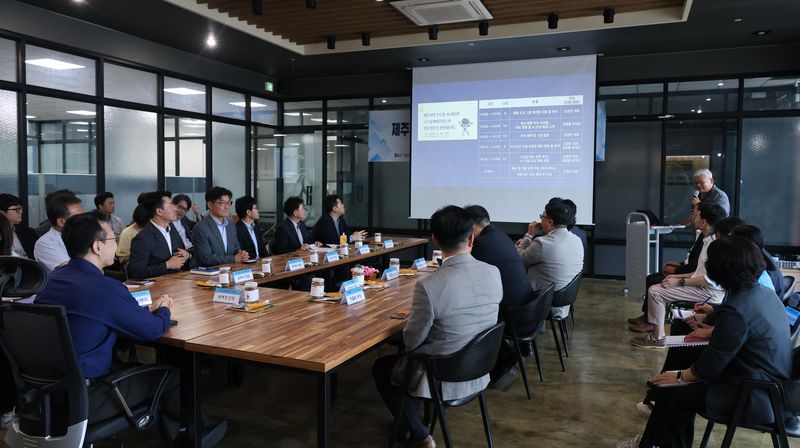
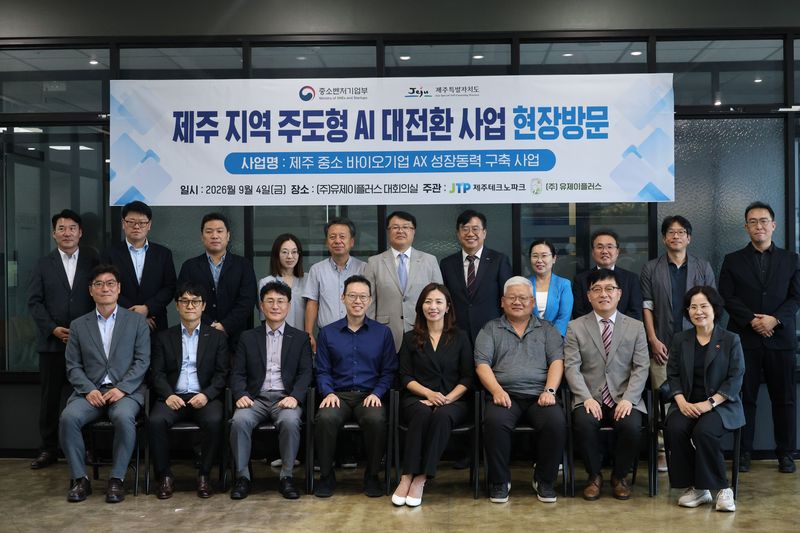
According to Jeju Special Self-Governing Province and Jeju Technopark on the 7th, the Ministry of SMEs and Startups’ Small Business AI Diffusion Task Force visited Jeju Technopark and UJ Plus on the 4th to review the progress of the “Jeju Small and Medium-Sized Biotech Companies’ AX Growth-Engine Project” and the companies’ on-site outcomes.
AX stands for AI transformation and refers to changing existing processes by applying artificial intelligence to companies’ production, research, and business operations. Jeju was selected last year as a support region for the Ministry of SMEs and Startups’ “Region-Led AI Transformation” project and is expanding AI use among small and medium-sized enterprises, with a focus on the biotech industry.
A total of 31 companies are eligible for support this year: 12 for AI solution adoption, three for production-system upgrades, six for proof-of-concept (PoC) projects, and 10 for AI dubbing. The province is also pursuing the construction of a biotech-focused AI data center so companies can jointly use high-performance computing resources that would be difficult to secure individually.
On-site outcomes are also beginning to emerge in concrete figures. UJ Plus introduced a solution that analyzes the condition of raw citrus materials with AI and recommends suitable conditions for the drying process. According to the company’s demonstration results, normal-material classification accuracy rose 15 percentage points, from 70% to 85%.
The detection rate for materials unsuitable for input into the production line reached 100%. In food manufacturing, variations in the size, moisture content, and quality of raw materials can affect drying time and the quality of finished products. The demonstration’s key finding is that combining AI analysis with the sorting and processing-condition decisions previously based on workers’ visual inspections and experience can reduce quality variations and the use of defective materials.
At a meeting that day, the Ministry of SMEs and Startups, Jeju Province, and Jeju Technopark also discussed follow-up support measures to ensure that initial technology adoption leads to actual productivity improvements and commercialization rather than ending as a one-time demonstration.
Jeju’s decision to make the biotech sector a major target of its AI transformation is rooted in the region’s industrial base, including food, cosmetics, and natural products. Data accumulated from raw-material production through processing and quality control can be combined with AI, creating significant potential for improving processes at small and medium-sized manufacturing companies.
The Ministry of SMEs and Startups’ Region-Led AI Transformation Project also focuses on narrowing the gap in AI use between the Seoul metropolitan area and other regions, as well as between large enterprises and small and medium-sized companies. In Jeju, the project is being implemented by combining AI adoption at biotech companies with the construction of shared infrastructure to create a region-wide demonstration model.
Kwak Jae-kyung, head of the Ministry of SMEs and Startups’ Small Business AI Diffusion Task Force, said, “It is important to support regional small and medium-sized companies so they can apply AI in real industrial settings and produce results. We will provide the necessary support so that on-site needs are reflected in follow-up policies.”
Jang Cheol-won, Director of the Future Industries Bureau of Jeju Province, said, “We will strengthen support tailored to each company’s on-site needs so that AI adoption leads to higher productivity and competitiveness for biotech companies.”
Yong-Hwan Jung, acting president of Jeju Technopark, stated, “We will carry out the construction of AI infrastructure and customized support for each company without disruption, ensuring that AI transformation at Jeju’s small and medium-sized companies leads to tangible business results.”
Kim Kyung-eun, CEO of UJ Plus, said, “Based on the data accumulated in the field, we will develop a concrete AX model that can be applied to Jeju’s food manufacturing industry.”
The key measure of future success will be changes on the ground, rather than the number of companies receiving support. The remaining task is to quantify how much AI adoption at the 31 companies reduces production time, defect rates, and costs, and how effectively it leads to increased sales and new businesses.
[email protected] Yongbok Jeong Reporter