[Exclusive] Seoul Electric-Bicycle Accidents Triple in Four Years; Average Age of Those Involved Falls by Seven Years
- Input
- 2026-09-07 15:55:12
- Updated
- 2026-09-07 15:55:12
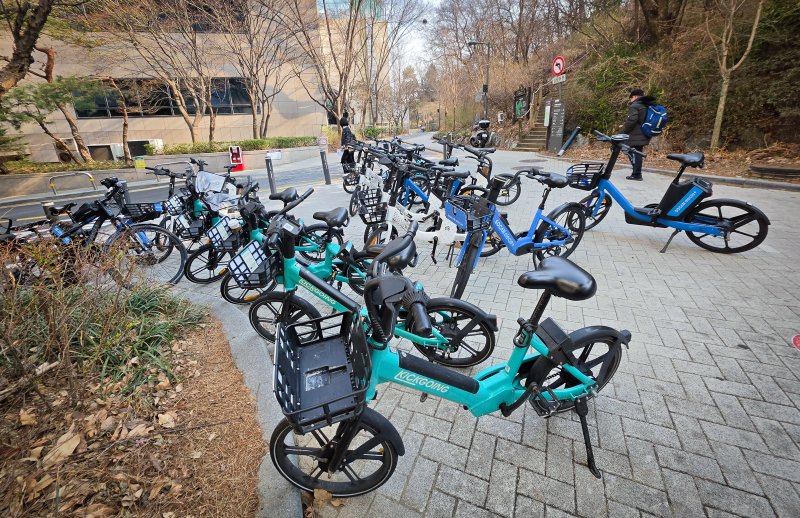
[Financial News] The number of electric bicycles in Seoul has risen sharply, and related traffic accidents have more than tripled in four years. Electric bicycles with distinctly different operating methods, such as pedal-assist (PAS) and throttle systems, are subject to different regulations. However, because they are difficult to distinguish by appearance, experts say the safety-management system needs to be overhauled.
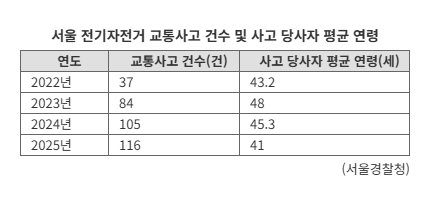
According to data provided to Financial News by the Seoul Metropolitan Police Agency on the 7th, the number of electric-bicycle traffic accidents in Seoul rose from 37 in 2022 to 84 in 2023, 105 in 2024 and 116 in 2025. The number of accidents more than tripled in four years.
The average age of those involved in the accidents is also falling rapidly. The average age declined from 48 in 2023 to 45.3 in 2024 and 41 in 2025. In just three years, the average age fell by seven years, suggesting that electric bicycles are rapidly spreading among younger users.
Song Tae-jin, a professor in the Department of Urban Engineering at Chungbuk National University (CBNU), explained, "As the use of new forms of transportation, including electric bicycles, increases, the risk of accidents may also rise." He added, "Although the dangers of electric kickboards have received attention, there is no reason to view electric bicycles differently when it comes to safety issues."
The number of electric bicycles in Seoul is indeed growing rapidly. According to the Seoul Metropolitan Government, the number increased from 5,230 in 2022 to 52,605 as of June this year—nearly ten times the previous figure.
Although electric bicycles are becoming increasingly widespread, concerns are growing that the safety-management system has failed to keep pace. Under the PAS system, in which the motor operates only when the rider pedals, a bicycle is classified as such if it meets certain requirements. By contrast, throttle-operated bicycles, which can be ridden using only an accelerator, and bicycles combining PAS and throttle systems are classified as personal mobility devices (PMs). The safety standards and regulations differ depending on the operating method, but the systems are difficult to distinguish by appearance alone. As a result, experts say blind spots are emerging in on-site enforcement and safety management.
Ko Jun-ho, a professor at Hanyang University’s Graduate School of Urban Studies, said, "If PAS and throttle systems cannot be easily distinguished by appearance, institutional measures are needed to identify them." He added, "We need to consider ways to distinguish them so that their operating methods can be checked immediately in the field and used for enforcement."
Some also argue that more fundamental measures—including safety education and speed management—must accompany enforcement. Eui Soo Kim, a professor in the Department of Safety Engineering at Korea National University of Transportation, emphasized, "Simply stressing the use of helmets and protective equipment has limitations." He continued, "Along with safety education on the risks of electric bicycles and sudden braking and sharp steering, engineering measures such as speed limits should also be implemented."
[email protected] Lee Dong-hyuk Reporter