Kim Sang-wook actively supports the consolidation of public institutions... "Opposes political squandering"
- Input
- 2026-09-07 15:24:10
- Updated
- 2026-09-07 15:24:10
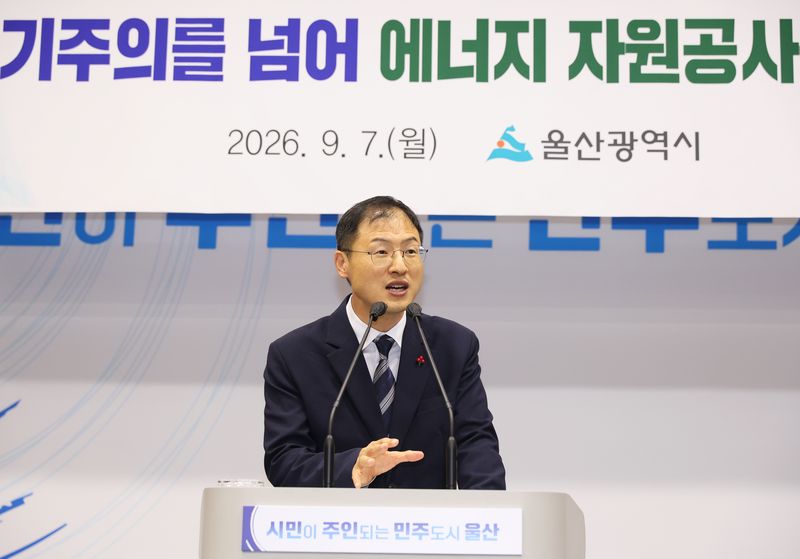
[Financial News Ulsan = Reporter Choi Su-sang] Ulsan Mayor Kim Sang-wook expressed a strong determination to attract the integrated headquarters of Korea National Oil Corporation and Korea Gas Corporation (tentatively named Korea Energy Resources Corporation) to Ulsan, in line with the government's plan for the functional reform of public institutions.
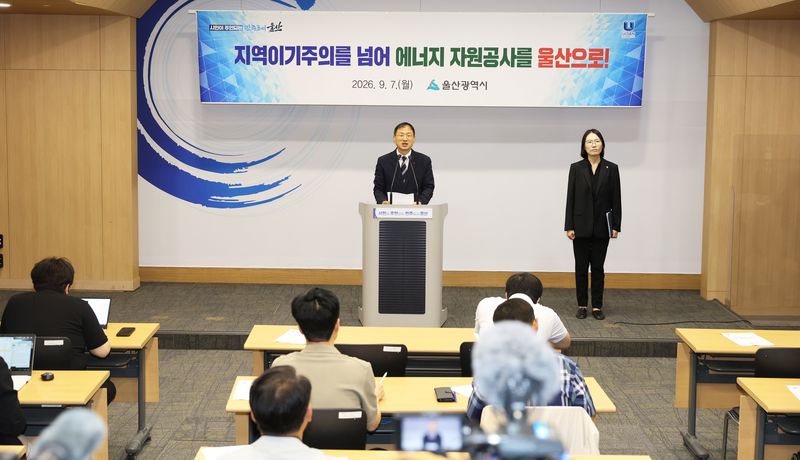
Mayor Kim announced a statement containing these details at the Ulsan City Hall Press Center at 1:30 p.m. on the 7th, emphasizing that if Ulsan is developed into a 'Northeast Asia Energy Hub' where traditional and future energy are fused, South Korea's energy security and energy efficiency will be maximized.
■ "Relocation of Public Institutions Must Exclude Political Considerations and Focus on 'Efficiency and Function'"
First, Mayor Kim expressed his strong support for the "Plan to Promote Functional Reform of Public Institutions" announced by the government on the 3rd, stating that it is "a measure to improve inefficiency caused by the proliferation of unnecessary public institutions and the distribution of positions based on favoritism."
However, Mayor Kim made it clear that the core of public institution reform must be 'functional reform,' just as the name suggests.
He emphasized, "Political considerations conscious of population size or votes, regional selfishness, and placement based on a 'sharing the spoils' mentality will become a disease of the entire Republic of Korea," adding, "The only criterion for judgment must be where to place them to benefit the entire nation—that is, 'strengthening functions through agglomeration.'"
He added that he would actively support and participate in the specialized strategies based on the strengths of other local governments, such as the concentration of marine-related functions in Busan, the fostering of semiconductor production bases in Gwangju, the development of science and technology R&D centers in Daejeon, and transportation and logistics centers in Daegu, and appealed, “Please concentrate energy-related public institutions and functions, such as the Korea Energy Resources Corporation, in Ulsan so that it can be reborn as a ‘Northeast Asia Energy Hub.’”
■ From oil to hydrogen... Strengths of a world-class, complete energy ecosystem
Regarding Ulsan's competitiveness and the background of the bid, Mayor Kim emphasized, "We already possess an energy infrastructure with a complete structure rarely seen globally."
Ulsan Port is South Korea's largest and the world's fourth-largest liquid logistics port, handling massive quantities of oil and liquefied natural gas (LNG). Along with Korea National Oil Corporation's 16.8 million-barrel oil storage facility, the Korea Energy Terminal (KET) in the North Port is in commercial operation, and world-class national petrochemical industrial complexes, including S-OIL and SK Energy, are concentrated in the area. In particular, S-OIL is preparing for the commissioning of the 'Shahin Project,' a large-scale petrochemical business worth 9.258 trillion won, at the end of this year.
Ulsan is also the fastest in transitioning to a future clean energy ecosystem. It is pursuing the world's largest floating offshore wind power project and possesses the nation's largest hydrogen pipeline network, spanning 198 km to directly connect industrial facilities with charging stations. Furthermore, the world's first hydrogen terminal with an annual capacity of 320,000 tons is being constructed at Ulsan Buksin Port with a target completion date of 2030. Global companies are also concentrating their future energy R&D and investments in Ulsan, including Hyundai Motor Company's construction of a new hydrogen fuel cell plant (targeted for completion in 2027) and HD Hyundai Heavy Industries' development of hydrogen engines for ships.
■ "KOGAS should not absorb KNOC... Future-oriented integration is needed"
Mayor Kim also voiced caution regarding the theory of absorption integration centered on large public enterprises, which has been raised in some quarters.
He pointed out, "If you compare the past and present scales of Korea Gas Corporation (assets of 53 trillion won) and Korea National Oil Corporation (assets of 19 trillion won), Korea Gas Corporation appears like a dinosaur, but a merger in which Korea Gas Corporation simply absorbs Korea National Oil Corporation does not help strengthen future-oriented functions." The implication is that the purpose of the merger into the Korea Energy Resources Corporation must be thoroughly focused on strengthening future-oriented functions and enhancing efficiency for the public.
This is interpreted as emphasizing that if the Korea National Oil Corporation is merged and the entity remains in place based solely on the current scale of the Korea Gas Corporation in Daegu, the government's commitment to reforming the functions of public institutions could be diminished.
Finally, Mayor Kim appealed, "If the centralization of energy institutions in Ulsan fails due to regional power-sharing, the losses will spread to the entire Republic of Korea," adding, "I ask the citizens of Ulsan, local politicians, cities and provinces nationwide, and the government to join forces to foster Ulsan into a Northeast Asian energy hub based solely on the criteria of function, efficiency, and the interest of the people."
[email protected] Choi Su-sang Reporter