Kim Min-seok’s “Zero-Point Shift” Gets Underway with Mega-Special Zone Law
- Input
- 2026-09-07 14:42:05
- Updated
- 2026-09-07 14:42:05
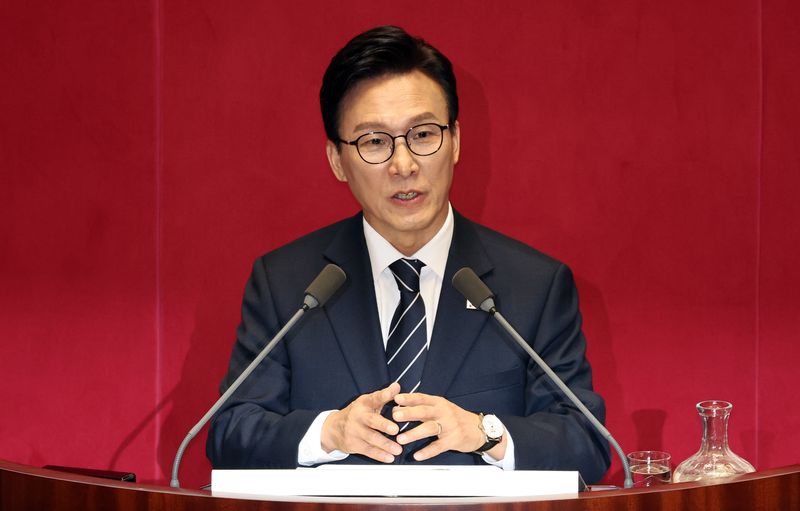
In his floor speech at the National Assembly of the Republic of Korea that day, Kim designated the Mega-special zone law as the top legislative priority of this regular session. The law is legislation supporting the three major mega-projects ambitiously prepared by the Lee Jae-myung administration. Its key provision is to offer companies investing in designated mega-special zones not only financial, tax, and infrastructure support, but also special labor-flexibility measures such as the so-called “white-collar exemption.”
Labor groups are expected to oppose the Mega-special zone law, yet Kim has made it his top priority. This marks a notable departure from the Democratic Party of Korea’s traditionally pro-labor stance. Kim also stressed that the government would establish a consultative body involving the National Assembly of the Republic of Korea, businesses, and labor groups to ease opposition from organized labor. Rather than simply repeating the policies pursued so far, his remarks suggest an intention to combine policy flexibility with an approach suited to changing times.
Kim also said, “The painful reality of the Republic of Korea since democratization is a winner-takes-all, divided society,” adding, “We must move beyond industrialization and democratization toward a society of dignity. A ‘basic society’ that guarantees all citizens a dignified life is the way forward for us.” He emphasized the need for a basic society on the assumption that job displacement and other changes will become widespread as artificial intelligence develops. This, too, is interpreted as part of Kim’s zero-point shift.
Kim also pointed to the need to revise the country’s diplomatic strategy in response to geopolitical changes. First, he suggested that North Korea’s advocacy of the “theory of two hostile states” should instead be used to promote peaceful coexistence. His proposal takes into account the fact that the international community has effectively regarded the Republic of Korea and North Korea as separate states, as well as North Korea’s current circumstances ahead of its fourth-generation succession.
Regarding relations with the United States, Kim predicted that the Republic of Korea could expand its leading role in the world by leveraging key industries such as semiconductors and shipbuilding, at a time when the U.S.-led global order is being shaken. He also said that Japan and the Republic of Korea should strengthen their cooperative relationship while resolving historical issues.
Kim also signaled his intention to pursue constitutional reform, which has made little progress in political circles. He plans to begin by including the spirit of the Gwangju Uprising and the Busan–Masan Uprising in the Constitution’s preamble. For the central and most contentious issue—constitutional reform concerning the structure of government power—he said the public’s views would be reflected.
Although Kim’s zero-point shift appears to be getting underway across various areas, some analysts say the outlook is far from bright. As noted above, the labor-flexibility provisions in the Mega-special zone law must overcome opposition from labor groups. The “basic society” policy is also expected to face opposition from the People Power Party. If the agenda expands to constitutional reform concerning the power structure, the People Power Party is highly likely to oppose that as well. Revising diplomatic strategy is also expected to be difficult given the dynamics of international relations. Ultimately, attention is focused on whether Kim can overcome all these obstacles.
[email protected] Kim Hyeong-gu Reporter