Yen Surges ¥5 in Three Days as Speculation Grows That Era of Extreme Yen Weakness Is Ending; ¥150 to the Dollar Also Discussed
- Input
- 2026-09-07 15:10:16
- Updated
- 2026-09-07 15:10:16

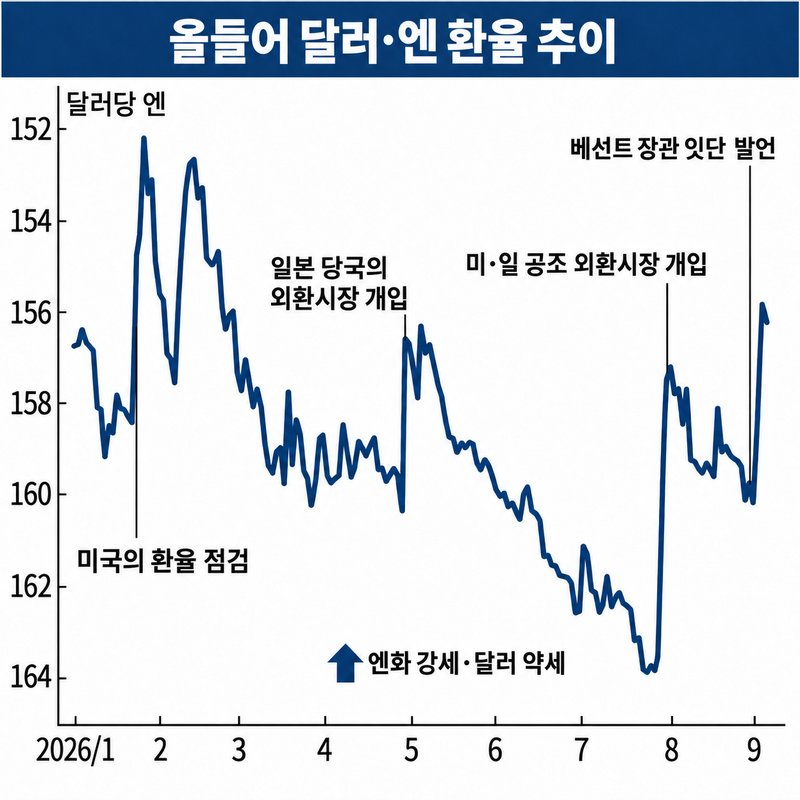
【Financial News, Tokyo = Correspondent Hye-jin Seo】The yen has risen by more than ¥5 against the dollar in just three days, fueling speculation that the five-year period of extreme yen weakness may be reaching a turning point. The move came after U.S. Treasury Secretary Scott Bessent publicly urged Japan to correct the yen’s weakness and end its reflationary policy, while expectations of a Bank of Japan (BOJ) rate hike also grew. Expectations for a stronger yen have increased, but relations between the United States and Japan over fiscal and monetary policy are now on a knife edge.
In Tokyo’s foreign exchange market on the 7th, the dollar-yen exchange rate stood at 155.83–155.85 yen per dollar as of 3 p.m., down 0.46 yen from the end of the previous week. The rate fell from the low 160-yen range on the 2nd to the low 155-yen range on the morning of the 4th, sending the yen up by more than ¥5 in three days. The yen continued to strengthen that day.
The yen fell to around 164 yen per dollar in July, approaching its lowest level in about 40 years. However, yen selling was curbed this month as the United States stepped up pressure on Japan to correct the yen’s weakness and BOJ officials successively mentioned the possibility of a rate hike.
After a meeting of Group of Twenty (G20) finance ministers and central bank governors on the 1st local time, Bessent said, "Japan achieved great success with Abenomics, so it should now stop its reflationary policy." Reflation is a policy that combines fiscal expansion and monetary easing to escape deflation.
U.S. pressure is expanding beyond BOJ monetary policy to the proactive fiscal policy of the Sanae Takaichi administration. Japan’s initial general-account budget request for fiscal 2027 totaled ¥143 trillion, marking a record high for the fourth consecutive year.
Concerns are also growing that Japanese institutional investors could sell U.S. Treasuries and shift funds into domestic government bonds as Japan’s long-term interest rates rise to the 3% range for the first time in 30 years. This could push up U.S. Treasury yields and borrowing costs for the United States, which carries national debt of $40 trillion. The Nikkei assessed that "fiscal issues have been added to the U.S. agenda toward Japan following joint intervention in the foreign exchange market," adding that "the close relationship between U.S. and Japanese authorities is on a knife edge."
As expectations grow that the U.S.-Japan interest-rate gap will narrow, the possibility of an unwinding of yen carry trades is also increasing. According to the Commodity Futures Trading Commission (CFTC), hedge funds’ net short yen position stood at 102,188 contracts on the 1st, worth approximately ¥1.2 trillion, up 33% from the previous week. If these positions are unwound all at once, yen buying could intensify further.
The cost Japan has paid to defend against extreme yen weakness has also risen to a record level. Foreign exchange reserves released by Japan’s Ministry of Finance that day stood at $1.2075 trillion at the end of August, down 6.2% from a month earlier. It was the largest decline since statistical revisions in April 2000, while the $79.5 billion decrease was also the largest on record.
Japan’s government and the BOJ spent a record ¥15.3993 trillion on yen-buying intervention carried out with the United States at the end of July. Foreign securities, including U.S. Treasuries, declined by $87.7 billion among Japan’s foreign exchange reserves, prompting speculation that Japan may have used proceeds from selling U.S. Treasuries to fund the intervention.
Markets are watching the U.S. Consumer Price Index (CPI) for August, due to be released on the 11th. If the increase comes in below expectations, the dollar-yen exchange rate could fall below 155 yen and decline to the low 150-yen range, analysts forecast. However, resilient U.S. employment and rising international oil prices could limit the yen’s gains.
[email protected] Hye-jin Seo Reporter