Kakao Mobility CEO Alex Ryu: "Commercialization Tailored to Urban Environments Is Key to Autonomous Driving"
- Input
- 2026-09-07 14:21:46
- Updated
- 2026-09-07 14:21:46
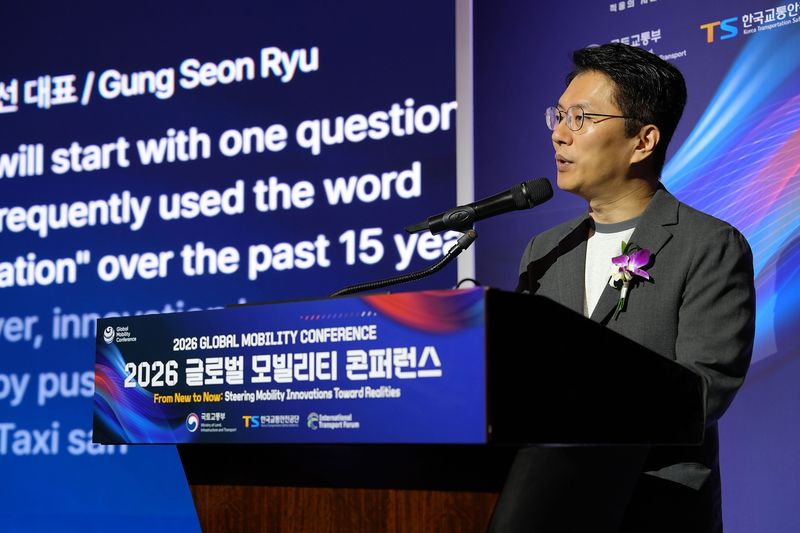
[Financial News] Kakao Mobility CEO Alex Ryu emphasized that the key to autonomous driving is commercialization tailored to urban environments. He also proposed that an autonomous-driving ecosystem involving technology companies, manufacturers, public-sector organizations and academia should be designed as soon as possible.
On the 7th, Alex Ryu delivered a keynote speech at the 2026 Global Mobility Conference on the theme "Bringing Autonomous-Driving Technology into Everyday Mobility." He said the industry must look beyond perfecting autonomous-driving technology and consider how it can become part of daily life. The conference was jointly hosted by the Ministry of Land, Infrastructure and Transport (MOLIT), the Korea Transportation Safety Authority and the International Transport Forum (ITF) under the Organisation for Economic Co-operation and Development (OECD). Kakao Mobility, Waymo and NVIDIA also took the stage for keynote speeches, presenting their visions for the future of mobility.
Alex Ryu stressed that commercializing autonomous driving cannot be achieved simply by introducing the technology into existing modes of transportation. He said the effort must expand across three stages: driving technology, services and urban infrastructure. "New technology should not belong exclusively to a select few; it must serve all users, and it should reach people directly in their everyday lives," he said.
Kakao Mobility plans to make autonomous driving part of everyday life by leveraging not only its proprietary driving technology but also its operational capabilities, built through 24-hour uninterrupted services. In fact, 97% of users of the late-night autonomous-driving service in Gangnam encountered the service through the existing Kakao T interface without installing a separate app. The vehicle utilization rate was also found to be 82.5%.
Alex Ryu emphasized that commercializing autonomous driving represents a major transformation involving urban infrastructure, users’ daily lives, the transportation ecosystem and vehicles. Just as roads, traffic lights and crosswalks emerged when transportation shifted from walking and horse-drawn carriages to automobiles, autonomous driving will also require changes to urban-space design and social infrastructure. "Even with the same technology, a change in the city presents a different 10 percent of challenges," he said. He added, "The evaluation standard for autonomous-driving services must shift from how well a single vehicle drives to how hundreds of vehicles can be operated within a city."
Alex Ryu introduced the trend in global leading markets, where the entire industrial structure is being reshaped beyond vehicle manufacturing and driving technology.
Kakao Mobility has directly developed autonomous-driving technology and operated vehicles while internalizing key capabilities, including high-definition maps, simulators, traffic-control systems and an integrated AI model. The company aims to build concrete collaboration models across the ecosystem with automakers, parts suppliers, public-sector organizations, local governments and academia. Its efforts include defining service-specific vehicles, stabilizing supply chains, establishing route and safety standards, and verifying end-to-end mobility completion rates.
"Autonomous vehicles drive on their own, but autonomous-driving services must be created together," Alex Ryu said. "Building on more than a decade of experience developing mobility technologies and operating platforms, we will contribute through public-private cooperation to creating a sustainable ecosystem in which autonomous driving becomes an everyday transportation service."
[email protected] Jang Min-kwon Reporter