Miral Welfare Foundation: "Employment of Artists with Developmental Disabilities Creates 3.3 Billion Won in Social Value"
- Input
- 2026-09-07 14:39:48
- Updated
- 2026-09-07 14:39:48
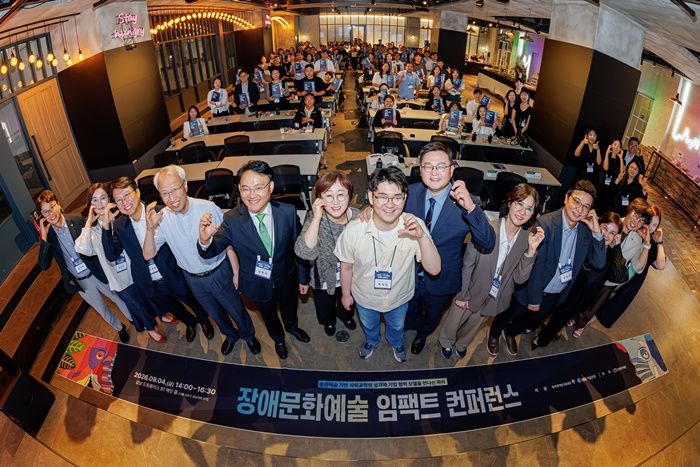
According to Miral Welfare Foundation on the 7th, approximately 100 people, including corporate representatives responsible for ESG (environmental, social, and governance), social contribution, and human resources, attended the 2026 Disability Culture and Arts Impact Conference held on the 4th at Gangnam Dream Plus in Seocho-gu, Seoul. The event was hosted by the foundation and supported by the Korea Employment Agency for Persons with Disabilities (KEAD) and Industrial Bank of Korea.
The 2026 Miral Welfare Foundation Social Value Report introduced at the event used methodologies including social return on investment (SROI) to convert into monetary value the changes the programs brought about for beneficiaries, their families, and local communities.
According to the report, the employment linkage program for artists with developmental disabilities, conducted from November 2023 through December 2025, invested 75 million won and was measured to have created approximately 3.33451 billion won in social value. In other words, approximately 44 won in value was generated for every 1 won invested. However, social value is a monetary conversion of a program’s effects and is distinct from accounting revenue.
Of this amount, the effects of generating earned income and establishing a foundation for economic independence totaled approximately 3.18 billion won, accounting for about 95% of the total. Other outcomes included greater social participation and sense of belonging through workplace life, reduced psychological burdens on families, the expansion of inclusive corporate cultures, and lower public job-support costs.
The culture and arts education program conducted from 2012 through 2025 invested approximately 4.8 billion won and created approximately 13.3 billion won in social value. The disability awareness improvement program was also found to have generated approximately 165.4 billion won in social value.
At the event, experts in business, education, and employment presented cooperation cases linking the discovery, development, and employment of artists with developmental disabilities. Bridge On Ensemble, affiliated with the foundation, performed classical music, while works by artists from Bridge On Arte were also exhibited.
Miral Welfare Foundation plans to connect companies seeking to employ people with disabilities with artists suited to their organizational size, work environment, and hiring needs. It will also support their creative activities and stable employment after hiring.
Jeong Gyu-tae, director of the Miral Culture and Arts Center, said, "We will work with companies to develop a new cooperation model that connects the discovery and development of artists with developmental disabilities to employment through the medium of culture and the arts."
[email protected] Insuh Jang Reporter