Structurally Challenged SSM Sector Seeks Growth Through One-Hour Quick Commerce
- Input
- 2026-09-07 14:55:46
- Updated
- 2026-09-07 14:55:46
[Financial News] The super supermarket (SSM) sector, facing a structural crisis amid the downturn in offline retail, is seeking a growth breakthrough through quick commerce. The strategy is to use its dense network of urban stores as delivery hubs and capture demand for nearby grocery shopping.
According to the Ministry of Trade, Industry and Energy on the 7th, SSM sales declined year on year for eight consecutive months from December last year through July this year. Sales fell 8.0% in May and 10.8% in June, followed by a 2.9% decline in July. The increase in grocery-shopping demand through summer delivery services during this year's heat wave also had a significant impact.
SSM companies are choosing to offset declining offline sales with quick commerce. Because their stores are closer to residential areas than hypermarkets, they can quickly deliver fresh food and daily necessities. The companies are using existing stores not merely as retail spaces but as urban logistics hubs, seeking to make up for fewer in-store customers with delivery revenue.
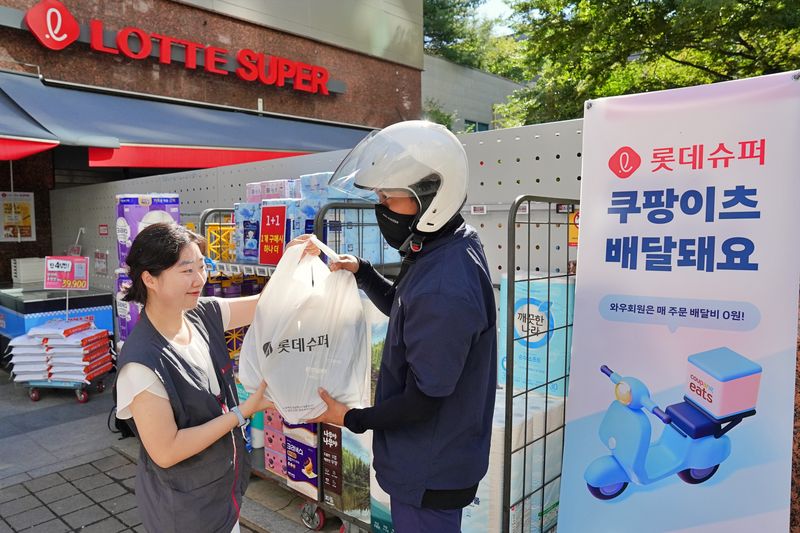
Starting today, Lotte Super launched a quick-commerce service in partnership with Coupang Eats at more than 170 stores nationwide. Lotte Super previously introduced its own “One-Hour Immediate Delivery” service through its app in 2020, but ended operations during its integration with Lotte Mart in 2023. Through its partnership with Coupang Eats, it has reentered the instant-delivery market.
Under Lotte Super's quick-commerce model, customers order products through the Coupang Eats app, after which store employees pick the items and delivery workers bring them to customers. Although delivery times vary by distance, the service aims to deliver orders in about one hour. The company said it is also targeting small-quantity purchases by one- and two-person households by setting the minimum order amount at 15,000 won.
GS The Fresh is also developing quick commerce as a key growth engine. It is strengthening one-hour grocery delivery through its own mobile app, Our Neighborhood GS, as well as Baedal Minjok, Coupang Eats, Yogiyo, and Naver's grocery-shopping service. From January 1 through September 6 this year, GS The Fresh's quick-commerce sales increased 46.7% from the same period a year earlier. In the second quarter, quick commerce accounted for 9.9% of total sales, the highest level on record.
Fresh food is particularly strong in quick-commerce orders. Fresh food accounted for 45% of GS The Fresh's quick-commerce sales in the first half of this year. The company said it is also improving store operating efficiency by offering agricultural, livestock, and seafood products in small packages and increasing the supply of preprocessed items.
Emart Everyday has also operated quick commerce since 2022. Its quick-commerce sales rose 52.2% year on year in the first half of this year. The service offers up to about 7,000 products through its own online mall, e-mile, as well as Baedal Minjok, Coupang Eats, Naver Shopping's grocery service, and Yogiyo. The company said this has expanded its core catchment area from a radius of about 500 meters around each store to as far as 4 km.
Industry observers expect competition in SSM quick commerce to intensify further. An industry official added, “SSMs are an attractive option in the quick-commerce industry because they can source fresh food from nearby. Delivery platforms can strengthen their grocery-delivery competitiveness by leveraging dense store networks and broad product assortments, while SSMs can improve both customer convenience and store competitiveness.”
[email protected] Kim Hyun-ji Reporter