Yeo In-hyung: "The 'ᄌ' in 'ᄌᄐᄇᄉ' refers to Kang Ho-pil... Everyone opposed martial law"
- Input
- 2026-09-07 16:49:14
- Updated
- 2026-09-07 16:49:14
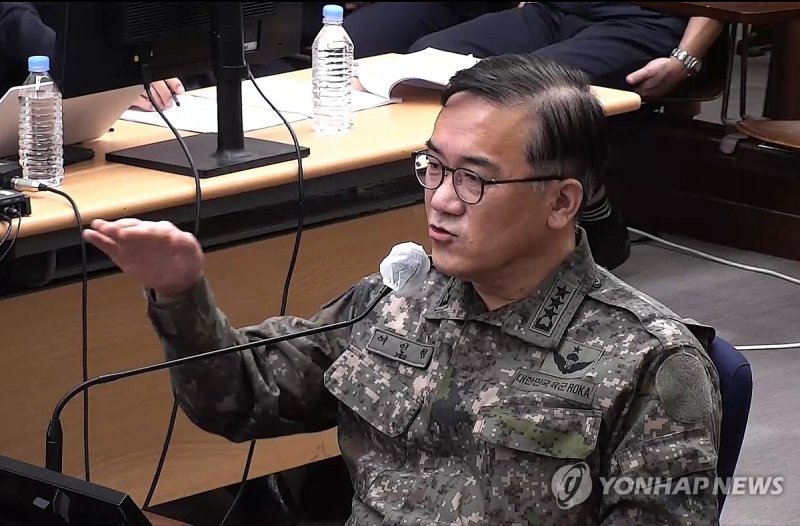
[Financial News] Yeo In-hyung, former commander of the Defense Counterintelligence Command (DCC), who is accused of helping plan the December 3 Martial Law in advance, identified the “ᄌ” in the memo “ᄌ·ᄐ·ᄇ·ᄉ”—a key piece of evidence—as then-Ground Operations Commander Kang Ho-pil.
Regarding the memo, Yeo said that its author had directly identified the person in question, amid differing interpretations: the Special Prosecutor’s Team for Insurrection, led by Special Prosecutor Cho Eun-seok, viewed it as referring to the Defense Intelligence Commander, while the special counsel team led by Special Prosecutor Kwon Chang-young interpreted it as referring to the Ground Operations Commander. Yeo maintained, however, that the memo was closer to an expression of opposition to martial law by the military leadership and that there had been no prior planning.
The Seoul High Court’s Criminal Division 12-1 held the 15th hearing in the appeals trial of former President Yoon Suk Yeol and former Minister of National Defense Kim Yong-hyun on the 7th. It questioned Yeo as a witness, focusing on the nature of cellphone notes he wrote on November 5, 2024, about a month before martial law: “the common opinion of ᄌ·ᄐ·ᄉ·ᄇ” and “ᄋ cannot be trusted.”
Based on when and in what context the memo was written, the Special Prosecutor’s Team for Insurrection identified “ᄌ” as Roh Sang-won, former commander of the Defense Intelligence Command. It argued that four commanders had decided in advance to impose martial law while excluding Army Chief of Staff Park An-su (ᄋ). The special counsel team, meanwhile, had identified “ᄌ” as former Ground Operations Commander Kang Ho-pil and indicted him on charges of participating in the insurrection.
In court, Yeo said, “It is an absurd misjudgment for the first-instance ruling to have concluded that ᄌ was Roh Sang-won. The symbol ‘ᄌ’ appears four times in the November 5 memo. Why should one ‘ᄌ’ in the same memo refer to Roh Sang-won while another refers to Kang Ho-pil?” In doing so, he accepted the special counsel team’s interpretation.
He rejected, however, the special counsel’s argument that Kang Ho-pil had participated in the alleged plot. Yeo stressed, “General Kang Ho-pil was someone who vehemently opposed martial law, even saying he was prepared to take off his uniform over it. After the parliamentary audit, the commanders of the Ground Operations Command, Special Warfare Command, Capital Defense Command and DCC were all utterly fed up with talk of martial law. I simply wrote down a fragment expressing the idea that ‘no one among the military leadership supports it.’” He explained that phrases such as “common opinion” and “preparedness” formed an ironic memo pointing to the military’s practical limitations, rather than an indication that martial law would be carried out.
He also explained the meetings prosecutors had identified as dates for prior planning. Regarding the November 9 dinner at the Hannam-dong Presidential Residence, he said, “Former President Yoon suddenly came downstairs wearing shorts and slippers, and it was a relaxed gathering where he exchanged pleasantries with the Ground Operations Commander by video call.” As for his activities on November 30, which the court ruled involved five hours of planning for martial law, he testified, “I spent a little over an hour giving the president an in-person briefing on the Chinese drone espionage case uncovered at the Busan Naval Operations Command. After that, I simply received 100,000 won from former Minister Kim to cover the meal before going on leave.”
Yeo drew a line under the allegation that he had helped plan the operation in advance, saying, “I never imagined that something like the actual December 3 Martial Law would erupt without anyone knowing. None of the soldiers knew.” He also maintained that the personnel changes affecting roughly half of the DCC’s lieutenant colonels and colonels in late November, shortly before martial law, were inconsistent with preparations for an emergency martial-law operation.
The special counsel team indicted former Commander Kang Ho-pil without detention on the 14th of last month on charges of performing a key role in an insurrection. Yeo was sent to trial on charges including deploying troops to the National Assembly and the National Election Commission (NEC) and forming and operating teams to arrest politicians during the December 3 Martial Law. The court is scheduled to issue its first-instance ruling on the 21st.
[email protected] Chang-hoon Lee Reporter