Geun-sik Chung’s Seoul education pledges elaborated into 5 major areas, 15 promises, and 50 tasks
- Input
- 2026-09-07 12:00:00
- Updated
- 2026-09-07 12:00:00
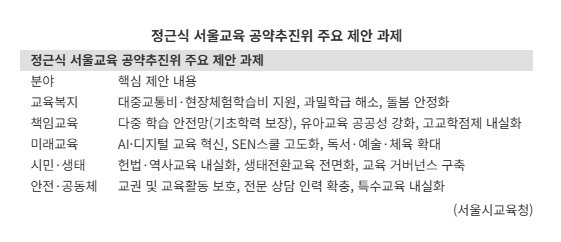
[Financial News] The direction for implementing Seoul Superintendent of Education Geun-sik Chung's campaign pledges has been concretized into five major areas, 15 promises, and 50 detailed tasks. The Seoul Metropolitan Office of Education (SMOE) announced on the 7th that it received a white paper containing the direction and proposals for the pledge implementation from the 'Seoul Education Committee for Happy Learning,' the committee for promoting the pledges of the 24th Superintendent of Education.
This white paper is the result of reviewing the vision and policy direction of Seoul education based on the opinions of students, faculty, parents, and citizens. The committee reviewed the practical relevance and feasibility of the pledges and proposed a direction for their implementation consisting of five major areas, 15 promises, and 50 detailed tasks.
The plan also includes educational welfare tasks that students and parents can experience firsthand. Representative examples include guaranteeing the right to educational mobility through support for students' public transportation costs, providing financial support for field trips for elementary and middle school students, and continuing free high school education. Proposals were also made to reduce the number of students per class, resolve overcrowded classrooms, and expand support for students with immigrant backgrounds and out-of-school youth.
The plan also includes measures to stabilize after-school programs and childcare, as well as to resolve issues regarding childcare spaces through collaboration with local communities. In the area of basic academic skills, proposals were presented to establish a responsibility guarantee system, such as a multi-layered learning safety net, and to strengthen the Seoul-style support system for basic academic skills. The plan also includes measures to ensure that students' learning does not stop through early childhood education, the high school credit system, and career and vocational education.
Tasks for future education, including AI and digital education, were also proposed. These include strengthening the capabilities of students and teachers through innovation in AI and digital education, and enhancing the operation of 'SEN School,' a Seoul-style teaching and learning platform. The plan also includes establishing AI and digital learning environments and smart administration, as well as expanding education in reading, discussion, humanities, arts, and physical education.
Democratic citizenship education, ecological transformation education, and school space innovation were also included in the policy direction. The plan involves strengthening constitutional, history, and peace and unification education, reinforcing ecological transformation education, and establishing educational governance involving parents and citizens. Proposals also included protecting educational activities and teachers' rights, strengthening school safety nets, supporting students' mental health, and improving the substance of special and inclusive education.
Not all contents of this white paper represent finalized pledged projects. The Seoul Metropolitan Office of Education plans to determine specific implementation methods for each proposal after comprehensively reviewing the conditions of the school environment and feasibility. The white paper does not present specific budget requirements or funding plans for each task.
The Office of Education plans to hold a grand public forum involving students, teachers, parents, citizens, and experts to share implementation plans for pledges and gather feedback from the field. The new education vision has been set as "Basic Education for All, Happy Cooperative Education," and the education indicators have been finalized as "Start meticulously, build a solid foundation, and grow diversely."
Seoul Superintendent of Education Geun-sik Chung stated, "We will carefully consider the opinions and suggestions of the educational community contained in the white paper, and responsibly fulfill the promises of Seoul education while closely examining the conditions in schools and the feasibility of policies."
[email protected] Kim Man-gi Reporter