Kim Min-seok’s “Reset”: Starting with the Mega Special Zone Act
- Input
- 2026-09-07 11:37:37
- Updated
- 2026-09-07 11:37:37
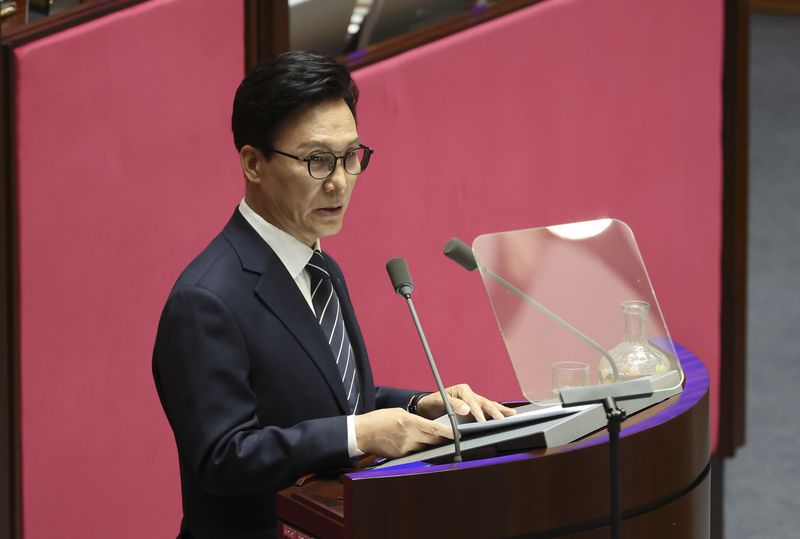
Speaking at the National Assembly that day, Kim said, "We will pass the Mega Special Zone Act as the top legislative priority of this regular session."
The Mega Special Zone Act is legislation designed to support the three ambitious mega-projects prepared by the Lee Jae Myung administration. Its key provisions would grant companies investing in designated mega special zones benefits including financial, tax and infrastructure support, as well as special exemptions for labor flexibility. As the government and businesses work to lay the groundwork for projects such as the Honam Semiconductor Cluster, the National Assembly is also pursuing legislation to support them.
The special provisions on labor flexibility are the central issue, as opposition from labor groups is expected. Kim therefore said, "To realize the three mega-projects, we will pursue a democratic eight-way consultation involving the central government, local governments, the National Assembly, local councils, universities, civil society, businesses and labor groups. The consultation will address ways to enable the voluntary and stable relocation of semiconductor-related workers to local areas and to establish efficient workforce management capable of competing with China and other rival countries."
Beyond the mega-projects, Kim presented various goals and policy directions. He first said, "The painful reality of South Korea since democratization is a winner-takes-all society marked by inequality," adding, "We must move beyond industrialization and democratization toward a society of dignity. A ‘Basic Society,’ which guarantees all citizens a dignified life, is the path we must take." His remarks reinforced President Lee Jae Myung’s signature Basic Society policy.
Kim also argued that the country needs to revise its diplomatic strategies in response to changed relations with North Korea, the United States and Japan.
Regarding relations with North Korea, he said, "It is difficult to agree with Chairman Kim Jong Un’s hostile two-state theory, which dismantled his grandfather President Kim Il Sung’s theory of unification. However, it reflects the international reality in which the two Koreas have effectively been recognized as separate states. Given North Korea’s reality—recovering its economic strength through cooperation with China and Russia and even signaling a fourth-generation succession—we must pool our wisdom to determine whether the two-state theory can be used for peaceful coexistence rather than being completely ignored."
On relations with the United States, he said, "The era of looking only to the United States has passed," emphasizing, "The United States’ overwhelming hegemony has declined, while South Korea’s capacity for self-reliance has grown. South Korea, a semiconductor and shipbuilding powerhouse, is a strategic partner of the United States no less important than Japan." Kim’s central argument was that South Korea should play a leading role in the international community.
Kim also noted that public anger and hostility toward Japan have eased, saying, "A pragmatic view of Japan has grown—protecting what must be protected, whether history or the national interest, while cooperating where cooperation is possible."
He added, "SK Group Chairman Chey Tae-won and Ven. Pomnyun have both proposed Korea-Japan economic cooperation and a Korea-Japan economic community," saying, "We need new imagination in Korea-Japan relations. We must find the wisdom to view Korea-Japan relations from the perspective of protecting both the past and the future."
Aware that public sentiment over real estate had deteriorated, particularly in Seoul, and that support for the party and government was falling, Kim went on to offer proposals on housing policy.
He said, "The fundamental goal of housing policy is to resolve housing problems, beyond stabilizing prices," adding, "We need public discussion on gradually pursuing a ‘Housing New Deal’ that would establish broad-based housing policy governance involving the central government, local governments, stakeholders and experts, while dramatically increasing housing budgets that have relied on funds and development and sales revenue."
He continued, "We also need discussions on high-density and mixed-use development in station areas and semi-industrial zones, including mixed-use development involving facilities such as the Tancheon Water Reclamation Center proposed by the Seoul Metropolitan Government." He added, "We will advance the third-generation new towns at an unprecedented pace so that citizens can feel the results by 2030. We will provide stable support for various policies and supply measures pursued by the government, including quickly breaking ground on land already announced for development."
Kim also said he would pursue the difficult task of constitutional revision despite differences within the political sphere. In particular, he proposed making the inclusion of the Gwangju Democratization Movement and the Busan–Masan Uprising in the Constitution the starting point for constitutional revision, while reflecting public demands in a revision of the power structure.
[email protected] Kim Hyeong-gu Reporter