"With stock markets unsettled, a 3% fixed-term deposit is better"... The era of KRW 1,000 trillion in deposits... Savings-bank rates move 'in reverse'
- Input
- 2026-09-09 21:02:39
- Updated
- 2026-09-09 21:02:39
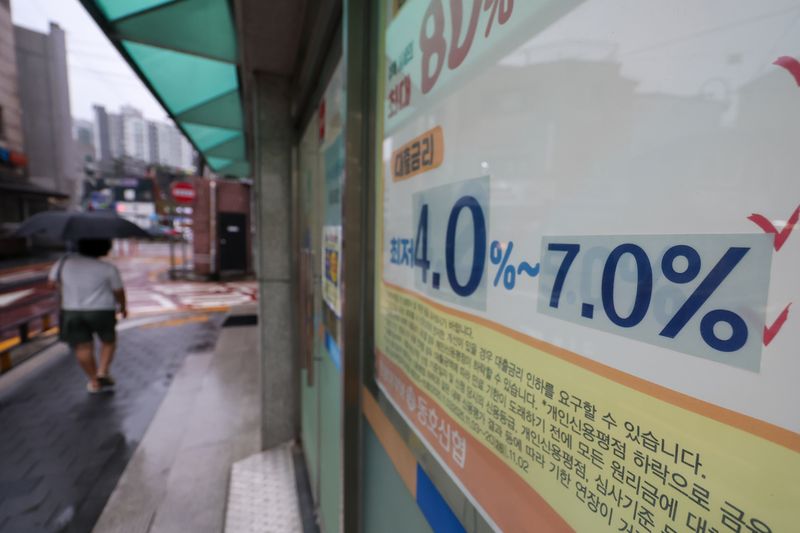
[Financial News] The Bank of Korea (BOK) raised its benchmark rate twice consecutively in July and August, pushing commercial-bank deposit rates into the 3% range. Savings-bank deposit rates, however, are falling due to limited growth in lending assets and other factors. Even during a period of benchmark-rate hikes, deposit-rate trends are diverging across banking sectors depending on funding demand and profitability.
According to the Korea Federation of Banks (KFB) on the 9th, the highest rates for 12-month fixed-term deposits offered by the five major commercial banks—KB Kookmin Bank, Shinhan Bank, Bank of Hope, Woori Bank and Nonghyup Bank—ranged from 3.20% to 3.30% per year.
The highest rates for the flagship fixed-term deposit products of KB Kookmin Bank, Bank of Hope and Woori Bank stood at 3.20% per year. Nonghyup Bank's 'NH All One e-Deposit' offers a base rate of 3.25% per year.
Shinhan Bank's 'Shinhan My Plus Fixed-Term Deposit' has a base rate of 2.55% per year and a maximum rate of 3.30%, the highest among the five major commercial banks. On the 3rd, Shinhan Bank raised the base rates on its major deposit and installment-savings products by 0.20–0.30 percentage points. The 12-month base rate for its flagship 'Sol Convenient Fixed-Term Deposit' rose by 0.25 percentage points to 2.55% per year.
As fixed-term deposit rates rose, large amounts of money flowed into the five major commercial banks' fixed-term deposits last month. Their fixed-term deposit balances reached KRW 1,005.2319 trillion at the end of last month, surpassing KRW 1,000 trillion for the first time. That was an increase of KRW 20.2920 trillion in one month from KRW 984.9399 trillion at the end of July.
Although corporate funds temporarily flowed out of fixed-term deposits this month, balances have remained above KRW 1,000 trillion. As of the 8th, the five banks' fixed-term deposit balances stood at KRW 1,003.3484 trillion, down KRW 1.8835 trillion from the end of the previous month. A commercial-bank official said, "The recent decline in fixed-term deposit balances was caused by the temporary withdrawal of corporate funds rather than individual funds."
Fund inflows into the banking sector are expected to continue for the time being. As stock-market volatility has increased, more funds are waiting to be invested in stable assets. Analysts also say deposit rates could rise further as the possibility of additional benchmark-rate hikes is being discussed.
Savings-bank deposit rates are moving in the opposite direction from the benchmark rate. The average rate for one-year fixed-term deposits at savings banks nationwide fell from 3.95% per year on July 8 to 3.74% per year on the 9th, a decline of 0.21 percentage points in two months. This is because savings-bank deposit rates respond to actual funding needs, including loan demand and liquidity. Savings banks use funds raised through deposits to make loans and earn the interest-rate spread between loans and deposits. If they attract more deposits than they can deploy as loans, their interest expenses may simply increase.
According to the Financial Supervisory Service, total savings-bank lending stood at KRW 95.8 trillion in the first half of this year, up KRW 2.3 trillion from the end of last year. Corporate lending rose 5.0% from KRW 46.2 trillion to KRW 48.5 trillion, while household lending remained roughly unchanged at KRW 39.6 trillion. With household lending stagnating, savings banks have little incentive to raise deposit rates.
Moreover, savings-bank profitability improved in the first half of this year mainly through gains related to securities, which also limited competition for deposits. Of the KRW 508.8 billion increase in net profit, KRW 401.2 billion came from higher securities-related gains. Interest income rose only 0.9%, leading to criticism that savings banks have little room to raise deposit rates.
A financial-sector official said, "Lending is unlikely to increase significantly because of lending regulations, and at present there does not appear to be any special factor that would drive up deposit rates." The official added, "Savings banks could resume competing for deposits if deposit outflows accelerate or loan demand recovers."
[email protected] Lee Hyun-jung, Ye Byung-jung Reporter