Incheon Airport Corporation Says It Will "Prevent Baggage Misclassification at the Source"... Files Patent for 'AI Detection System' with POSCO DX
- Input
- 2026-09-07 10:56:31
- Updated
- 2026-09-07 10:56:31
[Financial News] Incheon International Airport, which has one of the world's highest levels of baggage-handling accuracy, is using artificial intelligence (AI) to build a zero-defect baggage logistics system. The airport plans to use deep-learning technology to identify even subtle exceptional situations in real time—cases that are difficult to detect with the naked eye or existing sensors—and prevent misclassification and damage at the source. The combination of airport infrastructure and industrial AI technology is expected to set a new standard for the global air-cargo logistics network.
Incheon International Airport Corporation announced on the 7th that it had jointly developed an 'AI-based baggage anomaly detection system' with POSCO DX and completed an application for a related patent. Incheon Airport's baggage handling system (BHS) currently maintains a high level of accuracy, with only two bags not loaded per one million pieces of baggage. The introduction of the AI system is part of a technology-upgrade effort aimed at proactively controlling even minor error factors that occur rarely.
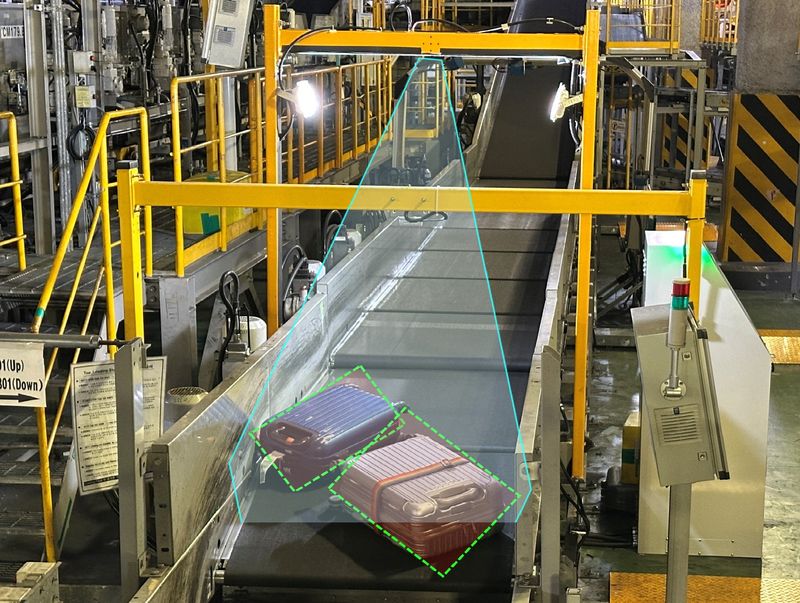
The system is a smart airport solution that uses a deep-learning model to analyze footage captured by vision cameras in real time. The AI has learned extensive data on baggage shapes, sizes, colors and loading patterns, and monitors bags moving at high speed on conveyor belts.
The main targets include 'double loading of baggage,' which interferes with barcode recognition; 'an extended suitcase handle,' which can cause bags to become caught on surrounding facilities; and 'separation of baggage from the tub,' in which a bag becomes detached from its dedicated carrier. When the AI detects an anomaly, the baggage is immediately and automatically diverted to a manual-processing area. An on-site worker then rechecks its condition and takes appropriate safety measures, preventing logistics delays before they occur.
The results of a recent pilot operation at Incheon International Airport Terminal 1 were positive. According to the corporation, the system demonstrated that it could identify 100% of abnormal baggage that could cause system errors or damage during the pilot period. The two companies are also developing an additional detection system dedicated to oversized baggage. Once commercialized, the system is expected to significantly reduce the rate of bags not loaded during the handling of out-of-gauge baggage.
The technology is regarded as a successful example of POSCO DX's intelligent factory expertise, accumulated in industrial settings, being applied to an airport logistics system. Yong-Soo Cho, head of the Operations Division at Incheon International Airport Corporation, said, "By securing unrivaled technological capabilities, we have improved both the accuracy of baggage handling and operational efficiency. We will continue our digital innovation by expanding the application of advanced technologies, including AI and the Internet of Things (IoT), across our infrastructure."
[email protected] Kim Dong-ho Reporter