[Exclusive] Domestic Unmanned Systems Draw Strong Interest Despite Being Undervalued—Why? “A Shift in Export Structure”
- Input
- 2026-09-07 16:32:16
- Updated
- 2026-09-07 16:32:16
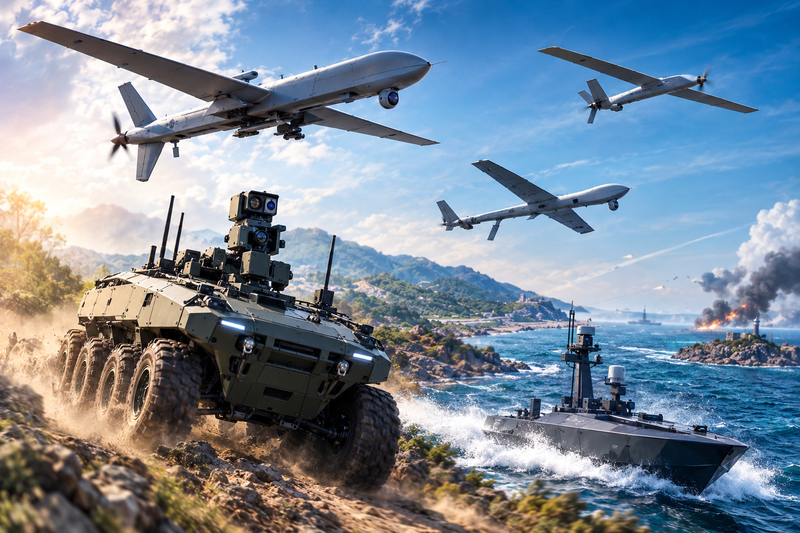
[Financial News] The budget for the multipurpose unmanned vehicle deployment program, in which Hanwha Aerospace’s Arion-SMET was selected as the final candidate, reflects only 3% of the amount requested by the Defense Acquisition Program Administration (DAPA). Domestic unmanned systems are therefore receiving limited support. Nevertheless, South Korean defense companies remain active in unmanned-system deployment programs. Rather than focusing on short-term profitability or budget allocations, they appear to be making a strategic decision to secure the clearly growing global demand for unmanned systems and target future export markets.
Behind the “token 0.3% budget” ... “Limits of domestic unmanned-system technology”
The budget proposal obtained on the 7th through Yoo Yong-won, a People Power Party lawmaker on the National Defense Committee of the National Assembly, contains several passages that could be interpreted as showing disregard for domestic products. Only 350 million won was allocated to the multipurpose unmanned vehicle program, despite an initial request for 8.8 billion won. The rifle-firing unmanned aircraft received 4.3 billion won, less than half of the 10.3 billion won requested. In particular, the coastal reconnaissance unmanned aircraft received only about 200 million won, or 0.3% of the 43.4 billion won requested. By contrast, 38.353 billion won—most of the requested 40.329 billion won—was budgeted for medium-range suicide drones scheduled for overseas purchase.Despite the government’s vision of a “500,000-strong drone force,” the meager budget allocation appears to reflect the still-insufficient capabilities of domestic unmanned systems. Neither of the two rifle-firing unmanned aircraft models that entered this year’s bidding met the performance requirements. The coastal reconnaissance unmanned aircraft underwent an attempted purchase test and evaluation this year after controversy over Chinese-made equipment in 2024, but the process was halted when it failed to meet the standards. A medium-sized suicide drone under domestic development also crashed just four seconds after takeoff during a maritime operational test in August.
Arion-SMET receives calls from three countries ... Export share expected to grow
Even in an unmanned-systems business environment where profitability is uncertain and budgets fluctuate sharply, domestic defense companies are pursuing orders across the board based on expectations of long-term global demand. Hanwha Aerospace and Hyundai Rotem competed fiercely for the multipurpose unmanned vehicle program alone.Hanwha Aerospace stated, “Regardless of the substantial cut to the multipurpose unmanned vehicle budget, we will devote ourselves to preparing for Arion-SMET mass production as originally planned.” The program itself is expected to continue without interruption because it is proceeding under a contract with DAPA.
Industry officials are optimistic about Arion-SMET’s future. The system has already been included in the South Korean military’s deployment plans and has had its capabilities verified, prompting overseas countries to send requests for information (RFIs). The three countries known to have sent RFIs are Romania, which successfully completed a local performance demonstration, Canada, and Finland.
Some observers also expect the structure of defense exports itself to change over the long term as the share of unmanned systems grows.
Song Bang-won, chairman of the Our Defense Industry Research Association, said, “It is not surprising that Arion-SMET has received an RFI because it was deemed suitable for combat use by the military. That shows there is demand for unmanned vehicles. The shortage of personnel and the need to improve survivability are common challenges worldwide, so unmanned forces are not an option but an inevitability. Their share of exports will gradually increase.”
Young-Dong Kim, a professor in the Department of Future Defense Convergence at Konkuk University, said, “In the past, UGVs (unmanned ground vehicles) were future-oriented weapons systems, but they are now equipment that replaces soldiers in actual combat. The unmanned-force market is newly opening up. In the long term, Hanwha Aerospace’s export structure could also change.”
If performance is strong enough, domestic systems can also receive premium treatment in South Korea. The medium-altitude reconnaissance unmanned aerial vehicle (MUAV) is a prime example. It is South Korea’s first strategic-grade unmanned aircraft, developed and mass-produced under the direction of DAPA and the Agency for Defense Development (ADD) by Korean Air, LIG Defense & Aerospace, and Hanwha Systems. Development began more than 20 years ago and was eventually completed; a total of 465.1 billion won will be invested through future mass production.
A DAPA official said, “As investment in and applications for unmanned aircraft are rapidly expanding worldwide, we expect the development of the MUAV to help secure a leading position in the global market. It also lays the foundation for key future unmanned systems, including unmanned combat aircraft.”
[email protected] Kim Yoon-ho Reporter