Nearly 560,000 Visitors Flocked to Hangang Park Swimming Pools This Summer, Including 120,000 at Night
- Input
- 2026-09-07 11:15:00
- Updated
- 2026-09-07 11:15:00
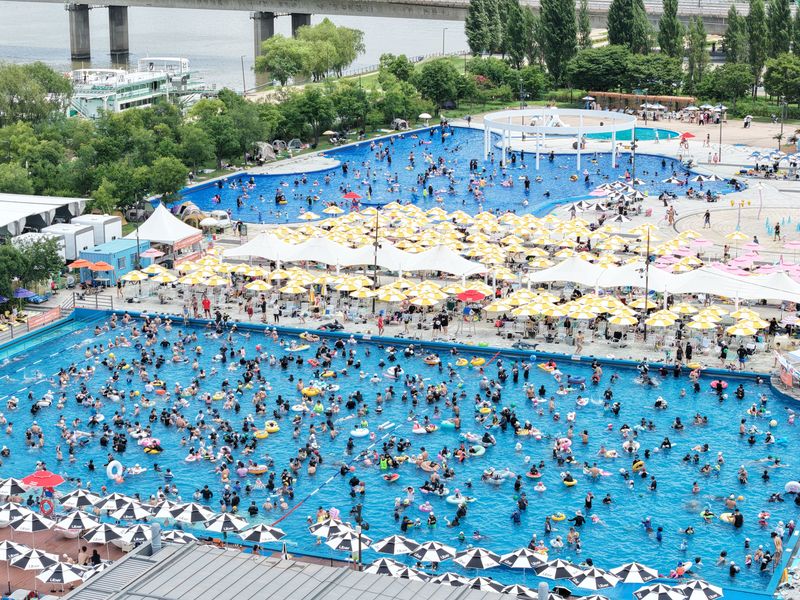
[Financial News] Nearly 560,000 people visited Seoul’s Hangang Park swimming pools and water-play facilities this summer. Nighttime openings and performance programs proved particularly popular, with 23% of all visitors using the Hangang swimming pools during evening hours.
The Seoul Metropolitan Government announced on September 7 that a total of 556,981 people visited six facilities operated from June 19 to August 30: the Yeouido and Ttukseom swimming pools, as well as the Jamsil Hangang Park Outdoor Swimming Pool, Nanji Swimming Pool, Yanghwa Water Play Area and Gwangnaru Water Play Area.
By facility, the Yeouido swimming pool recorded the highest number of visitors at 214,745, followed by the Ttukseom swimming pool with 182,581, the Jamsil Hangang Park Outdoor Swimming Pool with 56,748, the Nanji Swimming Pool with 46,367, the Gwangnaru Water Play Area with 38,813 and the Yanghwa Water Play Area with 17,727.
Visitor numbers at the Yeouido and Ttukseom swimming pools rose 58% and 36%, respectively, from the previous year. The Seoul Metropolitan Government attributed the increase to nighttime openings, performances such as DJ sets and busking, and distinctive water-play facilities at each pool. This year, operating hours at the Yeouido and Ttukseom swimming pools and the Jamsil and Nanji water-play facilities were extended from 6 p.m. to 10 p.m. Nighttime visitors alone totaled approximately 126,000.
By age group, adults aged 19 and older accounted for 377,709 visitors, or 68% of the total. Children aged 7 to 12 numbered 92,981, or 17%; teenagers aged 13 to 18 totaled 51,418, or 9%; and preschool children under 6 numbered 34,873, or 6%.
Safety and water-quality management were also strengthened in response to the increase in visitors. Fifty-nine safety personnel were deployed at the sites, and 136 CCTV cameras were operated. The Seoul Metropolitan Government also conducted joint inspections for illegal filming and on-site patrols with the Seoul Metropolitan Police Agency.
To manage water quality, the number of filter circulation cycles was increased from three to at least five per day. Basic water-quality tests were conducted every hour, while the Seoul Institute of Health and Environment carried out weekly water-quality tests. All tested items—including free residual chlorine, pH, turbidity, combined residual chlorine, potassium permanganate and coliform bacteria—met swimming-pool water-quality standards.
The Seoul Institute of Health and Environment tested 18 water samples collected from two swimming pools and four water-play facilities between August 3 and 21. Neither enterovirus, which can cause hand, foot and mouth disease, nor adenovirus, which can cause conjunctivitis, was detected.
Seoul Metropolitan Government will continue using Hangang Park as a leisure destination in the fall. A “Beach Garden” made with 185 tons of sand will be created at the Jamsil Hangang Park Outdoor Swimming Pool, while the Ttukseom swimming pool will serve as a venue for events such as the Drone Light Show and the Seoul Street Arts Festival. The city plans to turn Hangang Park into a year-round leisure destination by hosting performances, exhibitions and hands-on programs in spring and fall, in addition to summer swimming pools and winter sledding facilities.
Park Jin-young, head of the Future Hangang Headquarters, said, "The fact that approximately 560,000 people visited Hangang swimming pools and water-play facilities this summer confirms that the Hangang has established itself as one of Seoul’s leading summer attractions." He added, "In connection with efforts to revitalize the nighttime economy, we will further expand content that allows people to enjoy ‘Night on the Hangang,’ including DJ performances and busking."
[email protected] Seong Chorong Reporter