"Be Careful with Embers Starting Three Weeks Before Chuseok"... Grave Visitors Account for 80% of Wildfires
- Input
- 2026-09-07 10:42:53
- Updated
- 2026-09-07 10:42:53
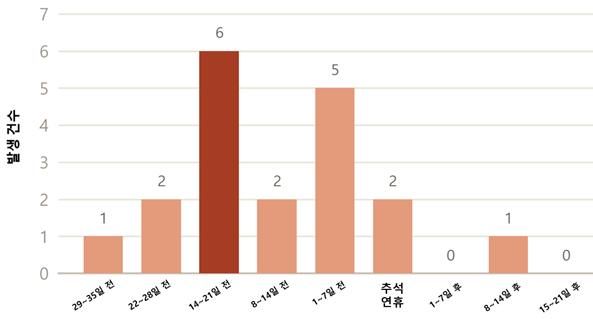
According to the Korea Forest Service's National Institute of Forest Science on the 7th, an analysis of data on 182 wildfires caused by grave visitors over the past 15 years (2011–2025) found that about 80% of all such fires occurred between three weeks before Chuseok and the Chuseok holiday period.
By period, the largest number of incidents—six—occurred 14 to 21 days before Chuseok, followed by five incidents one to seven days before the holiday. This timing is somewhat earlier than the pattern observed when all four major holidays, including Lunar New Year, Cheongmyeong and Hansik, are considered, with wildfires concentrated in the one to seven days before a holiday (42 cases). In the case of Chuseok, grass grows thick during this period, prompting people to begin cutting it around graves earlier than they do for other holidays.
The analysis of spatial characteristics also revealed a clear correlation. The higher the cemetery density and the closer an area was to cemeteries, the greater the probability of wildfires.
In particular, many “high-risk areas,” where the probability of wildfires caused by grave visitors exceeded 0.5, were found in Gyeongsang and Gyeonggi. Representative high-risk cities and counties included Andong-si in North Gyeongsang Province (34,974 hectares), Hapcheon County in South Gyeongsang Province (31,660 hectares), and Pocheon in Gyeonggi Province (23,082 hectares).
As climate change has caused dry autumn weather to begin earlier than usual, the risk has also grown that a small ember caused by a grave visitor could quickly develop into a large wildfire. Key causes include tiny sparks produced when the metal blades of brush cutters used during grass-cutting work strike rocks or gravel, as well as workers smoking and burning mats or waste.
Ahn Soo-jung, a researcher with the National Institute of Forest Science's Forest Fire Research Division, said, "The three weeks before Chuseok are when the risk of wildfires caused by grave visitors is at its highest, so wildfire monitoring and prevention measures should be strengthened, particularly in high-risk cities and counties." She added, "When visiting graves or cutting grass, people should refrain from carrying fire-starting devices such as lighters and strictly follow wildfire-prevention guidelines."
[email protected] Kim Won-jun Reporter