Supreme Court Justice Lee Heung-koo Retires Amid Two Vacancies: “We Must Overcome the Three Judicial Laws and Political Overreach”
- Input
- 2026-09-07 11:08:17
- Updated
- 2026-09-07 11:08:17
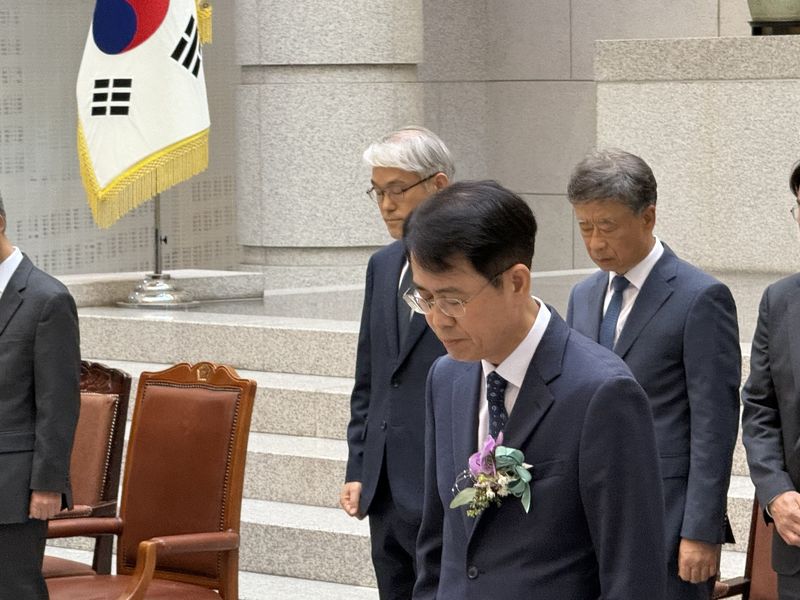
[Financial News] Supreme Court Justice Lee Heung-koo, 63, who graduated from the 22nd class of the Judicial Research and Training Institute, held his retirement ceremony on the 7th, officially concluding his six-year term. The appointment of a successor to former Supreme Court Justice Rho Tae-ak, who retired in March, has been stalled for more than six months amid a dispute between Cheong Wa Dae and the Supreme Court of Korea over a renewed recommendation. With Justice Lee also stepping down from the bench, the Supreme Court of Korea is facing the unprecedented situation of having two vacant justice positions at the same time.
In his retirement address, Justice Lee said, "As I have watched the series of events that unfolded after the December 3 emergency martial law declaration, I have often thought that the Supreme Court failed, or was unable, to properly convey the judiciary’s position to the public during a national crisis." He emphasized, "As political cases increasingly flood into the courts, it is important to consistently speak in the language and framework of the judiciary, rather than in the language and framework of politics."
Referring in particular to efforts to advance the Three Judicial Laws—constitutional complaint against court decisions, the crime of legal distortion, and an increase in the number of Supreme Court justices—he said, "They will bring major changes to the trial system and to the status and structure of the Supreme Court of Korea, which have been maintained for a long time." He added, "It is shocking and regrettable that legislation has proceeded without properly reflecting the views of the judiciary." At the same time, he noted, "We must not forget that this stems from the public’s long-standing dissatisfaction and distrust of trials, including trials that have been unfair or insufficiently thorough."
Justice Lee did not separately mention the Supreme Court vacancy that was officially confirmed that day. Chief Justice Cho Hee-dae, who attended the retirement ceremony, also concluded the event without making any notable remarks.
Justice Lee said, "Throughout my term, I tried to devote careful attention to each case while keeping in mind that protecting the people’s fundamental human rights is the most important constitutional value. In particular, I hoped that the rights of working people would be respected and effectively guaranteed." He emphasized, "I sought active legal interpretations so that people who are injured or killed at work, and their families, can maintain at least a minimum standard of living."
Justice Lee was appointed in September 2020 under the Moon Jae-in administration after being recommended by then-Chief Justice Kim Myung-soo. A former member of the progressive judges’ group Our Law Research Association, he is regarded as a “progressive judge,” having received a prison sentence for alleged violations of the National Security Act and other charges after participating in the student movement.
Kim Sung-soo, presiding judge of the Seoul High Court’s appellate division, who was recommended as Justice Lee’s successor, is undergoing a parliamentary confirmation hearing. Considering the vote on his appointment consent motion, the process is expected to take at least 10 days. Even after the parliamentary process is completed, the final appointment by Cheong Wa Dae, which is currently embroiled in a dispute, will remain. A vacancy involving two Supreme Court justices for approximately at least two weeks appears unavoidable.
[email protected] Chang-hoon Lee Reporter