Despite a rebound in reservoir levels nationwide, Jeju stands at a 'low' of 40.7%... at 67% of the average, placing it at the 'concern' level.
- Input
- 2026-09-07 10:30:28
- Updated
- 2026-09-07 10:30:28
[Financial News Jeju = Reporter Jeong Yong-bok] While the average water level of reservoirs managed by the Korea Rural Community Corporation nationwide has recovered by more than 11 percentage points over the past ten days or so, it actually declined in Jeju. The average water level of the 10 reservoirs managed by the corporation in Jeju was 40.7%, the lowest among regional averages nationwide.
According to the Korea Rural Community Corporation's Rural Water Information System on the 7th, as of 8:20 a.m. on that day, the average water level of 3,403 reservoirs managed by the corporation nationwide was 58.1%.
Jeju stands at 40.7%, 17.4 percentage points lower than the national average. It is also 9 percentage points lower than the next lowest, South Jeolla Province at 49.7%.
North Chungcheong Province is the highest at 74.5%, followed by South Chungcheong Province at 71.9%, Gyeonggi Province at 70.7%, Gangwon Province at 66.7%, South Gyeongsang Province at 58.1%, North Gyeongsang Province at 53.2%, and North Jeolla Province at 51.0%. Only Jeju is in the low 40% range.
Jeju's current reservoir level is 8.9 percentage points lower than at the same time last year (49.6%). Compared with the average of 60.4%, the gap widens to 19.7 percentage points.
The recent trend is opposite to the national trend. On August 27, the average water level of reservoirs managed by the Korea Rural Community Corporation nationwide was 46.8%. It rose to 58.1% by the 7th, recovering by 11.3 percentage points. During the same period, Jeju fell from 43.4% to 40.7%, a decrease of 2.7 percentage points.
On August 27, there were regions with water levels lower than or similar to Jeju, such as North Jeolla Province (37.3%), South Jeolla Province (40.3%), and North Gyeongsang Province (42.8%). Subsequently, reservoir levels in these regions recovered to around 50% due to factors such as rainfall, but no recovery trend was observed in Jeju.
There are a total of 10 reservoirs in Jeju managed by the Korea Rural Community Corporation. The area benefiting from the supply of agricultural water from these reservoirs is 3,902.4 hectares. The total storage capacity is 4,296,000 tons, and the effective storage capacity available for actual use is approximately 3,817,000 tons.
It is not possible to immediately conclude that there is an agricultural water crisis based solely on a reservoir level of 40.7%. The Rural Information Service manages reservoir conditions based on the ratio of the current level to the average level. A level of 60–70% relative to the average is classified as "Attention," 50–60% as "Caution," 40–50% as "Alert," and less than 40% as "Severe."
Jeju's latest reservoir level relative to the average is 67%. Applying this standard, it falls under the "Attention" stage. Here, "Attention" does not signify a drought level for the entire island of Jeju. It is a management indicator representing the reservoir level relative to the average for reservoirs managed by the Korea Rural Community Corporation.
Jeju utilizes groundwater and other agricultural water supply facilities in addition to reservoirs managed by the Korea Rural Community Corporation. Therefore, to assess actual water conditions at farming sites, it is necessary to check the water levels of each reservoir, the status of other water sources such as groundwater and wells, and the water usage of each crop.
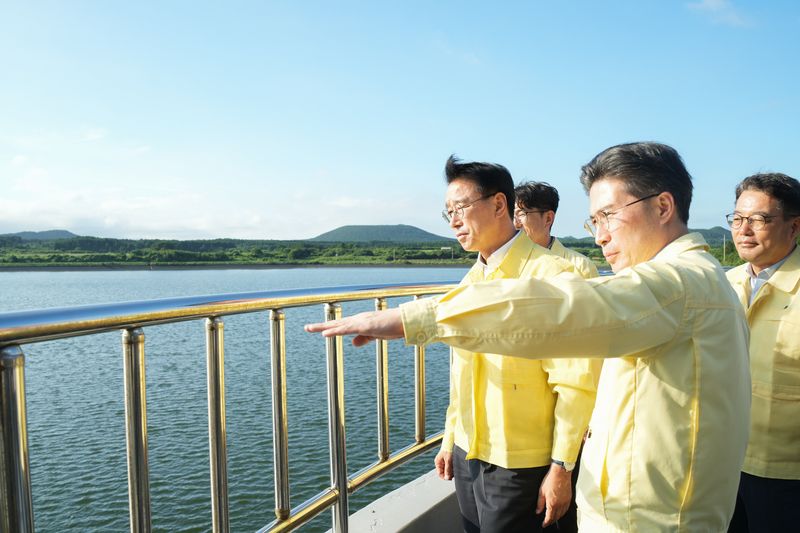
Jeju Special Self-Governing Province has also been inspecting the situation regarding agricultural water supply during the summer. On July 27, Jeju Governor Wi Seong-gon visited Seongeup Reservoir in Pyoseon-myeon, Seogwipo City, to check the water level and the status of agricultural water supply.
As the average water level of reservoirs managed by the Korea Rural Community Corporation failed to recover to normal levels even after the on-site inspection, water management for the autumn farming season has once again emerged as a challenge. The key is whether there are actual disruptions in the supply to agricultural land. To accurately assess the agricultural water situation in Jeju, it is necessary to check the water levels of each reservoir, whether water rationing is in effect, and the operation status of alternative water sources together.
[email protected] Jeong Yong-bok Reporter