"Babe, Your Hairline Is Becoming More and More Like a Capital M"... Changing Your Shampoo Won't Fix It: A Warning Sign of Hair Loss [Smart Wellness]
- Input
- 2026-09-07 19:00:00
- Updated
- 2026-09-07 19:00:00
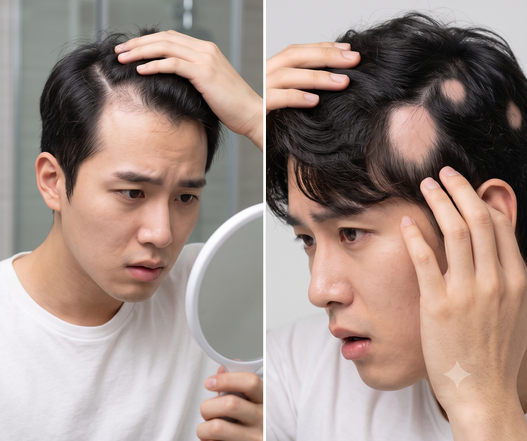
[Financial News] It is natural to feel alarmed when your hair begins to thin or you notice less hair overall. However, not all hair loss is the same.Hair loss can progress in very different ways and require different treatments depending on its cause, including genetics, hormones, immune-system abnormalities, extreme stress, and unhealthy lifestyle habits.Relying solely on shampoo or unproven home remedies without accurately identifying the cause and type of hair loss can easily mean missing the critical window for treatment. That is why it is important to determine which pattern your hair loss follows and begin personalized treatment.
A Receding Hairline in Men vs. a Widening Part in Women
The most common type,"male-pattern hair loss (androgenetic alopecia),"is caused by the effects of Dihydrotestosterone (DHT), a metabolite of male hormones. DHT gradually shrinks hair-follicle cells, causing the hair to become thinner and shortening its growth cycle. It typically appears as an M-shaped receding hairline or an O-shaped pattern in which the crown becomes sparse. Early diagnosis, before the follicles completely lose their function, is essential. Oral medications such as finasteride and dutasteride can effectively slow the progression.
By contrast,"female-pattern hair loss"is characterized by relatively preserved frontal hairlines, while the hair around the crown and part becomes generally thinner and less dense. Like male-pattern hair loss, it can be affected by DHT, but hormonal changes associated with childbirth or menopause, chronic stress, and iron deficiency are also considered major causes.
Treatment options for women are more limited than those for men. For women of childbearing age, oral medications that suppress male hormones, such as finasteride, are strictly restricted because of the risk of causing birth defects in a male fetus.
Kim Ji-seok, director of Busan Mammoth Hairline Clinic, which specializes in hair loss, explained, "For women of childbearing age, the only standard treatment that can be used safely is generally topical minoxidil, which helps improve blood flow to the scalp and promote hair growth. Lifestyle changes that improve the scalp environment must also be pursued, including dietary improvements to replenish insufficient iron and vitamins, adequate sleep, and stress management."
Alopecia Areata Caused by Immune Attacks and Telogen Effluvium Following Physical Stress
If clearly defined, coin-sized bald patches appear on the scalp,"alopecia areata"should be suspected. This is not a hormonal disorder but an autoimmune disease in which the body's immune cells mistakenly identify hair follicles as a threat and attack them. Stress is a major trigger, and if left untreated, multiple patches can merge and cause the affected area to expand rapidly. If a small bald patch appears when you are unusually tired or under severe stress, it is better to visit a hospital than wait for it to heal naturally. Early treatment with localized steroid injections or immune-modulating therapy at a dermatology clinic can help prevent follicle damage. "Telogen effluvium"occurs when the number of hairs entering the resting phase of the growth cycle rises abnormally. It is characterized by substantial hair loss two to three months after physical or psychological stress, such as major surgery, a high-fever illness, childbirth, or an overly restrictive fasting diet. In most cases, the hair recovers on its own over three to six months once the triggering factor is resolved. However, it can become chronic if nutritional deficiencies or persistent fatigue continue, making adequate protein intake and rest essential.
As more people restrict their diets and lose weight through injectable treatments such as Wegovy and Mounjaro, cases of telogen effluvium associated with this type of weight loss have also continued to emerge. Kim said, "When the body perceives that it is in a crisis, it prioritizes supplying nutrients to organs essential for survival and cuts off nutrients supplied to the hair. For women, limiting weight loss to less than 3 kilograms per month may help reduce the risk of telogen effluvium caused by rapid weight loss."
Scarring and Traction Alopecia Caused by Inflammation and Irritation
"Scarring alopecia"occurs when the follicles themselves are destroyed by trauma, burns, or severe inflammatory scalp conditions that damage the follicles. Hair cannot grow back from damaged follicles, so early diagnosis to stop the progression is critical. Hair transplantation may be considered after the inflammation has completely subsided.In addition, "traction alopecia," which develops when the roots are repeatedly pulled by tightly tying the hair or undergoing repeated hair-extension procedures, must first be addressed by changing styling habits that place tension on the roots. "Seborrheic alopecia," in which excessive sebum production causes scalp inflammation and weakens the follicles, requires keeping the scalp environment clean through anti-inflammatory or medicated shampoos that protect the scalp barrier, along with professional treatment. Particular caution is needed because untreated seborrheic dermatitis can worsen into severe folliculitis or a secondary bacterial infection, potentially leading to scarring alopecia that permanently destroys the follicles.Hair Loss Is a Condition in Which Early Action Determines the PrognosisKim explained, "If you notice changes such as losing more hair than usual or seeing your hair become thinner, it is important to visit a hospital and quickly determine the condition." He added, "The direction of future treatment also depends on how early you respond."
Ways to make life healthier and more vibrant are not far away. [Smart Wellness] shares insights for caring for the body and mind based on scientific evidence and the latest trends. Subscribe to the reporter's page to conveniently receive [Smart Wellness].
[email protected] Kim Hyeon-seon Reporter