KDCA Designates 10 Countries as Priority Quarantine Management Areas for Ebola
- Input
- 2026-09-07 09:10:25
- Updated
- 2026-09-07 09:10:25
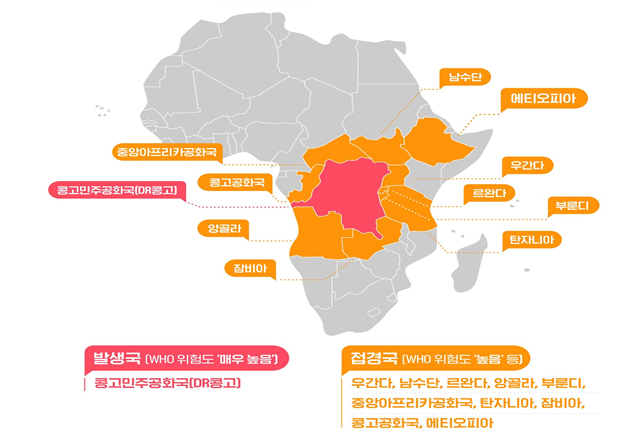
According to the KDCA on the 7th, confirmed Ebola cases in the Democratic Republic of the Congo surged after mid-July. As of August 31, there were 6,186 confirmed cases and 3,007 deaths. With the outbreak spreading to six provinces, concerns are growing that it could spread to neighboring countries.
The World Health Organization (WHO) officially confirmed the end of Uganda’s Ebola outbreak last month after no additional cases were reported for 42 days following the discharge of the last patient on the 27th. However, the possibility of reintroduction remains because Uganda shares a border with the Democratic Republic of the Congo.
Accordingly, on the 24th of last month, the WHO assessed the risk level in the Democratic Republic of the Congo as “very high.” It rated the risk as “high” in nine neighboring countries: Angola, Burundi, the Central African Republic, Rwanda, South Sudan, Tanzania, Uganda, Zambia and the Republic of the Congo.
The KDCA will operate a two-tiered quarantine system based on risk levels.
Travelers entering South Korea after visiting or staying in any of the nine neighboring countries, including Uganda and South Sudan, must report their health status through Q-CODE or a health status questionnaire. Departing travelers will receive text messages about Ebola precautions. They will also be advised to report to the 1339 Call Center or a public health center if they develop suspected symptoms, such as fever or abdominal pain, after entering the country.
Medical institutions will be provided with information on visits to areas at risk of outbreaks through the overseas travel history information system (DUR-ITS), enabling the early detection of patients in local communities.
Quarantine measures will be strengthened further for travelers arriving from the Democratic Republic of the Congo, where the Ebola outbreak is ongoing. Information on travelers transiting through other countries will be obtained in advance, and targeted quarantine screening will be conducted at arrival gates to identify those subject to screening. Active monitoring will then be linked to the process for up to 21 days after entry, taking the maximum incubation period into account.
Kenya will be removed from the quarantine management area designation. Ethiopia, meanwhile, will be managed as a priority quarantine management area. This decision reflects the fact that Ethiopia is a major air transit hub in Africa and has direct flights to South Korea, making it highly likely to be used as a transit point by visitors from high-risk areas entering the country.
These measures will take effect on the 7th. The KDCA plans to continuously monitor the Ebola situation and risk levels in each country and adjust the level of quarantine accordingly.
The KDCA urged the public to cooperate, saying, “Although the risk of Ebola being introduced into South Korea is not currently high, this is a preemptive measure to closely monitor the outbreak situation in Africa and concentrate disease-control capabilities according to the level of risk.” It added, “If you develop suspected symptoms after visiting the affected areas, please report them immediately to the 1339 Call Center or a public health center.”
[email protected] Reporter Jeong Sang-hee Reporter