Optimizing a Chinese Robot with AI Cuts Clothing-Folding Time by 25 Seconds
- Input
- 2026-09-07 09:11:21
- Updated
- 2026-09-07 09:11:21
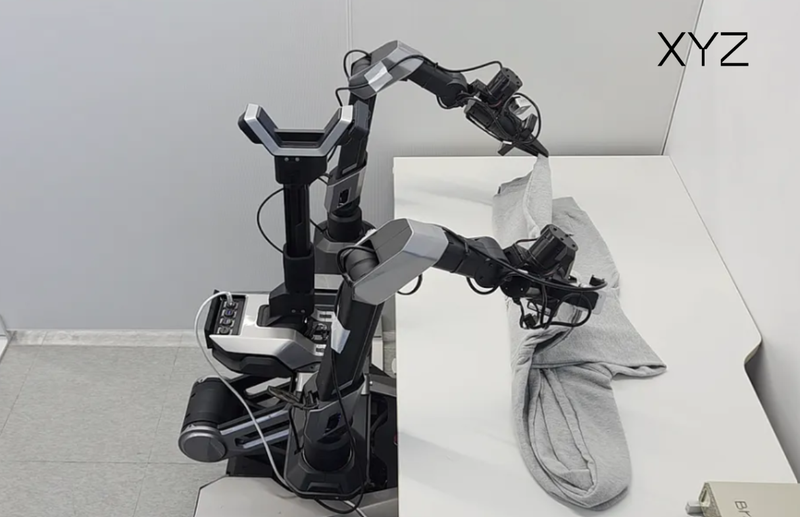
[Financial News] XYZ has doubled the speed of its robot’s clothing-folding operations compared with the previous level. The company reduced the time required for the task from approximately 50 seconds to approximately 25 seconds. The robot also achieved a 96% success rate in a 2×-speed environment. The improvement is attributed to the optimization of everything from model inference to the actual robot’s execution and control, based on its proprietary embodied-intelligence system, BrainX. This enabled high-speed manipulation while improving both speed and stability.
According to industry sources on the 7th, objects such as clothing, whose shapes are irregular and subject to friction and slipping, can develop greater trajectory errors and vibrations as manipulation speed increases. This can reduce the task’s success rate and overall quality.
XYZ used the Galaxea AI R1 Lite Wheeled Humanoid Robot (R1 Lite), developed by Chinese robotics company Galaxea AI, to train a BrainX-based clothing-folding model and optimize it for high-speed manipulation. In particular, the company used asynchronous inference, in which the robot infers its next action while carrying out the current one. This allowed it to overlap inference by the vision-language-action (VLA) model with the actual execution of the robot.
During this process, the research team conducted an ablation study by applying VLASH’s open-source model and core algorithms to an actual clothing-folding environment. The goal was to reduce inference latency in real-time VLA operations.
The validation showed that some of VLASH’s approaches, which predict the state at a future execution point, generated movements larger than the range required for precise fabric manipulation in high-speed clothing-folding environments.
Rather than applying the existing approach as is, XYZ incorporated the core concept of asynchronous inference into BrainX and combined it with proprietary optimization technology tailored to the robot’s high-speed manipulation. The company optimized the entire control process, from model inference to robot execution, by applying data-efficient learning, downsampling-based acceleration, a smoothing filter, and adaptive speed control.
Downsampling reduced the impact of noise in expert trajectories while allowing the model to learn the essential movements. A smoothing filter reduced end-effector vibrations and trajectory noise that can occur during high-speed movements. Adaptive speed control adjusts speed limits in real time according to the robot’s movements, allowing it to move quickly during transit and more precisely during sections requiring delicate contact, such as grasping or releasing clothing. After the task was completed, the folded clothing showed a quality similar to that achieved previously, without unwanted wrinkles, bunching, or deterioration in shape.
XYZ explained that the results demonstrate the importance of comprehensively optimizing not only a model’s ability to perform tasks but also inference speed and the robot’s execution and control performance when applying physical AI to real-world environments.
XYZ plans to continue researching ways to further increase the success rate in a 2×-speed environment while securing stable performance at even faster manipulation speeds. The company also plans to develop and later disclose quantitative evaluation methods for objectively measuring and verifying clothing-folding quality.
[email protected] Jang Min-kwon Reporter