Credit Unions Train Specialists to Help Social Solidarity Economy Enterprises Raise Funds
- Input
- 2026-09-07 09:15:22
- Updated
- 2026-09-07 09:15:22
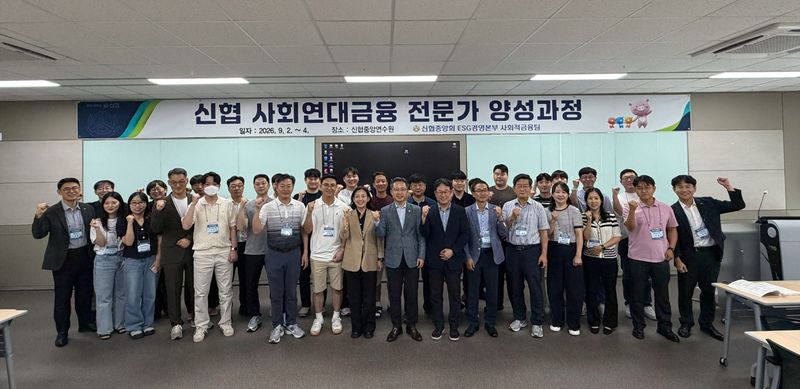
[Financial News] The National Credit Union Federation of Korea has begun training specialists to support financing for social solidarity economy enterprises and handle loan screening and post-loan management.
According to financial industry sources on the 7th, the National Credit Union Federation of Korea held the 2026 Social Solidarity Finance Specialist Training Program from the 2nd to the 4th at its training institute in Yuseong District, Daejeon.
The program was designed to develop social solidarity finance specialists at credit unions and strengthen their practical capabilities. It offered field-oriented training that covered the concept of the social solidarity economy and its business models, as well as financial and loan screening, post-loan management, and actual cases of financial support.
The Korea Social Enterprise Promotion Agency (KOSEA) and the Korea Social Value Solidarity Foundation jointly participated as organizing institutions, enhancing the program’s professional expertise. A total of 43 people, including practitioners from 29 credit unions nationwide and social finance intermediary institutions, took part. They shared field experience and know-how while building a foundation for cooperation among the institutions.
On the first day, Oh Young-taek, a team leader at KOSEA, introduced the history and concept of the social solidarity economy, its necessity, and the types of social solidarity economy enterprises in Korea. Ko Sun-mi, executive director of Jeonju Health Welfare Social Cooperative, and Yoo Don-soon, standing director of Bukwon Credit Union, then shared cases involving cooperative financing and project finance for social purposes. Nam Won-ho, a department head at the Korea Social Value Solidarity Foundation, explained the concept and characteristics of social finance, along with its major funding providers.
The second day focused on strengthening practical capabilities, including loan screening criteria and post-loan management for social solidarity economy enterprises. Kim Jong-hoon, an advisory committee member of the Korea Social Value Solidarity Foundation, Nam Won-ho, a department head, Byun Si-yeon, a team leader, Jeon Jae-hong, executive director of Bukseoul Credit Union, and Jeon Jeong-hyun, a department head at the Korea Credit Guarantee Fund (KODIT), introduced field cases and practical know-how on social solidarity finance loan screening, calculating appropriate borrowing amounts, and managing nonperforming loans.
On the final day, the National Credit Union Federation of Korea presented the role of credit unions as providers of social solidarity finance and outlined tasks for the future. Moon Sung-sik, a team leader at the Jeju Social Economy Support Center, then introduced cases involving the creation of local mutual-aid funds, major loan screening criteria, and post-loan management. After the training, participants discussed directions for developing social solidarity finance and ways to expand its use in the field, bringing the program to a close.
Hwang Dong-ho, head of the ESG Management Division at the National Credit Union Federation of Korea, said, "This program went beyond theoretical education and was designed as a practical, field-oriented program that participants can use immediately, including mock loan screenings and actual loan-handling cases." He added, "The credit union movement will continue to train specialists in social solidarity finance and expand cooperation with related institutions to help create a sustainable social solidarity finance ecosystem."
[email protected] Seo Ji-yoon Reporter