Tokyo on Alert After '524 mm of Rain in a Day'; Rail and Air Services Disrupted
- Input
- 2026-09-07 09:09:42
- Updated
- 2026-09-07 09:09:42
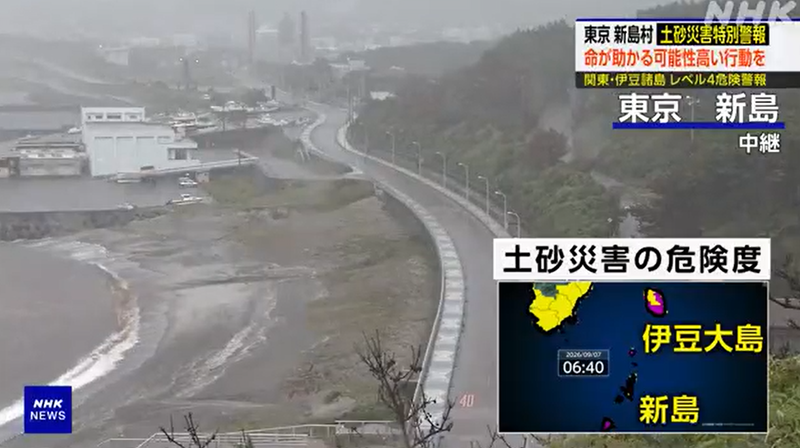
【Financial News, Tokyo—Correspondent Seo Hye-jin】Record-breaking torrential rain has battered the Tokyo metropolitan area, prompting the issuance of Japan's highest-level, Level 5 special warning for landslide disasters in the Izu Islands south of Tokyo. As evacuation orders expanded to Tokyo, Kanagawa Prefecture, Chiba Prefecture, Ibaraki Prefecture, and Fukushima Prefecture, rail services in the metropolitan area were reduced by up to 30%, while some domestic flights at Tokyo International Airport (Haneda Airport) were canceled. Further cancellations and delays were also possible.
According to Japan Broadcasting Corporation (NHK) and other outlets on the 7th, the Japan Meteorological Agency (JMA) issued a Level 5 special warning for Niijima Village in the Izu Islands early that morning. It is the highest of Japan's five disaster-prevention warning levels and indicates an extremely high likelihood that serious disasters, such as landslides, have already occurred.
The heaviest rain fell on the Izu Islands, located offshore south of central Tokyo. Niijima Village and Hachijō-machi each recorded 364 mm of rain over 24 hours, the highest amounts since observations began. Izu Ōshima received 524 mm, far exceeding the average rainfall for the entire month of September.
The JMA issued Level 4 danger alerts for parts of the Kanto region, the Izu Islands, and Fukushima Prefecture, urging the highest level of caution against landslides and river flooding. At Level 4, all residents in hazardous areas must evacuate. At Level 5, however, traveling outside may be even more dangerous, so people should seek safety on higher floors of buildings or in other secure locations.
Evacuation orders were issued for 5,207 residents of Kita City in Tokyo and 5,206 residents of Yokosuka City in Kanagawa Prefecture. The same measures were also implemented in parts of Kashiwa City in Chiba Prefecture and Miura City in Kanagawa Prefecture.
Takahagi City in Ibaraki Prefecture ordered 8,627 residents in five areas to evacuate after a river exceeded its flood-risk level. Hirono Town in Fukushima Prefecture also issued an evacuation order covering all 4,665 residents.
The torrential rain was caused by the autumn rain front and Typhoon No. 24. Forecast rainfall through 6 a.m. tomorrow is 200 mm in the Tohoku region, 180 mm in the Kanto and Kōshin regions, and 150 mm in the Tokai and Kinki regions. Atmospheric instability is expected to continue even after the typhoon weakens into a tropical depression.
The morning commute in the Tokyo metropolitan area was also disrupted. East Japan Railway Company (JR East) reduced the number of services on major lines, including the Yamanote Line, Chūō Line (Rapid), Sōbu Line (Rapid), and Keihin-Tōhoku Line, by 20% to 30% from normal levels.
All Nippon Airways (ANA) canceled two morning domestic flights between Haneda Airport and Hachijōjima because of strong winds. ANA and Japan Airlines (JAL) planned to operate their other flights normally, but additional delays or cancellations could occur depending on weather conditions.
Elementary and middle schools were temporarily closed in parts of Tokyo, as well as in Yokohama, Saitama, and Chiba cities. Some expressways in the Tokyo metropolitan area were also closed.
[email protected] Seo Hye-jin Reporter