Unemployed Young People Experience Burnout at 1.6 Times the Rate of Their Employed Peers
- Input
- 2026-09-07 07:47:27
- Updated
- 2026-09-07 07:47:27
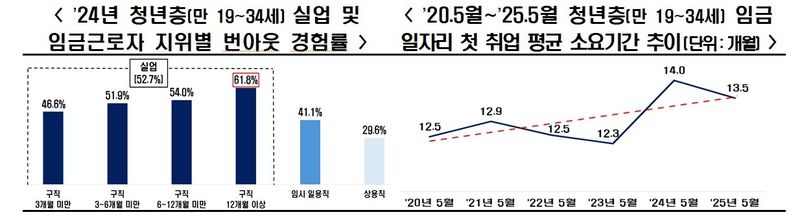
[Financial News] The rate at which unemployed young people experience burnout (emotional exhaustion) was found to be 1.6 times higher than that of employed young people. The burnout rate among unemployed young people was 52.7%, while the rate among unemployed young people who had been seeking work for at least one year reached 61.8%.
The Federation of Korean Industries announced on the 7th the findings of its analysis, titled “Burnout Among Young People by Unemployment and Wage-Worker Status: Current Status and Implications,” based on microdata from the Office for Government Policy Coordination’s “2024 Survey on the Lives of Young People.”
The analysis found that the burnout rate among unemployed young people was 52.7%. This was approximately 1.6 times higher than the 32.4% recorded among employed young people.
A comparative analysis of burnout rates among young wage workers by employment status found that the rate among young temporary and daily workers, whose employment is unstable, was 41.1%. This was approximately 1.4 times higher than the 29.6% rate among young permanent workers, whose employment is relatively stable.
As the average time young people take to obtain their first wage-paying job has increased over the past five years, the difficulties they face in finding employment and their employment insecurity appear to be intensifying burnout.
Unemployed young people cited career uncertainty as the leading cause of burnout at 68.4%, followed by doubts about work—including work, job preparation, and studies—at 9.9%, and work-life imbalance at 7.1%. Young temporary and daily workers cited career uncertainty at 57.0%, excessive workload at 13.6%, and doubts about work at 12.1%, respectively. Career uncertainty accounted for more than half of the responses in both groups.
By contrast, the responses among young permanent workers were more evenly distributed, including excessive workload at 23.2%, career uncertainty at 20.5%, and doubts about work at 19.9%.
The association recommended strengthening active labor market policies, including vocational training and employment services, to ease burnout caused by career uncertainty among young people.
An analysis of the education and training young people who experienced burnout due to career uncertainty need for job preparation, changing jobs, and improving work skills found strong demand among both unemployed young people and young temporary and daily workers for active labor market policies. These included support for job-preparation costs, vocational training, and employment counseling services to strengthen employment capabilities and support job-search activities.
A review of vocational training in Organisation for Economic Co-operation and Development (OECD) countries found that institution-based vocational training accounted for approximately 82.1% of South Korea’s total vocational training expenditure in 2024, relatively higher than the OECD average of 67.4% across 31 countries. By contrast, workplace-based vocational training accounted for 1.5%, below the OECD average of 11.7% across 31 countries, indicating that vocational training has insufficient links to workplaces.
Sangho Rhee, head of the association’s Economic Division, emphasized, “Considering young people’s high demand for policy support, we need to improve the accessibility and effectiveness of employment services, including support for job-preparation costs and employment counseling, so that young people can feel the benefits in practical terms.” He added, “We must pursue both quantitative and qualitative improvements by expanding investment in vocational training, which remains below the OECD average, while strengthening support for corporate workplace training to improve the connection between vocational training and actual workplaces.”
[email protected] Sohyun Park Reporter